Pensacola man accused of threatening Circle K employee with knife
A 55-year-old Pensacola man is jailed on aggravated assault charges after allegedly threatening a Circle K employee with a knife.
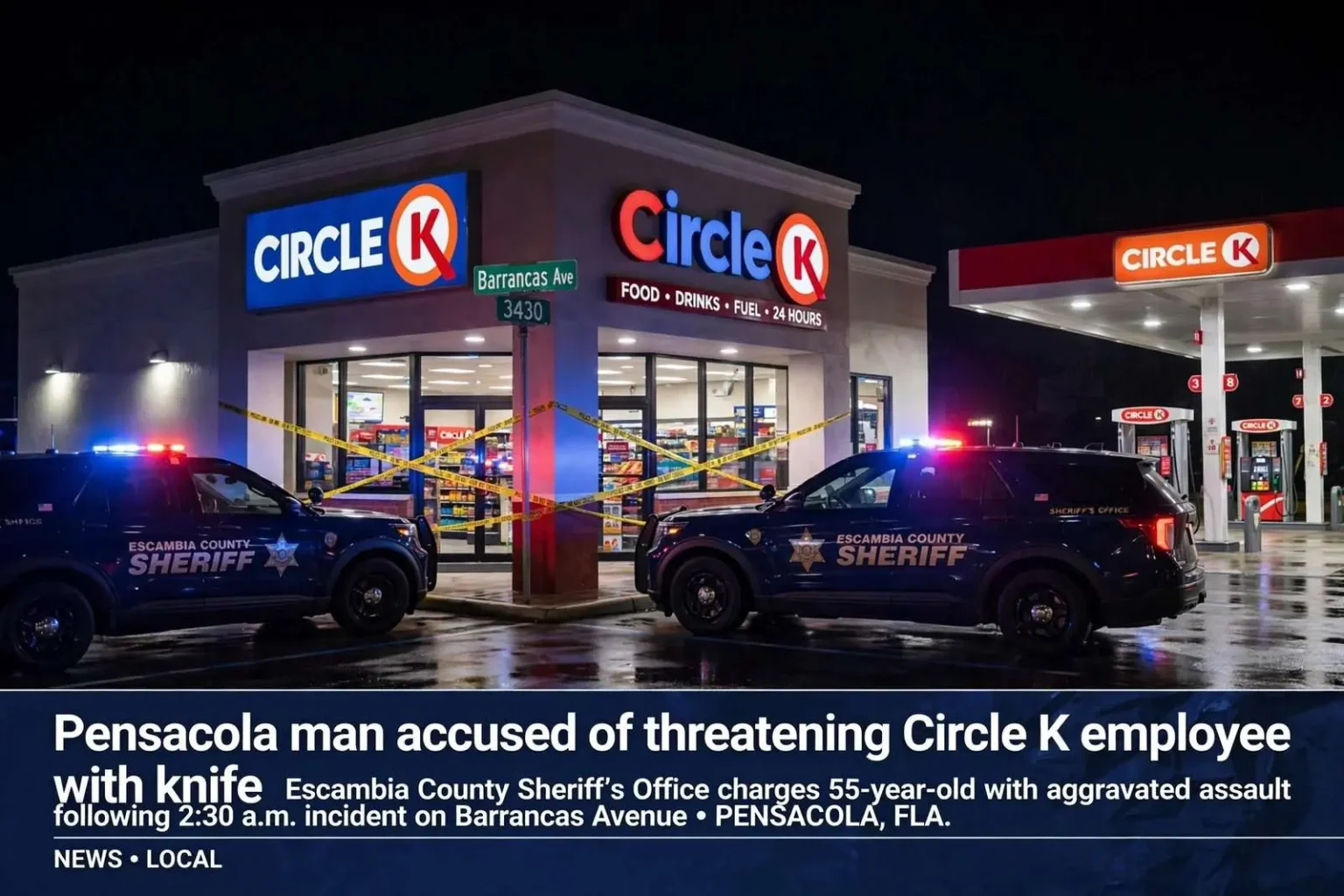
PENSACOLA, Fla. — A Pensacola man is facing an aggravated assault charge after deputies said he walked up to a Circle K gas station employee, pointed a knife at him and threatened to cut the employee’s throat. The Escambia County Sheriff’s Office identified the suspect as Eddie Ray Miller, 55. The threat unfolded outside the Circle K at 3430 Barrancas Avenue, a busy convenience store and fuel stop on the corridor that connects Pensacola Naval Air Station with the Warrington area and downtown Pensacola.
According to deputies, the employee had stepped outside the store for a cigarette break just before 2:30 a.m. Wednesday when Miller approached him. Miller was yelling as he walked up, deputies said, and threatened to cut the employee’s throat while pointing a knife at him. The worker told Miller to get off the property, then went back inside the store and called the Escambia County Sheriff’s Office to report the encounter. Deputies took Miller into custody and charged him with aggravated assault.
What the charge means under Florida law
Aggravated assault is one of the more serious violent-crime charges in the Florida Statutes. Under state law, an assault becomes aggravated when it is committed with a deadly weapon or with the intent to commit a felony. A knife pointed at a person while making a threat against their life falls squarely within that definition, which is why deputies moved from a threat report to a felony arrest rather than treating the episode as a simple disturbance.
As a second-degree felony, aggravated assault in Florida carries a maximum penalty of up to 15 years in prison, 15 years of probation and a fine of as much as $10,000 if a defendant is convicted. Prosecutors weigh factors such as whether the victim was a worker performing a job in a public-facing setting, whether the weapon was displayed rather than merely described, and any prior record the accused may have. The case will now move through the Escambia County court system, where a first appearance and the setting of conditions of release are typically the earliest steps after booking.
For the victim, the charge is only the beginning of a process. Convenience store employees who are targets of threats are often interviewed by deputies, asked to provide statements and, in some cases, shown photo lineups. Store surveillance video from the forecourt and entrance is frequently a key piece of evidence in cases that begin in the middle of the night, when few witnesses are around and the testimony of the person threatened carries the most weight.
Overnight shifts at convenience stores carry real risk
The incident highlights the realities of overnight work at gas stations and convenience stores across the Gulf Coast. Late-night employees often work with minimal staff in the building, handle cash transactions and deal with people who wander onto the property at odd hours. Industry safety guidance has long urged store operators to train clerks on de-escalation, to keep entrances well lit and to make sure workers know when to disengage from an aggressive person and call law enforcement rather than confront them.
In this case, the employee’s response mirrored that guidance. He separated himself from the aggressor, went back inside and reported the threat immediately. Escambia County dispatchers route such calls to the nearest available deputy, and the Sheriff’s Office maintains patrols across the unincorporated county as well as contract areas, with response priority shaped by whether a weapon was displayed and whether the threat is believed to be ongoing.
Barrancas Avenue, which carries U.S. Highway 98 through the southwestern part of Pensacola, is lined with service stations, restaurants and shops that serve both the Warrington community and the steady stream of traffic connected to Pensacola Naval Air Station. Stores along the corridor operate around the clock, meaning employees are working alone or in small crews during the pre-dawn hours when incidents like this one tend to occur.
How the Escambia County Sheriff’s Office handles threat calls
The Escambia County Sheriff’s Office is the primary law enforcement agency for Florida’s westernmost county, providing patrol, investigations and dispatch services across a jurisdiction that includes Pensacola’s outskirts, Century, Cantonment, Warrington and the beach communities on Santa Rosa Island. The agency handles tens of thousands of calls for service each year, ranging from traffic complaints to violent crime, and its deputies work closely with the State Attorney’s Office for the First Judicial Circuit when arrests lead to charges.
When a threat involving a weapon is reported, deputies typically document the scene, interview the victim and any witnesses, collect physical evidence such as photographs of the weapon if it is recovered, and determine whether an arrest can be made on probable cause. Florida law allows warrantless arrests for certain offenses committed in a deputy’s presence or when probable cause is established through investigation, and aggravated assault is among the offenses where that authority applies.
Sheriff’s officials have consistently encouraged residents and workers in Escambia County to report threats promptly and to preserve details such as descriptions of the person involved, the direction they left and any weapon seen. In convenience store cases, that early information is often decisive, because the person involved may still be nearby on foot or may be known to deputies from previous calls in the same area.
A familiar scene for Gulf Coast night workers
Across the Panhandle, late-night retail workers regularly report encounters with aggressive or intoxicated people, and law enforcement agencies in Escambia and neighboring Santa Rosa counties have repeatedly reminded store operators that no merchandise or confrontation is worth an employee’s safety. Trade groups for the convenience store industry recommend two-person coverage for overnight shifts where feasible, security cameras covering the fuel islands, and panic buttons or silent alarms that connect directly to dispatch.
Northwest Florida has seen a string of cases in recent years in which customers or trespassers threatened store clerks, and prosecutors in the region have treated threats made with weapons as serious felonies even when no one was physically injured. The law recognizes that the trauma of having a knife drawn and a threat made against one’s life is not diminished by the fact that the attack was not carried out.
Local advocates for workers have also noted that many convenience store employees earn modest wages and cannot simply change jobs when their workplace becomes dangerous, which places additional importance on how seriously agencies and prosecutors treat crimes against them. A worker who follows safety procedures and reports a threat should expect the report to be investigated thoroughly, they argue, because word travels quickly among both employees and offenders about which businesses and jurisdictions take such incidents seriously.
What happens next in the case
After a felony arrest in Escambia County, the suspect is typically booked into the Escambia County Jail, and the case file is forwarded to the State Attorney’s Office for review. Prosecutors decide whether to file the charge as presented, amend it or decline to file, and formal charges are followed by an arraignment where the defendant enters a plea. Bond conditions, if any, are set by a judge and can include no-contact orders protecting the victim.
Conviction can also carry consequences beyond incarceration, including a permanent felony record that affects employment, housing and the right to possess firearms under both Florida and federal law. For a 55-year-old defendant, the potential exposure underscores how quickly a late-night confrontation outside a store can become a case that shapes the rest of a person’s life.
Meanwhile, the Circle K location remains open, as stores along the corridor generally do after such incidents. Corporate policy for the chain, which operates thousands of stores across the United States, directs employees to comply with demands during dangerous encounters and to let law enforcement handle enforcement, a philosophy meant to keep clerks out of harm’s way. In this case, the employee’s decision to walk away from the confrontation and call for help appears to have ended the encounter without physical injury, even as the criminal case moves forward.
Broader context: crime and safety along Barrancas Avenue
The Barrancas Avenue corridor has long been one of the busier commercial stretches in western Pensacola, serving commuters headed to the naval air station, residents of the Warrington and Myrtle Grove neighborhoods, and travelers on U.S. 98 toward Perdido Key. With that volume of traffic comes a steady demand for 24-hour services, and the gas stations and convenience stores that line the road are among the few businesses that keep their doors open at 2:30 in the morning.
Pensacola Police and the Escambia County Sheriff’s Office split responsibility in the area depending on precise jurisdictional lines, and deputies from the Sheriff’s Office handle calls in the unincorporated and contract zones while city officers cover addresses within Pensacola’s limits. Businesses sit close to those boundaries along Barrancas, which is why agencies urge store employees to know which agency serves their address and to give dispatchers the most exact location possible when reporting an incident.
The human side of a 2:30 a.m. encounter
For the employee involved, the moments between the threat and the arrival of deputies are often the hardest to shake. Workplace-safety counselors who work with victims of violent threats note that employees who are targeted while simply doing their jobs, such as stepping outside for a break, frequently report lasting anxiety about returning to overnight shifts. Employers in the industry are increasingly urged to offer schedule flexibility and check-ins after serious incidents, both as a matter of employee welfare and to retain staff in a labor market where overnight positions are difficult to fill.
The fact that the employee finished his break, went back inside and made the report himself reflects the kind of quick thinking that safety trainers try to build. Depriving an aggressor of an audience, creating distance and getting behind locked doors are the standard steps recommended when a person with a weapon approaches a business, and they apply just as much to a smoker standing outside as to a clerk behind the register.
What neighbors and customers can do
Law enforcement agencies across the Panhandle ask the public to treat threats against retail and service workers as reportable offenses rather than disagreements to be ignored. Witnesses who see a confrontation developing outside a store are encouraged to call the non-emergency line, or 911 if a weapon is visible, and to note descriptions, vehicle tags and the direction the person left. Those details, sheriff’s officials say, are often the difference between a quick arrest and a suspect who remains at large.
As for the case against Miller, it will proceed like any other aggravated assault case in the local courts, with the next public milestones coming at the hands of the State Attorney’s Office and the judiciary rather than the Sheriff’s Office. Until then, the incident stands as a reminder of the risks that come with keeping a store open through the night on one of Pensacola’s busiest corridors, and of how a routine cigarette break can turn into a life-threatening moment in a matter of seconds.