
Pensacola sets first gun buyback event for March 20 at Bill Gregory Park
Pensacola scheduled its first gun buyback for March 20 at Bill Gregory Park, offering $125 to $200 per firearm plus free gun locks, Mayor Grover Robinson.
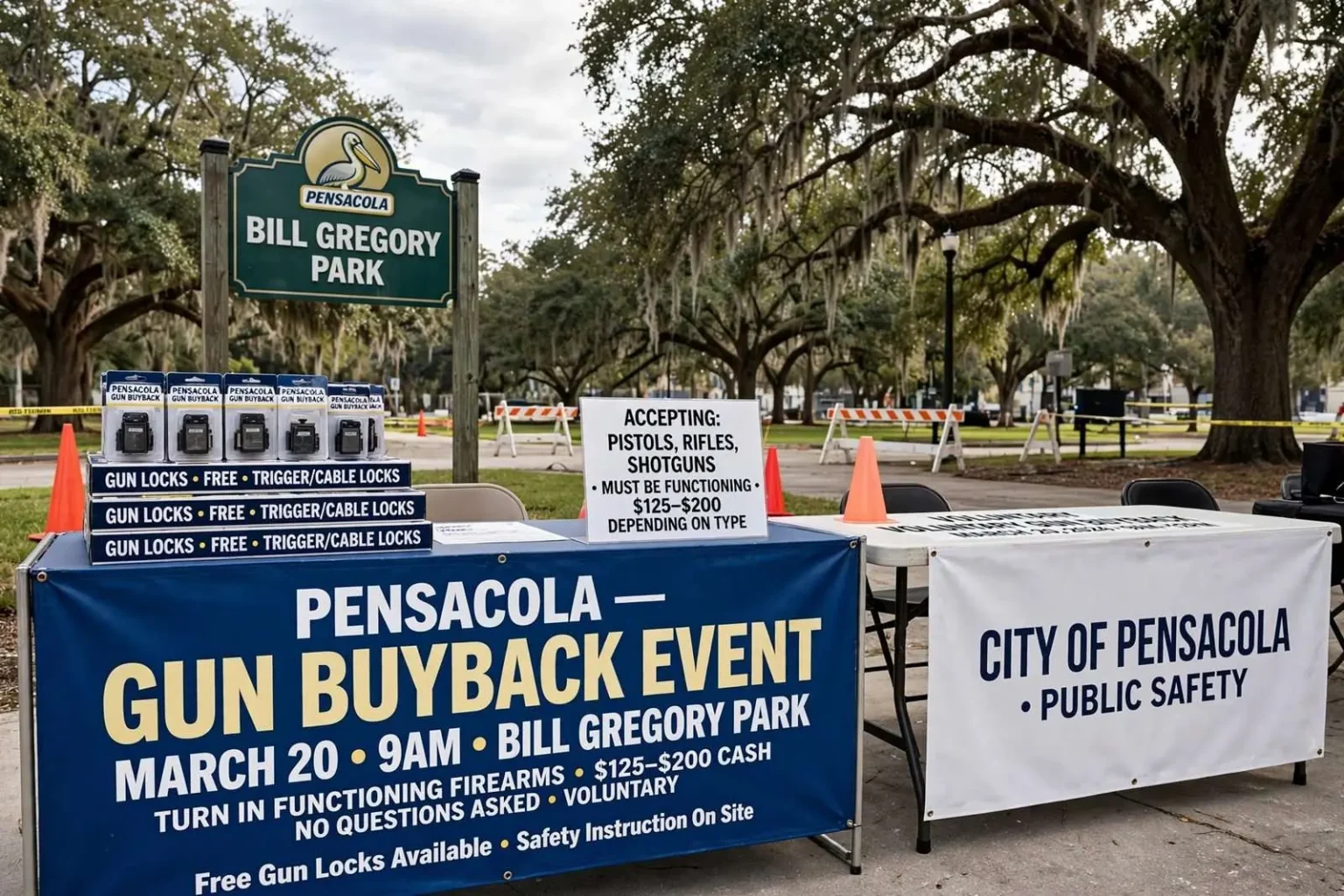
Pensacola is preparing for a first in the city’s history: a gun buyback event, scheduled for 9 a.m. on March 20 at Bill Gregory Park. Residents who bring a functioning firearm can sell it to the city and receive between $125 and $200, depending on the type of weapon they turn in. The event marks the first time Pensacola’s municipal government has organized a program to purchase guns directly from the public, placing the city alongside a growing list of Gulf Coast communities that have used buybacks as a tool for reducing the number of unwanted firearms in circulation.
Buyback events work on a simple premise. People who own guns they no longer want — inherited weapons, firearms left behind by relatives, guns they feel unsafe keeping in the home — can turn them in without paperwork, background questions or fear of prosecution for the weapon itself. In exchange, the city pays a modest sum, and the firearms are taken out of private circulation entirely. For a functioning firearm, the $125 to $200 range Pensacola has set covers the typical spread used by such programs, with higher payments generally reserved for categories of weapons considered more dangerous. Every gun surrendered is one that cannot be stolen in a burglary, sold on the informal market, discovered by a child in a closet or used in a moment of crisis.
Voluntary by Design
Mayor Grover Robinson stressed that participation is entirely voluntary. “Everybody is free to do whatever they want to, and if they wish to come do that, we’ve made that available,” Robinson said. “We are not forcing anybody to do that.” The mayor’s framing reflects the political reality of buyback programs in a state where gun ownership is widespread and deeply woven into the culture. Pensacola, the county seat of Escambia County in the far western Panhandle, sits in one of the most pro-gun regions of one of the most pro-gun states in the country, and city officials were careful to present the event as an option rather than a policy — a door opened for those who want to walk through it, with no judgment attached for those who do not.
That framing matters both politically and practically. Buyback programs succeed when gun owners themselves see the value in them; they fail when residents perceive them as a first step toward confiscation. By emphasizing choice, Pensacola’s leadership positioned the event as a community service — one aimed specifically at guns that owners already wish to be rid of, sitting unloaded in closets and gun safes, rather than an attempt to reach the firearms that owners intend to keep.
A Council Vote That Flipped
The buyback’s path to approval was itself a small study in how local government responds to constituents. The proposal advanced after a shift on the Pensacola City Council. Council President Jared Moore and Councilman Casey Jones had supported the measure a month earlier, but flipped their votes when the item came back before the council, this time opposing it after hearing from constituents in their districts who disapproved. That kind of reversal is not unusual in municipal politics — a month between votes is enough time for emails, phone calls, social media campaigns and lobby conversations to reshape how a council member weighs an issue that touches on guns.
The flip also illustrates how narrowly such measures can pass. With two votes moving to opposition, the buyback survived by the thinnest of margins, meaning a single additional vote would have ended the program before it began. The council’s eventual approval therefore represented both a policy decision and a compromise: the city would proceed, but on a modest, one-event scale rather than as an ongoing commitment, leaving room to evaluate the results before deciding whether the idea has a future in Pensacola.
The initiative originated with Councilman Delarian Wiggins, who proposed the buyback and described a program that goes beyond simply collecting firearms. The event will also hand out 190 gun locks, adding a safety dimension that extends the benefit even to residents who leave their weapons at home. Gun locks — cable locks or trigger locks that render a firearm inoperable — are one of the most direct tools available for preventing accidental shootings, particularly involving children, and for keeping guns from being grabbed in a theft. Offering them at a public event reaches exactly the households where an unsecured gun is most likely to sit in a drawer or on a shelf.
Wiggins also arranged for a firearms instructor to be on hand to discuss safety. That element serves several purposes at once. It acknowledges the gun culture of the community rather than working against it, offering expertise instead of lectures. It gives attendees — including those who would never surrender a weapon — practical information about storage, handling and responsible ownership. And it signals that the city sees the event as public safety programming in the broadest sense, not a political statement about guns themselves. Safety instruction has become a standard feature of buyback events across Florida, where organizers have learned that the audience for a buyback overlaps substantially with the audience for education about locking, storing and transporting firearms responsibly.
The Goal: Guns Off the Street
The stated purpose, according to Wiggins, is to get guns that could be stolen and used in a crime off the streets. That framing targets a specific pathway in gun violence: the firearms used in crimes are frequently not purchased by the people who use them. Many are stolen from homes and vehicles, then traded or sold on the informal market, moving from a legal owner who no longer secured them to a person who should never have had them. Every gun that enters a buyback bucket is one that can no longer travel that path — not because it was seized from a criminal, but because its lawful owner chose to give it up.
Bill Gregory Park, the venue for the event, is a neighborhood park in Pensacola, and its use for the buyback reflects the logistics these events require: outdoor space for an orderly line of vehicles or walk-ups, room for security and handling procedures, and a location residents can reach easily from across the city. Police departments typically run buybacks with strict handling protocols — firearms are treated as loaded until proven otherwise, are secured immediately upon surrender, and are later checked against records to determine disposition. Escambia County law enforcement agencies have participated in regional gun safety initiatives in the past, and cooperation between the city and police is essential for an event of this kind to operate smoothly.
What Success Would Look Like
The measure of the event’s success will be twofold. The first is numerical: how many firearms are surrendered on March 20, and what the collection tells the city about demand for the program. Buybacks elsewhere have ranged from dozens to hundreds of guns in a single day, and Pensacola’s 190 gun locks suggest organizers prepared for a turnout in the low hundreds. The second measure is harder to quantify but just as important to supporters: whether the event starts conversations in households across Escambia County about guns that are no longer wanted, and whether residents who missed the March date ask for another one.
For the mayor and the council members who voted to proceed, the event also serves as a test of whether such a program can exist without controversy in a community where many residents own firearms by choice and by tradition. The emphasis on voluntariness, the presence of a firearms instructor and the distribution of locks all point toward a model designed to let the program stand on its own merits. Whether Pensacola repeats the event will depend on what March 20 brings — how many guns come through the line at Bill Gregory Park, and what the community concludes afterward about whether the city should make the offer again.
The buyback also arrives at a moment when municipalities across Florida and the wider Gulf Coast have been reconsidering the tools available to them for reducing gun violence. State law in Florida largely preempts local governments from regulating firearms, which means cities cannot pass their own restrictions on sales, carrying or storage. What a city can do is operate programs: education campaigns, safe-storage giveaways, and buybacks that pay owners to surrender weapons voluntarily. Within those narrow boundaries, an event like Pensacola’s represents nearly the full extent of municipal action on gun availability — which is precisely why city councils in preemptive states have become some of the most frequent organizers of buybacks.
The mechanics of payment are straightforward but worth noting for anyone planning to attend. The $125-to-$200 range depends on the weapon, and the requirement that firearms be functioning distinguishes the program from collection drives that accept junk guns for destruction. A functioning weapon has resale value on the street; a broken one has little. By paying more for working firearms, the city targets the guns that would actually move through the informal market. Residents who attend should expect identification of the weapon, payment on site, and handling procedures run by officers rather than volunteers. What happens to surrendered guns afterward — destruction or auction under Florida law — is governed by state statute, and cities generally publicize their disposition plans to reassure participants that a surrendered firearm will not simply reenter circulation.
For now, the city’s message is simple: on March 20, from 9 a.m. at Bill Gregory Park, anyone who wants to sell a firearm to the city can do so, no questions asked, and walk away with cash in hand and, if they want it, a lock for the gun they keep.


