Perdido Kids Park to Reopen Sept. 3 After Renovation
Perdido Kids Park reopens Sept. 3 with a 10 a.m. ribbon cutting, featuring new equipment and ADA amenities while preserving beloved original features.
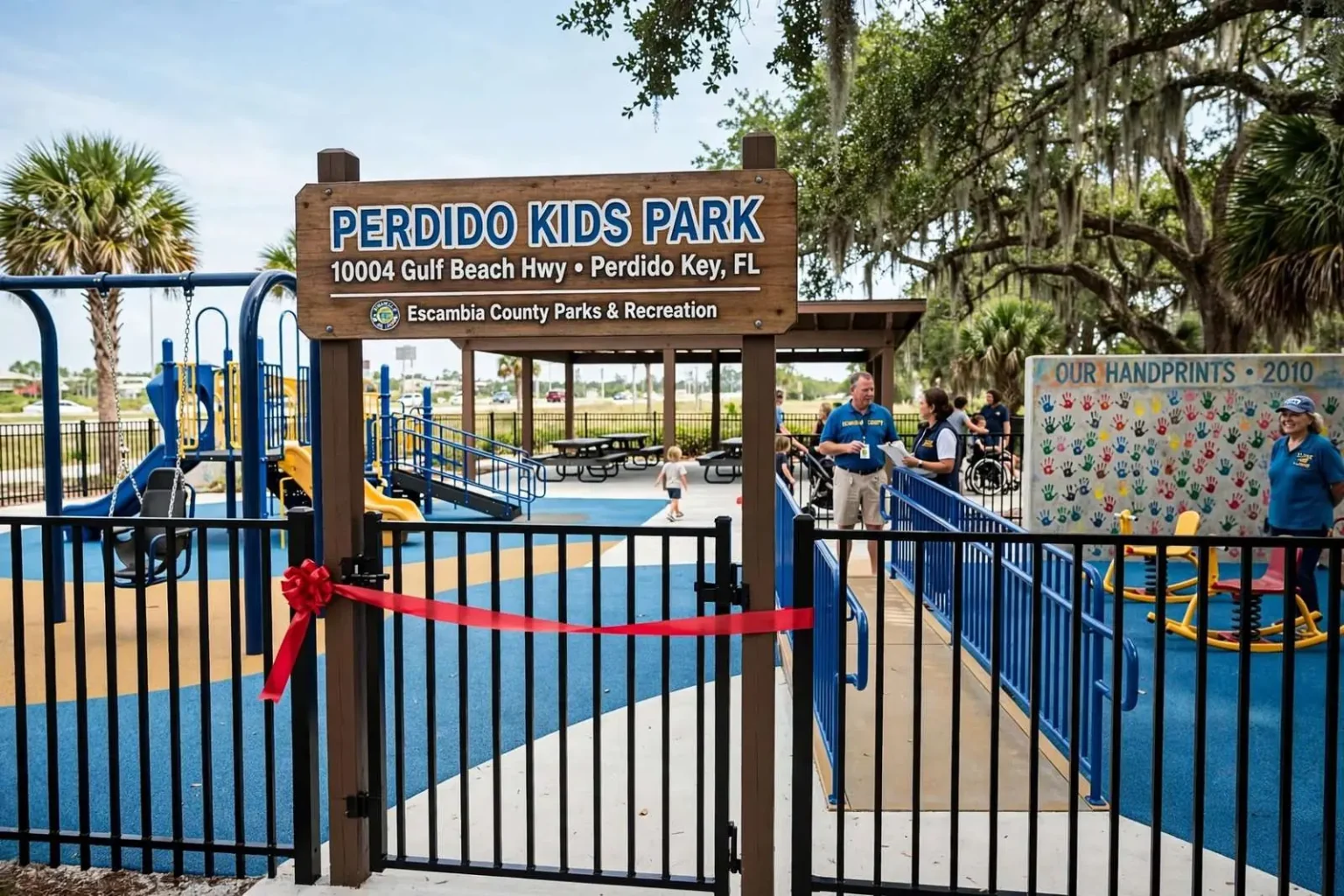
Perdido Kids Park, the popular playground that has been closed since April for a major overhaul, will welcome families back on Wednesday, Sept. 3. A 10 a.m. ribbon cutting will mark the reopening and is expected to draw Escambia County officials as well as members of the Kiwanis Club of Big Lagoon, the organization that led construction of the original park in 2010. The ceremony gives the community a chance to mark not just the new equipment but the institutions that built and maintained the park across its first fifteen years.
The park, located at 10004 Gulf Beach Hwy., had fallen into deteriorating condition, prompting county leaders to close it for renovations. Gulf Beach Highway runs through one of the fastest-developing corridors in the Perdido Key area, and the playground serves a widening base of families drawn to the schools, beaches and neighborhoods nearby. A playground that age — exposed year-round to salt air, summer sun and hurricane seasons — inevitably accumulates wear that routine maintenance cannot keep up with, and county leaders opted for a comprehensive overhaul rather than piecemeal repairs.
The refreshed park features new, durable playground equipment, new ADA-accessible amenities and new fencing designed to make the space safer and more welcoming for children of all abilities. The accessibility upgrades matter as much as the new swings and climbers: inclusive design means ramps, ground-level play features and surfacing that accommodates mobility devices, so that children who use wheelchairs or have other disabilities can play alongside their peers rather than watch from the perimeter. Modern playground standards treat accessibility as core design rather than an add-on, and the renovation brings the park in line with that expectation.
Preserving what families remember
Even with the upgrades, crews were careful to preserve pieces of the park that hold sentimental value for longtime visitors. Several original features remain in place, including the children’s handprint wall, the climbing trees, the swings, the existing picnic table pavilion and the airplane rocker toys. Those elements are the details that families photograph, revisit and measure their children against year after year — a handprint pressed into the wall at age four becomes a landmark a teenager comes back to find.
“I’m especially excited that we were able to preserve several original components that hold sentimental value for many families, including the original children’s handprint wall, climbing trees, and the airplanes,” said District 2 Commissioner Mike Kohler. “Our Parks and Recreation team has been working incredibly hard on this project, and I look forward to seeing many families and children of all ages enjoy this new and improved park in District 2.” The commissioner’s comments capture the balance the renovation struck between modernization and memory — replacing what was worn out while keeping what the community asked to keep.
The Kiwanis Club of Big Lagoon’s role in the park’s history is central to the story. Community-built playgrounds of the kind the club led in 2010 are typically the product of volunteer design workshops, donated materials and thousands of volunteer hours compressed into a build week, and the finished park becomes a point of civic pride precisely because the community made it. When the county took on the renovation, preserving the volunteer-built landmarks — the handprint wall above all — acknowledged that the park’s value was never only in its equipment.
Kiwanis International’s service mission centers on children, which makes a community playground a signature project for a club like Big Lagoon. Clubs across the Gulf Coast have built or supported playgrounds, school programs and children’s health initiatives for decades, and the Perdido Kids Park build remains one of the region’s most visible examples. The club members expected at the Sept. 3 ribbon cutting will be seeing the second act of a project they started with shovels and lumber in 2010.
What the renovation includes
The new durable playground equipment installed during the closure reflects current standards for commercial park construction: powder-coated steel and rotationally molded plastic components engineered to withstand coastal weather and heavy use, with surfacing and shade structures designed around safety codes that have tightened considerably since the original build. New fencing around the playground perimeter addresses one of parents’ most consistent requests at parks near busy roads — a clear boundary that keeps children inside the play area and sight lines that let caregivers supervise from benches outside it.
The ADA-accessible amenities extend beyond the play structures themselves. Accessible routes from parking, transfer platforms, ground-level panels, and inclusive swings and spinners are among the features modern inclusive playgrounds incorporate, and their inclusion at Perdido Kids Park brings a community staple in line with what newer parks in the region offer. Families in the Perdido Key area previously traveled to other communities for fully inclusive play options; the renovation keeps those outings local.
The park’s location on Gulf Beach Highway places it along the route many residents drive daily between the Perdido Key beaches, the Pensacola-side neighborhoods and the schools in between. That daily visibility is part of what made the April closure so noticeable — a community landmark going dark for the summer — and the Sept. 3 reopening arrives just as the busy beach season winds toward fall, handing families a refreshed destination at the moment the school-year routine makes a nearby playground most valuable.
Escambia County’s parks system maintains dozens of playgrounds, boat ramps, beach access points and sports facilities across the county, from the urban parks of Pensacola to the waterfront properties along the Perdido Key corridor. Renovation projects of this scale are among the most visible things a parks department does, and the Perdido Kids Park overhaul drew on the department’s experience with coastal-environment construction — equipment selected for corrosion resistance, surfacing that tolerates flooding and sand, and layouts that work within the constraints of a high-traffic highway corridor.
The five-month closure timeline — from April to a Sept. 3 reopening — tracks with what a full playground replacement actually requires: demolition and removal of the old structures, site work and drainage corrections, installation of new equipment, poured or tiled safety surfacing that needs curing time, and the fencing and site furnishings that finish the project. Compressing that work into a summer minimized the time families lost access, and finishing before the school year’s after-school traffic resumed was the obvious scheduling goal.
Community-built playgrounds entering their second decade face a familiar crossroads: the volunteer energy that built them has moved on, the equipment has aged past its service life, and the responsible public agency must decide between continued patching and full renovation. Perdido Kids Park’s overhaul represents the latter path, and the county’s decision to keep the sentimental landmarks while replacing the underlying equipment offers a template other communities with aging volunteer-built parks can follow — modernize the infrastructure, preserve the memory.
The ribbon cutting at 10 a.m. Wednesday, Sept. 3, is open to the community, and the presence of both county officials and Kiwanis Club members will connect the park’s two eras in a single ceremony: the volunteers who built it in 2010 and the public workforce that renewed it in the present year. Families who spent the summer without their regular playground will find the handprint wall and the climbing trees where they left them, the airplanes still rocking on their springs — and around them, equipment, amenities and fencing built to carry Perdido Kids Park through its next fifteen years on Gulf Beach Highway.
For parents, the practical differences will show up in the details. The new equipment’s durability ratings translate into fewer closed features and fewer “out of order” weeks, and the fencing turns the drop-off-and-supervise routine into a simpler proposition for caregivers managing multiple children. Inclusive amenities change the experience for families who previously found parts of the park unusable — a child in a wheelchair can now reach the play structures by route and by design, and the new surfacing keeps mobility devices from bogging down in sand or mulch. Those are quiet changes individually, but together they determine how many families make the park part of their weekly routine.
The preserved handprint wall deserves particular attention because of what it represents to the families who built the original park. Handprint walls and tile fundraisers are the record of a community project’s human scale — every print on that wall belonged to a specific child on a specific build weekend in 2010, and fifteen years later many of those children are now adults who bring their own kids to find their prints. Counties renovating volunteer-era parks routinely face requests to save exactly these features, and the decision to keep the wall, the trees, the swings, the pavilion and the airplane rockers answered those requests in full.
The climbing trees, too, are the kind of feature no equipment catalog sells. Natural shade trees that generations of children have scaled, named and claimed are irreplaceable on any practical timeline, and their survival through the renovation preserves the park’s character as much as any single attraction. The trees also anchor the picnic areas under the pavilion, where birthday parties and school outings will resume once the gates reopen.
With the ribbon cut, the county’s parks team will turn to the routine work of keeping the refreshed park up to standard — inspections, surfacing checks and the maintenance schedule that protects the investment. The Kiwanis Club of Big Lagoon, meanwhile, sees in the reopened park the continuation of a service project that has outlasted the build week that created it. Perdido Kids Park reopens Wednesday, Sept. 3, at 10004 Gulf Beach Hwy., following the 10 a.m. ceremony, and the families of the Perdido Key area can pick up where they left off in April: new equipment around them, the old landmarks in place, and the park’s second act underway.