
Performer Speaks Out as Protests Loom Over Mobile’s First Drag Queen Story Hour
Mobile's first Drag Queen Story Hour at Ben May Main Library drew planned protests; performer Wade Brasfield speaks out.
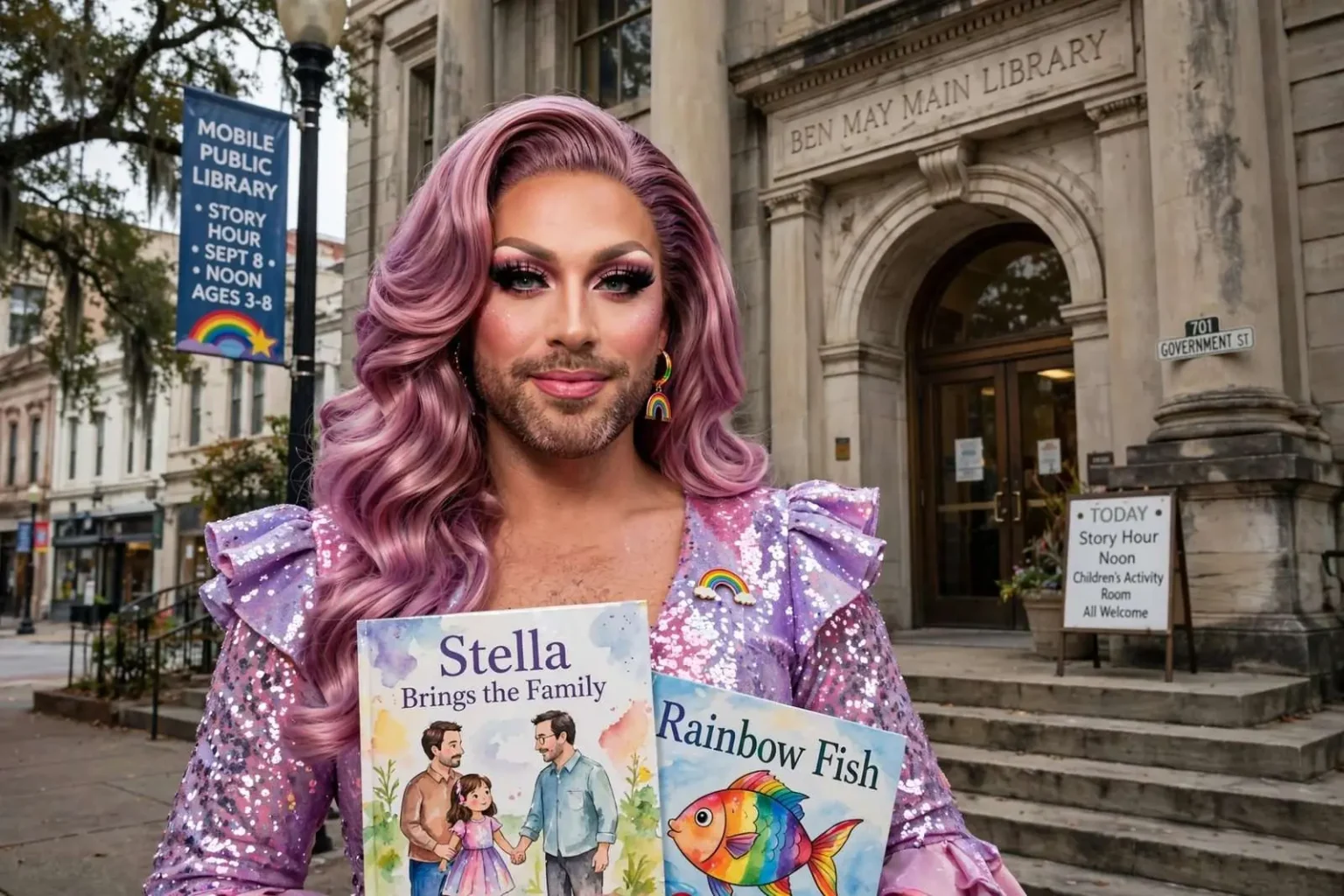
The performer at the center of Mobile’s first Drag Queen Story Hour says he isn’t letting planned protests rattle him ahead of the September 8 event at the Ben May Main Library. Wade Brasfield, who has performed as Khloe Kash for nearly a decade, jumped at the chance to read to children when he was approached about the program. “In my mind, it was I’ll read to kids, we’ll dance around for a minute, we’ll do arts and crafts, it’ll be great,” Brasfield said. “I remember being a kid and going to the library and getting lost for hours in books.”
Those two sentences capture the gap that has opened up around the event: between the performer’s memory of the library as a refuge — a place where a child could disappear into a book for an afternoon — and the national argument that has followed Drag Queen Story Hour from city to city as it has arrived in new communities. Mobile is now one of those communities, and the week before the event has turned a noon reading hour into one of the most discussed public meetings of city institutions in recent memory.
How the Event Works
The story hour, sponsored by Rainbow Mobile, is set for noon on September 8 and is designed for children ages 3 to 8, though anyone may attend. Brasfield — trained by a local elementary school teacher for the role — will read storybooks dressed in drag. It is the first time the national Drag Queen Story Hour concept has come to Mobile. The program model, which has run in libraries from New Orleans to New York, pairs a trained drag performer with picture books and a craft activity, with organizers describing it as a way to introduce young children to diversity in a setting they already know.
The training component is deliberate. Children’s programming in a public library carries expectations about age-appropriateness, and organizers have pointed to Brasfield’s preparation with a working elementary school teacher as the answer to questions about how a nightclub entertainer adapts to a room of preschoolers. The reading list itself is conventional: the selections are published picture books that appear on library shelves and school lists around the country.
Planned Protest and Community Objections
Opponents have organized a demonstration hours before the reading begins. The Common Sense Campaign Tea Party plans to gather outside the library at 701 Government Street starting just before 10 a.m., assembling on the sidewalk in front of the main branch well before families arrive for the noon program. Local pastors have also voiced objections, including Fred Wolfe of Luke 4:18 Fellowship, who argued the event is unhealthy for children and questioned its use of a tax-supported public facility. “It’s being used in a public forum supported by taxpayers’ money to promote something that we think is divisive in the community,” Wolfe said.
Still, Wolfe said both sides intend to keep things peaceful. “What we’re doing is letting them exercise their freedom of speech and assembly and we’re going to do the same thing,” he said. “And I think that is what America is all about.” That framing — protest as protected speech rather than disruption — sets the ground rules for the morning, and library officials have been briefed on security arrangements for a building that will hold both a children’s program and a demonstration outside its Government Street frontage.
Ben May Main Library is the flagship of the Mobile Public Library system, a Carnegie-era institution that anchors the western edge of downtown along Government Street. Its auditorium and children’s spaces host programs throughout the year, from summer reading events to author talks, and staff there are accustomed to families arriving with strollers and school groups on scheduled visits. What they have not hosted before is a program that arrives with a national controversy attached.
The Organizer’s Case
Organizer Rainbow Mobile framed the program as a lesson in inclusiveness for young readers. Executive director Bryan Fuenmayor said exposing children to differences early can pay off later. “I think, personally, if children get to see that, then it will help a lot with bullying when they get older,” Fuenmayor said, pointing to children with two moms or two dads as an example of the acceptance the event aims to promote.
That argument — that early exposure reduces the bullying those children’s classmates will face later — is the core of the case organizers make wherever the program appears. Rainbow Mobile has operated in the city as an advocacy and community organization serving LGBTQ residents, and the story hour represents its highest-profile collaboration with a public institution to date. Fuenmayor’s framing deliberately keeps the conversation on the children in the room rather than on the politics outside it: the program’s promise, in his telling, is that a child from a nontraditional family sees a family like theirs treated as ordinary in a public building.
The reading list follows that theme. “Stella Brings the Family” by Miriam B. Schiffer tells the story of a girl with two fathers navigating a Mother’s Day classroom celebration, and “Rainbow Fish” by Marcus Pfister is a decades-old picture book about sharing whose shimmering scales have made it a preschool staple on its own merits. The stories will be followed by an arts and crafts session lasting roughly fifteen minutes, keeping the total program well within the attention span of the 3-to-8 age group it targets.
The Library’s Position
The Mobile Public Library emphasized that it is hosting but not sponsoring the event, saying neither the library nor the Friends of the Library provided any funds toward the program, and noted that patrons who prefer not to attend can visit any of its nine other branch libraries that day. That statement is doing considerable work: it distinguishes between providing space — which public libraries do under their meeting and program policies — and endorsing the content, and it offers an alternative for patrons whose objections are to the event itself rather than the library.
Library systems around the country have faced the same balancing question. Meeting room and program policies generally commit a library to viewpoint-neutral access: if a religious group can use the auditorium, a community organization can too, and refusing one while hosting another exposes the institution to legal challenge. The not-hosting-not-sponsoring formulation is the standard answer, and the reminder about the system’s nine other branches — from Saraland to Semmes to West Mobile — gives objecting patrons a practical accommodation while keeping the main branch’s doors open for the program as scheduled.
For Brasfield, the week’s noise does not change what he expects to find at noon on September 8: children on the carpet, a picture book open, and the same kind of library afternoon he remembers from his own childhood in this city. The demonstration will have dispersed by then, or it will not, and the reading hour will proceed on the schedule Rainbow Mobile and the library agreed to months ago — two books, a craft, and an institution’s ordinary Saturday programming carrying an extraordinary amount of civic attention.
A Program With a National History
Drag Queen Story Hour began nationally as a small library program and has since spread to branches and bookstores in dozens of cities, accumulating both a following and a pattern of organized opposition wherever it lands. The pattern is consistent: a local organization brings the program to its library, a coalition of faith and political groups announces a demonstration, and the event itself proceeds under whatever security arrangements the library system and police department work out in the days before. Mobile’s version has followed that script almost exactly, with the September 8 date, the planned morning demonstration and the competing public statements all matching what other mid-sized cities have experienced.
The program’s supporters note that its activities — picture books, songs, crafts — are barely distinguishable from any other preschool library hour apart from the performer’s attire. Its opponents counter that the performer’s art form, whatever its merits for adults, is not suited to early childhood programming and that a public institution should not lend its credibility to it. Neither argument is new to the national debate, and Mobile’s city officials have largely stayed out of it, leaving the library’s hosting-not-sponsoring statement as the municipal position.
Government Street’s Library and Its City
The venue adds its own weight to the occasion. Ben May Main Library sits along Government Street at the edge of downtown, a block from the civic institutions that define the area, and its reading rooms and meeting spaces have been part of Mobile public life for generations. A demonstration on its front steps places the debate in the city’s most visible civic corridor, where passersby, news cameras and library patrons will share the same sidewalk for the morning.
The library system’s reminder about its nine other branches underscores how geographically spread the system’s options are for patrons that Saturday. Mobile’s branches reach from the western suburbs to Prichard and Saraland on the north, and each runs its own Saturday programming. For families who object to the main branch event, the system’s message is that their library week can proceed elsewhere; for families attending, the story hour runs noon to early afternoon at the main branch, with the reading and craft session sized for the young audience it was designed for.
Whatever comes of the morning’s demonstration, the event has already produced one measurable result: a citywide conversation about what public libraries host, who decides, and how a diverse city talks about a program designed for its youngest readers. That conversation will outlast the September 8 event, and both the organizers who planned it and the opponents who demonstrated against it have made clear they intend to keep making their cases in the weeks after Khloe Kash closes the last picture book and the craft tables are put away.


