

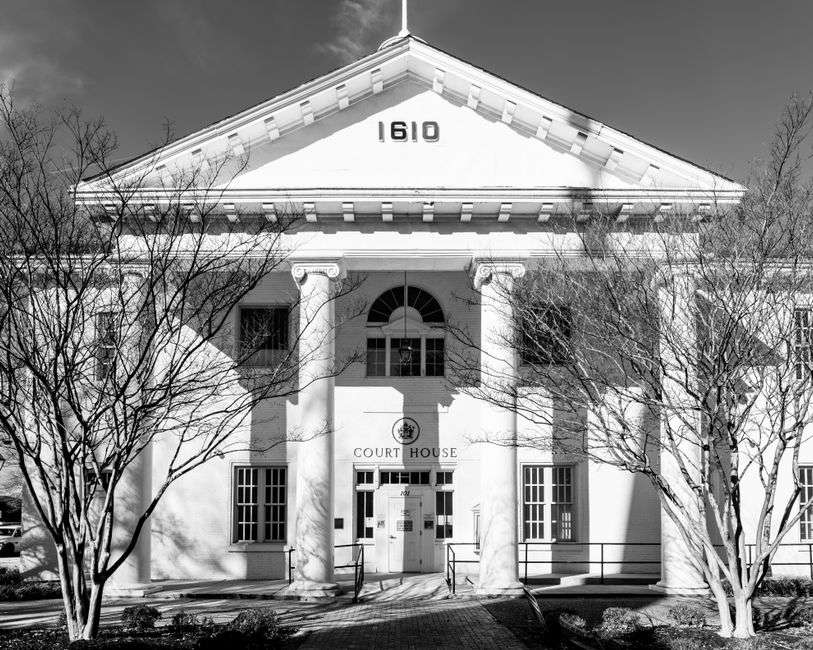
A group of Black Point Clear residents have won their lawsuit against the Baldwin County Commission, reversing a 2020 zoning vote that they accused the county government of drawing along racially discriminatory lines.
But the fight is not over: the county has now appealed the ruling to the Alabama Supreme Court.
The Ruling
On Aug. 10, Baldwin County Circuit Judge Byron Brackin ruled that the Baldwin County Commission violated state law when it did not express a reason to redraw the Planning District 19 boundaries, and failed to establish a justification for working to redraw them in the first place.
Brackin heard arguments in the case during a June 8 bench trial. His order, issued earlier this month, was appealed by the county’s attorneys on Thursday, Aug. 13, and the Alabama Supreme Court docketed the case on Monday morning, according to online court filings. As of publication, it is unclear when the state’s high court will take up the case.
How District 19 Came to Be
The story begins in the summer of 2020, when a group of property owners in the Point Clear area — just south of Fairhope on the eastern shore of Mobile Bay — petitioned the county to create a new planning district that would bring the area under Baldwin County’s zoning jurisdiction for the first time.
Under Alabama law that governs zoning in Baldwin County, planning districts must correspond to voting precinct boundaries unless the County Commission determines that using precinct boundaries is not feasible. Critics of the process noted early on that Planning District 19 took in only part of Voting Precinct 10 — a fact the county’s own administrators acknowledged they could not fully explain.
The commission approved the new district in August 2020, and a zoning election was scheduled for Dec. 29, 2020 — held at Bethel Lutheran Church, where voters cast ballots in the church’s sanctuary. The referendum passed by an overwhelming margin, establishing Baldwin County’s first new planning district in more than a decade.
But Black residents of the area said the process had excluded them. The newly drawn district did not reflect the wishes of the majority of people living within its boundaries, plaintiffs alleged, and the zoning rules it introduced would impose expensive regulations specifically on their homes. They also alleged that residents inside the district were not properly notified of the zoning election ahead of time — state law required the county to notify each qualified elector by mail, and many Black electors said they never received notice.
Only a fraction of the district’s qualified electors participated in the December 2020 vote, according to court filings in the case, and the plaintiffs argued the zoning measure never earned majority support from the people it would govern.
The Lawsuit
The residents filed suit against the Baldwin County Commission in 2021, after the zoning went into effect. The case became one of the most closely watched land-use disputes on the Eastern Shore, drawing support from civil rights organizations and drawing a parallel challenge from the Retirement Systems of Alabama, the state pension fund, which also sued over the district’s creation — arguing that the district’s boundaries were arbitrary, capricious and inconsistent with the character of the property RSA owns in the area.
At the heart of the residents’ case was a straightforward legal question: under state law, the county must justify departing from voting precinct boundaries when it draws a planning district. Judge Brackin concluded that the county never did so — neither explaining why it redrew the boundaries nor establishing a justification for the redraw in the first place.
Willie Williams, one of the Point Clear residents involved in the litigation, called the ruling a milestone moment for the community.
“The court’s ruling represents a significant victory for the Point Clear community,” Williams said. “The contested zoning action will not remain the governing land-use framework while the appeal proceeds. The affected area will revert to the applicable building-code and subdivision regulations.”
Williams was careful to note what the ruling does not mean: the area is not left without regulation. Building codes, subdivision regulations, permitting requirements and other applicable laws remain in effect. Rather, the community returns to the regulatory framework that applied before the contested zoning designation was layered on top of it.
What the Appeal Means
For property owners in District 19, the immediate effect of the ruling is uncertainty — followed, at least for now, by a reversion to the county’s baseline land-use rules while the appeal proceeds. Anyone planning construction or significant property changes in the area should expect the applicable framework to depend on how the Alabama Supreme Court ultimately rules.
For the county, the appeal represents an attempt to preserve a zoning framework that officials have defended as a citizen-driven process. County attorneys have argued that the commission does not control how a zoning district’s map is drawn or how the referendum is conducted, pointing instead to the petition process that initiated it.
The stakes extend well beyond Point Clear. Baldwin County is one of the fastest-growing counties in Alabama, and fights over planning districts — citizen-initiated zones that bring county zoning to unincorporated areas — have multiplied in recent years. Several proposed districts have been defeated at the ballot box or challenged in court, making District 19 a test case for how the state’s zoning-precinct rules are applied when the map doesn’t match the precinct.
With the case now docketed in Montgomery, the Alabama Supreme Court will decide whether Judge Brackin’s reading of the law stands. Until then, the residents of Point Clear who fought the district for five years hold a circuit court victory — and the county holds an appeal.