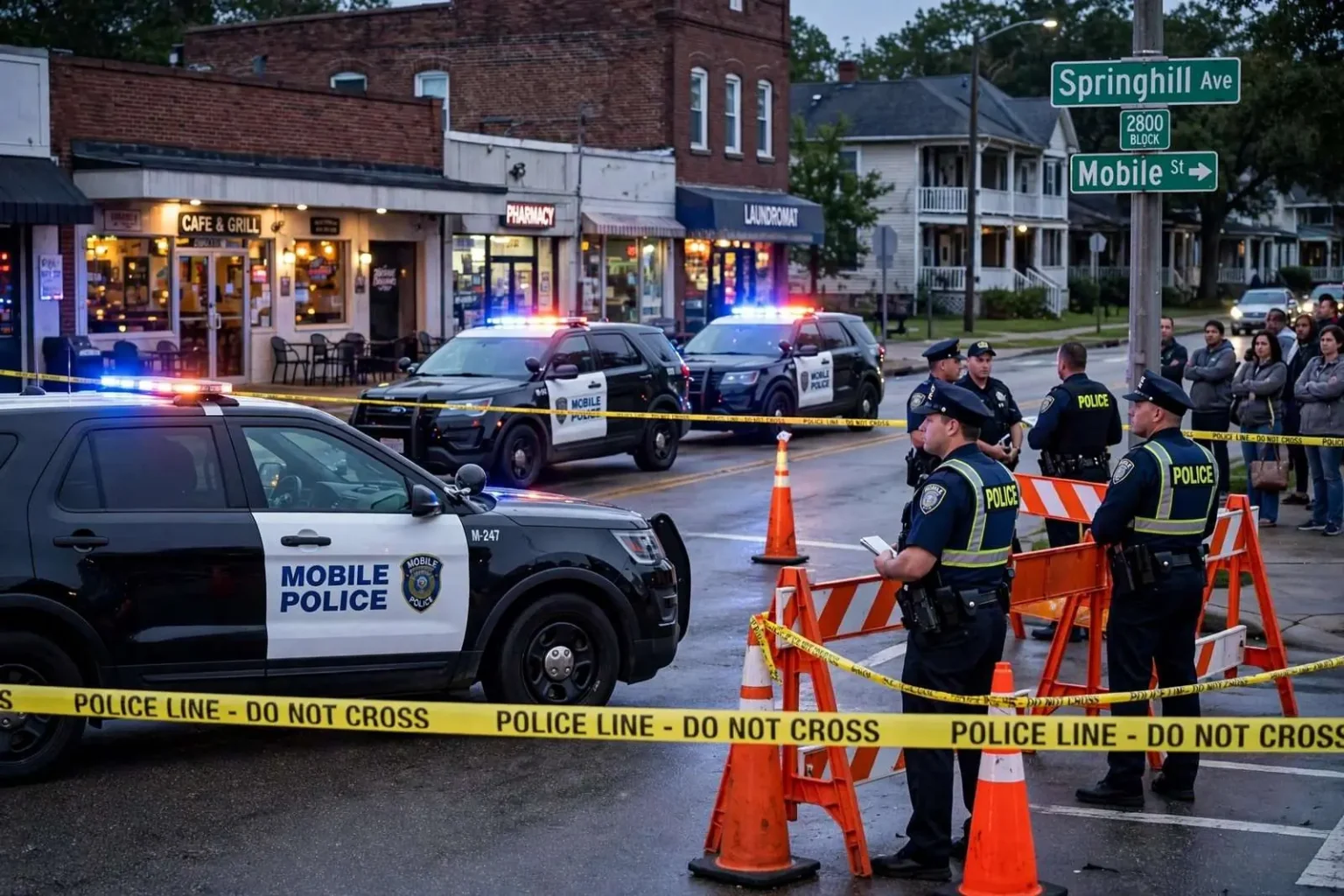
A stretch of Springhill Avenue near Mobile Street was cordoned off by Mobile police on Sunday evening as officers investigated an unfolding situation in the area.
Witnesses reported a heavy police presence along the corridor, with officers taping off part of the area to keep bystanders and traffic away while they worked the scene. As of the initial response, the Mobile Police Department had not released details on what prompted officers to the location.
The sight of crime scene tape on a busy city street always draws attention, and Sunday evening was no exception. Drivers slowed along the corridor, residents stepped onto porches, and passersby stopped at the perimeter to ask what had happened — questions officers at the scene, following standard practice, were not in a position to answer while the investigation was in its early hours. What could be confirmed was the response itself: multiple police vehicles, tape closing a portion of the roadway and officers working the area into the evening.
Springhill Avenue is one of Mobile’s busiest east-west corridors, connecting downtown to the city’s midtown neighborhoods and running near the Spring Hill area on the city’s west side. The stretch near Mobile Street sits close to residential blocks, small businesses and local restaurants, making any extended police activity there highly visible to residents and passersby.
The corridor’s character explains why. Springhill Avenue functions as both a commuter route and a neighborhood main street — a road that carries thousands of vehicles a day between downtown and the western neighborhoods while fronting the homes, shops and restaurants of the people who live along it. When police tape goes up on Springhill, it goes up in front of an audience; there is no industrial stretch or empty block to absorb the activity unseen. By Sunday evening, word of the cordon had already spread through neighborhood social media groups, where residents swapped sightings of police cars and asked whether anyone knew what was happening.
What Police Cordon Procedures Mean
Incidents like this are a reminder of how quickly a routine evening in a busy corridor can turn into an active police scene. Mobile police routinely tape off areas during investigations to preserve evidence and protect the public, a standard practice regardless of the underlying cause of the response.
The perimeter serves several purposes at once. It preserves the scene in whatever condition officers found it — critical if the investigation involves evidence scattered across pavement, sidewalks or a storefront frontage. It keeps vehicles and onlookers out of the path of evidence technicians, detectives and any medical response underway. And it gives investigators the space to work methodically, photographing and collecting before the scene is returned to its everyday routine. Residents who see tape go up should treat the boundary seriously: crossing a police line during an active investigation can interfere with the case and expose the person to charges.
The initial hours of any such response follow a familiar sequence. First units secure the scene and check for injuries. Detectives are called out, and a command officer assumes control of the perimeter. Evidence technicians begin their work while officers canvass the block for witnesses and camera footage — doorbell cameras, storefront systems and dashcams have become central to how modern investigations reconstruct the crucial minutes of an incident. Public information officers coordinate what can be released, and the department’s silence in the first hours is usually a sign that the work is ongoing, not that information is being withheld.
Local outlets on the scene continued to monitor the situation as it developed. Details such as the nature of the incident, whether any injuries were reported, or whether arrests were made were not immediately available.
That caution is deliberate and, residents should know, routine. Police departments release information about active investigations only when doing so will not compromise the case — naming a suspect too early, confirming details only witnesses would know or describing evidence before it is documented can all damage a prosecution. In the early hours of an incident, the department often confirms only that officers are on scene and investigating, with fuller statements following once detectives have a grasp of what occurred. Media outlets that monitor scanners and maintain reporter relationships with local agencies typically have confirmed updates within hours, and the department’s public information office fields requests as the investigation allows.
The Corridor and Its Neighborhood
Springhill Avenue’s role in Mobile’s street grid makes Sunday’s scene notable beyond the immediate blocks. The avenue runs from the downtown grid northwest through midtown toward the Spring Hill neighborhood, threading through some of the city’s most established residential districts and past the churches, schools and businesses that anchor them. Mobile Street intersects in a stretch where those functions overlap — homes set close to the road, corner businesses, restaurants that draw evening traffic — and the mix means a police cordon disrupts several kinds of activity at once: commuters rerouting, diners changing plans and residents watching from their front steps.
The neighborhood around the intersection is also representative of midtown Mobile’s ongoing evolution. Older residential blocks, longtime family businesses and newer redevelopment share the corridor, and community associations in the area have historically been active in watching over public safety — reporting suspicious activity, working with the department’s precinct officers and pushing for improved lighting and traffic measures. An unexplained police scene on a Sunday evening lands in a neighborhood that pays close attention to its streets.
For businesses and residents directly along the taped-off stretch, the immediate impact is practical. Access may be limited for a few hours, parking blocked and foot traffic reduced while the investigation runs its course. Departments generally work to reopen roadways as quickly as the evidence allows, and most cordons of this kind lift within hours, though serious investigations can hold a scene much longer.
How Residents Can Follow Updates
Mobile police routinely share confirmed updates through the department’s official channels, and area newsrooms maintain running coverage of significant incidents. Residents looking for reliable information are best served by those sources — official statements and established local outlets — rather than the unverified claims that circulate quickly on neighborhood groups and social media while a scene is still active. Rumors move faster than facts in the first hours of any incident, and in a close-knit corridor like Springhill Avenue, speculation can outpace what officers themselves yet know.
Anyone who witnessed activity in the area Sunday evening — vehicles, individuals, anything unusual in the hours before police arrived — can contact the Mobile Police Department directly. Witness information gathered in the first day or two of an investigation is often the most valuable, particularly in a populated corridor where cameras and bystanders are plentiful. Tips can be submitted anonymously, and departments encourage callers to report even partial recollections.
Incidents like this are a reminder of how quickly a routine evening in a busy corridor can turn into an active police scene — and of the system that responds: the officers who secure the perimeter, the detectives who work the case, and the neighborhood that watches, waits and shares what it knows.
This is a developing story. Updates will be provided as more information becomes available from the Mobile Police Department.
Sunday Evening on a Busy Corridor
The timing of the response added to its visibility. Sunday evenings along Springhill Avenue bring a slower rhythm than weekdays — dinner crowds thinning, fewer commuters — which means both that unusual activity stands out more sharply and that residents have the time to notice it. Heavy police presences on weekend evenings tend to draw more onlookers and more social media posts than the same response would on a Tuesday morning, and departments are accustomed to managing both the scene and the audience that gathers around it.
The intersection area’s familiarity to Mobile drivers also fuels the attention. Springhill Avenue near Mobile Street is a stretch many residents traverse daily, and there is a particular unease when trouble appears on a road woven into one’s own routine — the store where you stop each week, the block where a neighbor lives. That familiarity is also a strength for investigators, since the people who know a corridor best are the ones most likely to recognize when something there is out of place.
As the investigation progresses, the department’s release of information will determine how much of Sunday evening’s activity becomes public record. Some cordons resolve quietly — an incident with no public safety implications beyond the hours of the response — while others develop into cases the department discusses publicly as arrests follow. Until then, the tape on Springhill Avenue stands for the ordinary machinery of an investigation: a scene secured, a neighborhood watching, and answers still being assembled.