Possible Infant Skull Found In Wooded Area Near Byrneville Prompts Investigation — But It Was A ‘Realistic Fake’
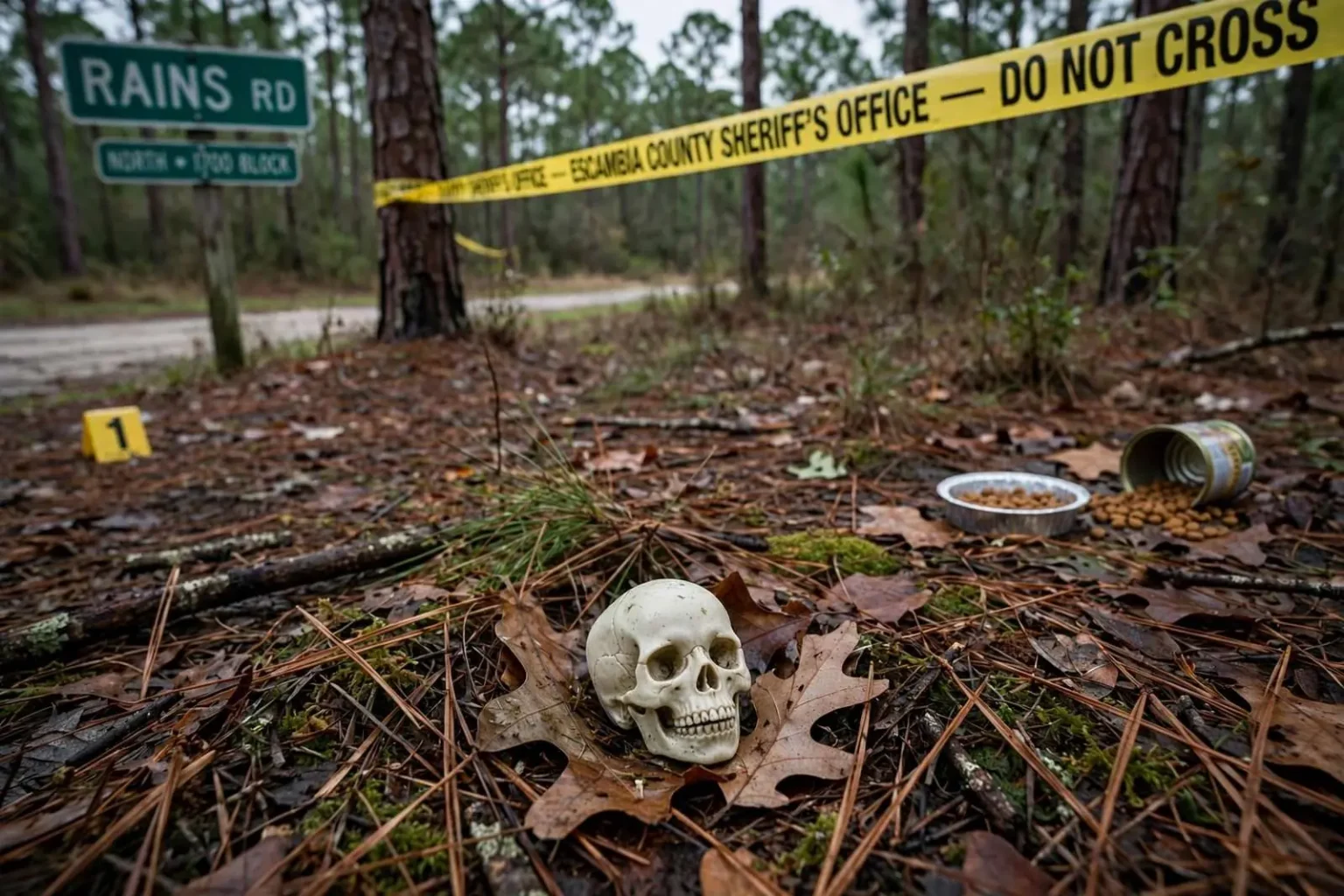
An investigation determined that a possible human skull found Sunday evening near Byrneville was, in fact, not human or primate. The small skull, described as an old but realistic-looking fake, was located in a wooded area on the east side of Rains Road, less than a mile north of West Highway 4 before 6 p.m. by someone feeding cats. Concerned that the skull might be that of an infant, the person finding it called the Escambia County Sheriff’s Office. At first glance, the “skull” pieces appeared to be real and belonged to an infant or even a primate like a monkey, according to the ECSO, which was attempting to locate an anthropologist for an opinion.
After further investigation, “the Medical Examiner determined that the ‘skull’ is a realistic-looking fake,” Morgan Lewis, spokesperson for the ECSO said shortly after 9 p.m. Sunday. The discovery and the quick resolution underscored both the public’s willingness to report possible remains and the careful process law enforcement follows before drawing any conclusions about what has been found.
Where Byrneville Sits
Byrneville is a small community in northern Escambia County, Florida, not far from the Alabama state line in the Florida Panhandle. The area is characterized by pine woods, rural residential properties, and scattered unincorporated neighborhoods where residents often keep animals and look after feral cat colonies. The stretch of Rains Road referenced in the report is typical of the quiet, wooded lanes that wind through this part of the county, where encounters with wildlife and forgotten curiosities are not unusual.
The proximity to West Highway 4, a key east-west route through the Panhandle, places the discovery site within a short drive of both Century to the west and the broader Pensacola metropolitan area to the south. Despite that relative proximity to population centers, much of the immediate vicinity remains lightly developed forest and pasture, and rural roadways like Rains Road can carry a steady flow of foot traffic from residents tending to outdoor animals.
How Such Findings Are Handled
When a member of the public reports what appears to be human remains, law enforcement treat the matter seriously until proven otherwise. The Escambia County Sheriff’s Office responded to the call and began the process of determining what had been found, securing the area and attempting to contact a qualified anthropologist for an expert opinion. The agency’s initial caution reflected the possibility, however remote, that the item was genuinely biological rather than artificial.
In cases where a medical examiner or forensic anthropologist is unable to make a determination in the field, items are often transported to a forensic laboratory for closer examination. Dental structure, bone density and microscopic surface features can all be used to distinguish real bone from resin, plastic or other materials commonly used in replicas and Halloween-style props. In this case, the medical examiner’s review concluded quickly that the item was a realistic-looking fake, allowing investigators to close the inquiry without further forensic work.
Why the Initial Concern Was Reasonable
The size and apparent condition of the object were enough to trigger the standard protocol. Reports of infant or small primate remains require immediate attention regardless of context, both because of the possibility of foul play and because the size and shape of the object can complicate visual identification in the field. Investigators noted that the pieces appeared at first glance to be consistent with an infant or small primate, which justified the call for an expert opinion.
Equally important is the public’s role in such cases. The person who located the object while feeding cats did exactly what authorities ask of residents who come across suspected remains: leave the items in place, avoid handling them and contact law enforcement. That quick reporting allowed deputies to recover the item intact and to involve the medical examiner before any conclusion was reached.
A Reminder About Reporting Possible Remains
Law enforcement agencies across the Gulf Coast routinely emphasize that residents who find bones, skulls or other objects that may be human should not attempt to identify them on their own. Many animal bones can closely resemble small human remains, and replicas sold for Halloween, educational displays or theatrical use are realistic enough to fool even experienced observers. Calling the sheriff’s office or the local police department ensures that the right experts are brought in from the start.
The Escambia County Sheriff’s Office
The Escambia County Sheriff’s Office serves a Florida Panhandle county that stretches from the western suburbs of Pensacola northward toward the Alabama state line. Sheriff’s deputies in the northern part of the county regularly handle calls in communities such as Byrneville, Century, Walnut Hill and McDavid, where rural landscapes and small residential lots are common. Many of the calls in those areas involve animals, missing persons, traffic crashes on two-lane highways and the kind of unusual discoveries that occasionally surface along the back roads of the Panhandle.
Public information officers such as Morgan Lewis routinely release short updates on active investigations once deputies have enough information to share. The Sunday evening statement that the “skull” was a realistic-looking fake was the agency’s way of putting a quick end to speculation about the discovery while also reminding residents that reports of this nature will always be investigated thoroughly before being cleared.
Forensic Resources in the Region
Northwest Florida and the broader Gulf Coast region are served by a network of medical examiner’s offices, district attorney’s offices and university anthropology departments that can be called on for help identifying unusual remains. The District One Medical Examiner’s Office, which covers Escambia County, works with local law enforcement to determine whether items recovered in the field are biological, archaeological or artificial. When additional expertise is needed, university programs in Florida, Alabama and across the Southeast can provide consults on skeletal identification.
For the Byrneville case, the medical examiner’s review was sufficient to classify the object as a fake. No anthropologist consult was ultimately required, and the ECSO was able to close the inquiry within hours of the initial report. That swift resolution allowed deputies to return to regular patrols in the area while reassuring residents that nothing further had been found in the surrounding woods.
A Quiet Resolution in a Rural Setting
By Monday, the discovery on Rains Road had become a brief chapter in a long line of unusual reports that have come out of the Byrneville area over the years. The combination of pine forest, rural residential lots and the steady presence of feral cat caretakers means that objects can sit undisturbed for long stretches before being noticed, and the occasional find of an unusual item is part of life in that part of the Panhandle. For residents who reported the object and for the deputies who responded, the case stands as an example of how quickly a potentially serious call can be resolved when everyone follows the right steps.
What Happens After a Realistic Replica Is Identified
Once a forensic examiner confirms that an object is a replica rather than biological material, the case typically wraps up with a short public statement and the item is turned over to the originating law enforcement agency for storage or disposal. In some cases, replicas are kept as evidence if there is any question about how they ended up at the location where they were found, particularly if a property owner or local resident might have information about their origin. In Byrneville, the ECSO’s quick determination allowed the agency to release a brief update shortly after 9 p.m. Sunday without the need for further canvassing.
A Familiar Pattern Along the Gulf Coast
Realistic-looking skulls, bones and anatomical replicas are widely available through Halloween suppliers, educational catalogs and online retailers, and they routinely show up in yards, wooded lots and along roadways after being discarded or lost. Gulf Coast sheriff’s offices and police departments field several calls a year about suspected remains that turn out to be replicas, and the standard response is to treat every report seriously until an expert can rule out the possibility of biological material. The Byrneville discovery followed that pattern, and the rapid resolution offered a clear reminder of how the process is supposed to work.
Staying Alert in Rural Communities
For residents of northern Escambia County and the surrounding rural communities in Santa Rosa County and south Alabama, the Byrneville case is also a reminder that the back roads can turn up unusual items at any time of year. Sheriff’s offices across the region encourage residents to report anything that looks out of place rather than handling or moving it, particularly when the item could be confused with human remains. The same guidance applies to suspected archaeological materials, hunting-related items and any object that might be connected to a previous investigation. Quick reports and a careful response, as happened Sunday evening near Byrneville, are the most reliable way to make sure unusual discoveries are resolved quickly and accurately.