
Preview: Birmingham’s Future Elevators Head to Callaghan’s Irish Social Club
Birmingham's Future Elevators were set to perform at Callaghan's Irish Social Club on August 21. We spoke with musician Michael Shackelford about the.
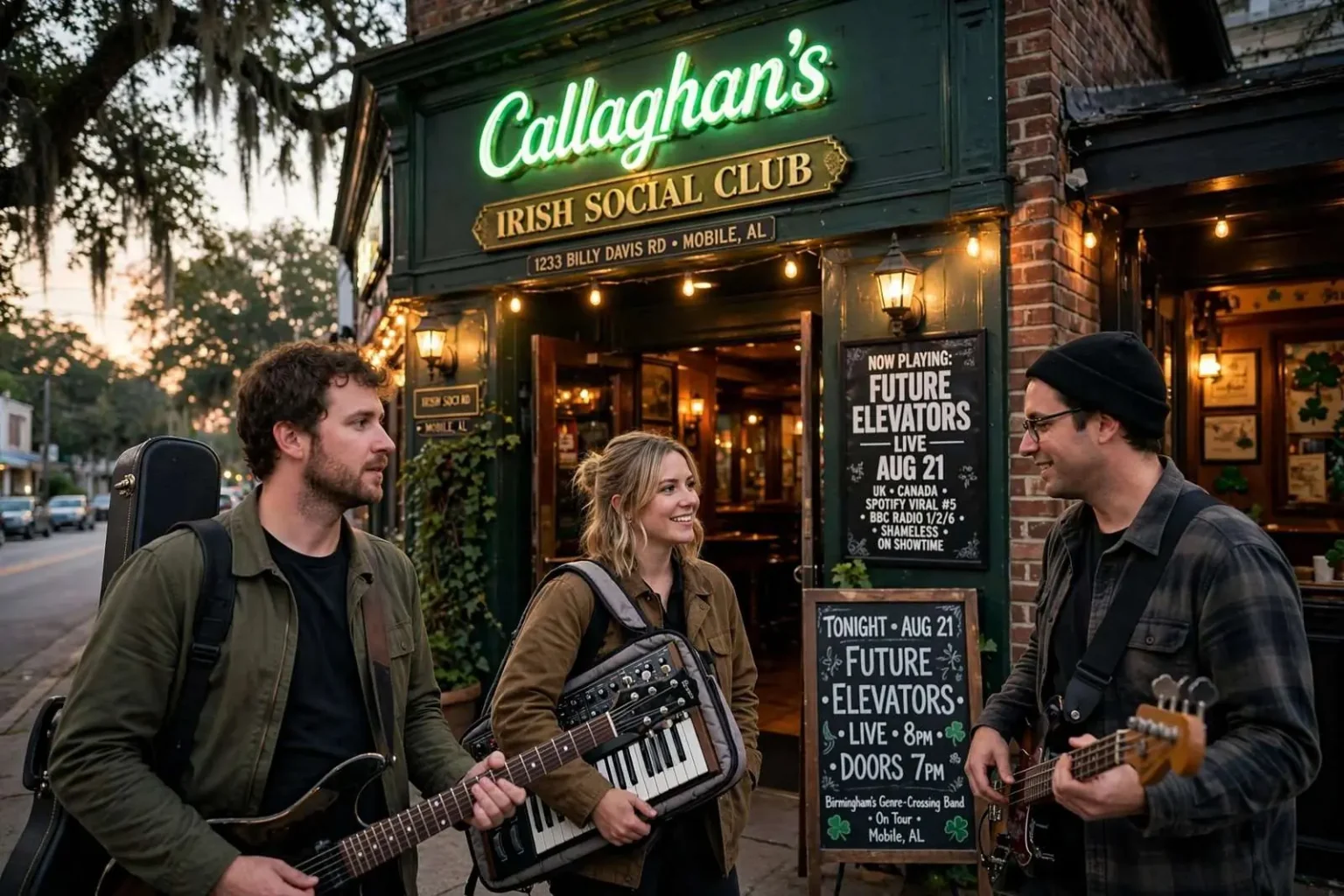
Birmingham’s Future Elevators were set to perform at Callaghan’s Irish Social Club on August 21, bringing a genre-crossing band with growing national and international attention to one of Mobile’s most beloved small rooms. Ahead of the date, the newsroom spoke with musician Michael Shackelford about the band’s momentum and the upcoming show.
A breakout year
The genre-crossing group had charted at number five on Spotify’s viral playlists in the UK and Canada, a striking achievement for a band whose home base sits more than four hours from the nearest radio market that knew its name. Viral chart placement reflects songs being shared and saved at an accelerating pace, and Future Elevators found themselves on playlists alongside acts with far larger promotional machinery behind them.
Television came calling as well. Their song “It Is What It Is” appeared twice on Showtime’s “Shameless,” the long-running series that has served as a tastemaker for independent music, while “Machine Maker” and “Modern World” were in rotation on BBC Radio 1, 2, and 6 in the United Kingdom. KCRW, the influential Los Angeles public radio station known for breaking acts well before the mainstream, was also spinning the record.
For a band at Future Elevators’ stage, that combination of sync placements and international radio is more than a trophy shelf — it is the engine of a touring career. Music supervisors and programmers reach listeners who never attend local shows, and each spin converts into streams, mailing-list signups and, ultimately, tickets in distant cities.
The band was touring the coast and Southeast ahead of a UK run in November, making the Mobile date part of a deliberate build toward the biggest stretch of shows in the group’s history. The coastal swing put the band in front of Gulf Coast audiences just as its overseas profile was peaking.
Why Callaghan’s
Shackelford said this was the band’s first time playing Callaghan’s, and the booking came about the old-fashioned way: owner John Thompson reached out directly. That kind of personal invitation still carries weight among touring musicians, who know that a room booked by hand is a room where the staff actually wants the band there.
Every musician Shackelford had asked praised how the venue treats its bands, and the club’s New Orleans-like vibe sealed the deal — though, as Shackelford noted, Mardi Gras actually originated in Mobile, a point of civic pride he was happy to assert. The offer of food and a hotel for the night did not hurt, a hospitality package that small venues far larger than Callaghan’s rarely extend.
Callaghan’s has built its national reputation among musicians exactly that way: a compact neighborhood club on Mobile’s Billy Davis Road corner that pays attention, feeds its bands well, and treats a Tuesday-level draw with the professionalism of a marquee theater. For touring acts passing through the Gulf Coast, it has become one of the stops that musicians recommend to each other.
The sound of Future Elevators
Future Elevators resist easy classification, which is precisely how the band ended up crossing from indie playlists to BBC daytime rotation and a prestige cable drama. The group’s material folds retro textures, electronic accents and melodic pop instincts into songs that work in radically different listening contexts — a club stage, a car radio, a television soundtrack.
That versatility shows in the band’s resume. A song like “It Is What It Is” has to earn a television placement on its dramatic merits, landing twice on “Shameless” because it served the scenes it underscored. Meanwhile “Machine Maker” and “Modern World” earning rotation across BBC Radio 1, Radio 2 and Radio 6 meant the band’s music was reaching everything from mainstream UK audiences to the station’s dedicated new-music listeners.
Shackelford’s role in the band anchors a project that has always been as much a studio creation as a live act, and translating that material to the stage is where a small room like Callaghan’s becomes an asset. Intimate venues compress the distance between a band’s recorded identity and its live presence, giving new listeners a direct, unfiltered introduction.
What the band wants from a show
Shackelford said the band hoped listeners would leave its shows feeling uplifted, describing live performance as an “aura massage” and a needed escape from a difficult world. The phrase captures the band’s ethos: entertainment as a restorative act, a set built to lift a room rather than to prove a thesis.
That sensibility has translated as the band’s audience has grown. Viral chart placement and international airplay brought curious listeners in the door, but the band’s booking philosophy has kept it on stages where the audience can feel the performance rather than observe it from a distance.
The August 21 date at Callaghan’s put that approach in front of Mobile audiences at a moment when the band was peaking regionally. Fans of the television placements or the UK radio spins could hear the songs in their natural habitat, in a room with no bad seat and a stage a few feet from the bar.
Mobile and the regional circuit
For Mobile, the show was another signal of the city’s place on the Southeast’s original-music map. Gulf Coast rooms like Callaghan’s increasingly book acts whose profiles have been built by streaming, sync licensing and international radio rather than traditional label pipelines, and local audiences benefit from the calibre of touring bands that path brings through town.
The stop also connected two of Alabama’s music cities. Birmingham’s scene has produced a steady stream of nationally recognized acts across genres, and when a Birmingham band with international momentum plays a Mobile stage, it strengthens the in-state circuit that lets original music travel between Alabama’s cities without a trip through Nashville or Atlanta first.
The road to a UK tour
The band’s itinerary told the story of where Future Elevators stood in the summer of the Callaghan’s show. Playing the coast and the Southeast kept the band sharp on home turf, while the November UK run loomed as the largest undertaking of the group’s career — a full tour of a country where three of its songs were already in rotation on national radio.
UK touring rewards that kind of preparation. British audiences discovered Future Elevators through the radio first, and a band arriving with BBC support plays to rooms where much of the crowd already knows the songs. The European dates promised to convert the band’s airplay into a transatlantic following, the same conversion American acts have chased for decades.
Before that leap, though, came the smaller rooms and the regional dates — shows where a band works out its live set, builds stamina and collects the stories that carry it through long drives. For Gulf Coast fans, the timing was fortunate: Mobile got the band at full stride, just before the group’s profile expanded across an ocean.
How songs end up on television
The appearances on “Shameless” illustrate the modern path from a Birmingham studio to millions of living rooms. Music supervisors for television series continually search for songs that serve a scene’s emotion without costing a network the licensing fees of a superstar track, and independent bands have become their richest hunting ground.
A single placement can outweigh months of touring in its effect on an act’s audience. When a song lands on a show with a devoted following, viewers stream it, add it to playlists and search for the band that made it. Two placements of the same song on a series, as with “It Is What It Is,” multiply that effect and signal that the show’s music team saw something durable in the track.
Combined with Spotify’s viral chart placement in the UK and Canada, the band’s sync success positioned Future Elevators in the rare category of an Alabama act known internationally before it had exhausted its domestic touring map — a reversal of the traditional career arc that streaming made possible.
The lasting case for small rooms
Shackelford’s appreciation for Callaghan’s — the personal outreach from Thompson, the way other musicians praised how the venue treats bands, the food and hotel offered without being asked — points to why small clubs remain essential even for bands on an upward arc.
Large venues pay better per show but flatten the experience on both sides of the stage. In a room the size of Callaghan’s, a band reads the audience, adjusts, and finishes the night knowing everyone in it. That relationship is what turns casual listeners into career-long fans, and it is what bands remember when they decide which cities to return to.
The August 21 show gave Mobile a chance to be one of those cities for Future Elevators — to send the band toward its UK tour with a warm room, a full bar and proof that the Gulf Coast shows up for original music when it comes through town.


