
Preview: The Heligoats Close Out USA’s Independent Music Collective Season at Satori
The Heligoats closed USA's Independent Music Collective season at Satori Coffee House, touring behind Back to the Lake.
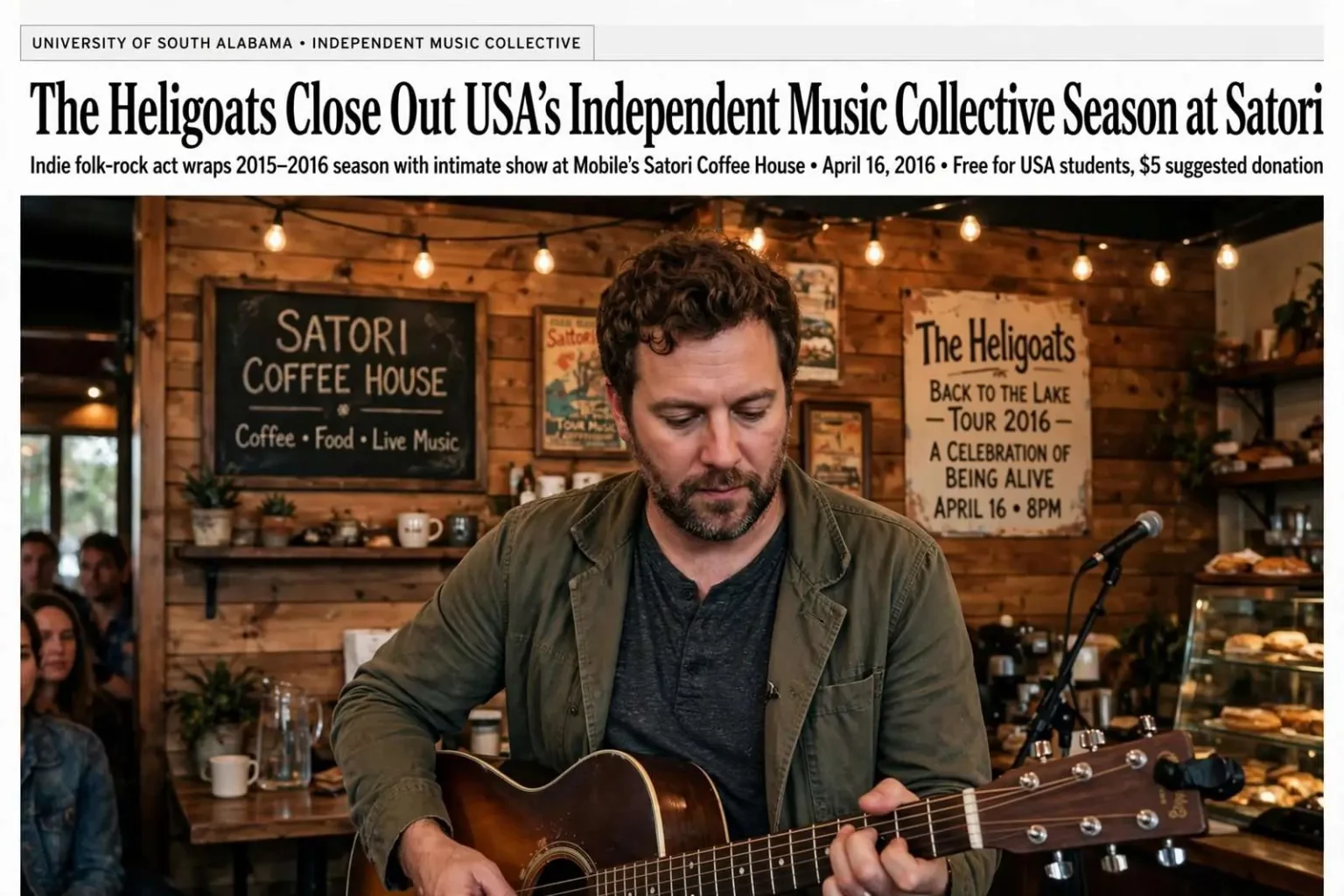
The University of South Alabama’s Independent Music Collective closed its 2015-2016 season with The Heligoats on Saturday, April 16, 2016, at Satori Coffee House. Doors opened at 7:30 p.m. with the show at 8 p.m.; admission was free for USA students and a $5 suggested donation for others. The booking put one of indie folk-rock’s most durable songwriters in one of Mobile’s most distinctive listening rooms, and it capped a season of shows that the student-run collective had spent the year assembling.
The Heligoats were touring behind their new album Back to the Lake, and the show was billed as A Celebration of Being Alive — a title that might sound like hyperbole attached to any concert until you hear frontman Chris Otepka describe what a live show means to him. When asked to do just that, Otepka said it is “an exchange and a celebration that we are even alive and able to do this.” For a songwriter whose material has always balanced urgency against warmth, the framing was characteristic: not a performance to be consumed, but a shared event that everyone in the room is, quite literally, lucky to be present for.
Satori Coffee House offered food, beverages and a great room for the performances, and the venue’s coffeehouse acoustics have long made it a favorite of touring songwriters. The Independent Music Collective brings top independent musicians to Mobile, filling a niche that commercial venues in the city do not always reach: nationally regarded independent artists, intimate rooms, and prices that a student budget can absorb.
The Band Behind the Bill
The Heligoats is the long-running project of singer-songwriter Chris Otepka, a veteran of the American independent scene who has spent years writing and touring at the pace that independent music actually runs on — constant, self-directed and close to the audience. The project’s catalog is known for dense, literate songs: lyrics that reward attention, melodies built for the long haul, and arrangements that can expand to a full band or compress to a single voice and guitar depending on the night. Otepka has fronted the project through numerous releases and countless tours, and Back to the Lake continued the catalog’s blend of intensity and hard-won optimism.
What that career trajectory means in a room like Satori is specificity. A songwriter who has played hundreds of rooms of a hundred people or fewer has a relationship with small audiences that bigger acts lose; the between-song banter responds to the actual room, the songs breathe differently in a quiet coffeehouse than they do in a bar, and the performance becomes a conversation rather than a delivery. The closing slot of a college collective’s season tends to draw exactly the audience that kind of show rewards: listeners who came for the songs, not the scene.
Back to the Lake itself gave returning listeners new material to hear live while bringing newcomers in at the current chapter of the band’s story. Albums on tour are the lifeblood of independent acts — record sales and door donations at shows are what fund the next tour — which makes the suggested-donation format of an IMC show not just a bargain for attendees but the direct economic support that keeps touring artists on the road.
Why Independent Venues Matter
Otepka warned that as music becomes “commercialized, weaponized, streamlined, monopolized,” independent venues and collectives are more vital than ever, offering alternatives and exposure. The warning has aged well. In the years since that April 2016 show, the pressures he named have only intensified: streaming economics that pay artists fractions of a cent per play, consolidation that funnels live music into fewer and larger corporate venues, and algorithms that decide what listeners hear next. Against that current, a coffeehouse hosting a touring songwriter for a five-dollar donation is a genuinely alternative distribution system — one where the money moves directly from audience to artist and where artistic risk is still allowed to exist.
He sees building a scene as “a mutual effort. A collective effort, even. We’re all in this together.” That ethic describes exactly how organizations like the Independent Music Collective operate. Student-run collectives exist because the commercial market will not reliably supply the connection between touring independent artists and the audiences who want them; someone has to do the unglamorous work of booking, promoting and hosting, and the IMC’s volunteers have done it season after season at the University of South Alabama.
The mutual effort goes in every direction. Students get world-class music at prices they can afford; touring artists get a room, an audience and gas money; the venues get traffic and community goodwill; and the city gets a live-music culture that does not depend on national tours routing through the Gulf Coast. Every part of that chain depends on the others, and a season-closing show like The Heligoats’ is the visible product of all of them working at once.
Satori and Mobile’s Listening Rooms
Satori Coffee House holds a particular place in Mobile’s music landscape. Coffeehouses work as venues precisely because they invert the priorities of a bar: conversation quiets for the songs rather than continuing through them, coffee and food replace alcohol sales as the economic engine, and the rooms tend to be built from old houses and storefronts whose warm acoustics flatter an acoustic guitar or a stripped-down band. For touring songwriters, a room where the audience actually listens is rarer and more valuable than a bigger room where nobody does, and Satori’s reputation as a listening room is what makes bookings like The Heligoats’ possible.
The venue’s layout — food, beverages and a great room for performances, as the show’s billing put it — also makes it a natural fit for a college audience. A student can spend an evening there for the cost of a sandwich and a suggested donation, and the early door time means the show ends at a hour that works on a school night. Those practical details matter more to a scene’s health than any amount of promotion: a music community grows out of rooms that are easy to say yes to.
The Independent Music Collective’s Season
The University of South Alabama’s Independent Music Collective has spent years bringing independent artists to Mobile, operating on the simple premise that the city’s students and residents deserve access to touring independent music without a drive to New Orleans or Pensacola. Its seasons typically string together a range of artists — songwriters, punk acts, experimental projects — booked by students who follow the national independent scene closely enough to catch artists on the way up, on the way through, or on reunion tours that commercial venues overlook. The 2015-2016 season’s closing date with The Heligoats followed that pattern: a respected touring act, an intimate room and a price built around access rather than profit.
Student collectives like the IMC also function as training grounds for the people who run them. Booking a show teaches budgeting, promotion, negotiation and the logistics of hosting traveling musicians — skills that the students involved carry into the region’s venues, festivals and record shops after graduation. A significant share of the Gulf Coast’s independent music infrastructure has been built by people who learned the work in exactly these organizations, which makes each season’s slate of shows an investment in the scene’s future as much as its present.
The free admission for USA students reflects the collective’s mission directly. University life is when lifelong music habits form — the bands students see in a coffeehouse at nineteen are the ones they follow for decades — and removing the cost barrier for the campus community is how a collective builds both its audience and its case for support. The $5 suggested donation from non-students covers the practical costs while keeping the event open to the whole city.
An Exchange Worth Showing Up For
Otepka’s description of a live show as “an exchange and a celebration that we are even alive and able to do this” doubles as a mission statement for the whole evening. Live independent music at its best is participatory: the audience’s attention shapes the performance, the donations fund the next tour, and everyone involved acknowledges the precarious, fortunate circumstances that put them in the same room. On Saturday, April 16, 2016, at Satori Coffee House, the exchange went both ways — Mobile got a closing show worthy of its season, and The Heligoats got a room that listened.
For Mobile audiences, the takeaways outlast the date. Support the student collectives that bring national independent talent to town; support the coffeehouses and small venues that give that talent somewhere to play; and when a songwriter who has spent decades on the road describes a show as a celebration of being alive, take the hint and be in the room. The independent music ecosystem that Otepka defended — against commercialization, monopolization and the slow flattening of what we hear — survives one five-dollar donation and one packed coffeehouse at a time. That night at Satori was one of them, and the scene’s future depends on there being more.


