Prichard Breaks Ground on the Davis-McFadden-Davis Veterans Memorial Park Along Wilson Avenue
Officials broke ground Saturday on the Davis-McFadden-Davis Veterans Memorial Park along Wilson Avenue in Prichard, with construction targeted to begin next summer and finish in 2028.
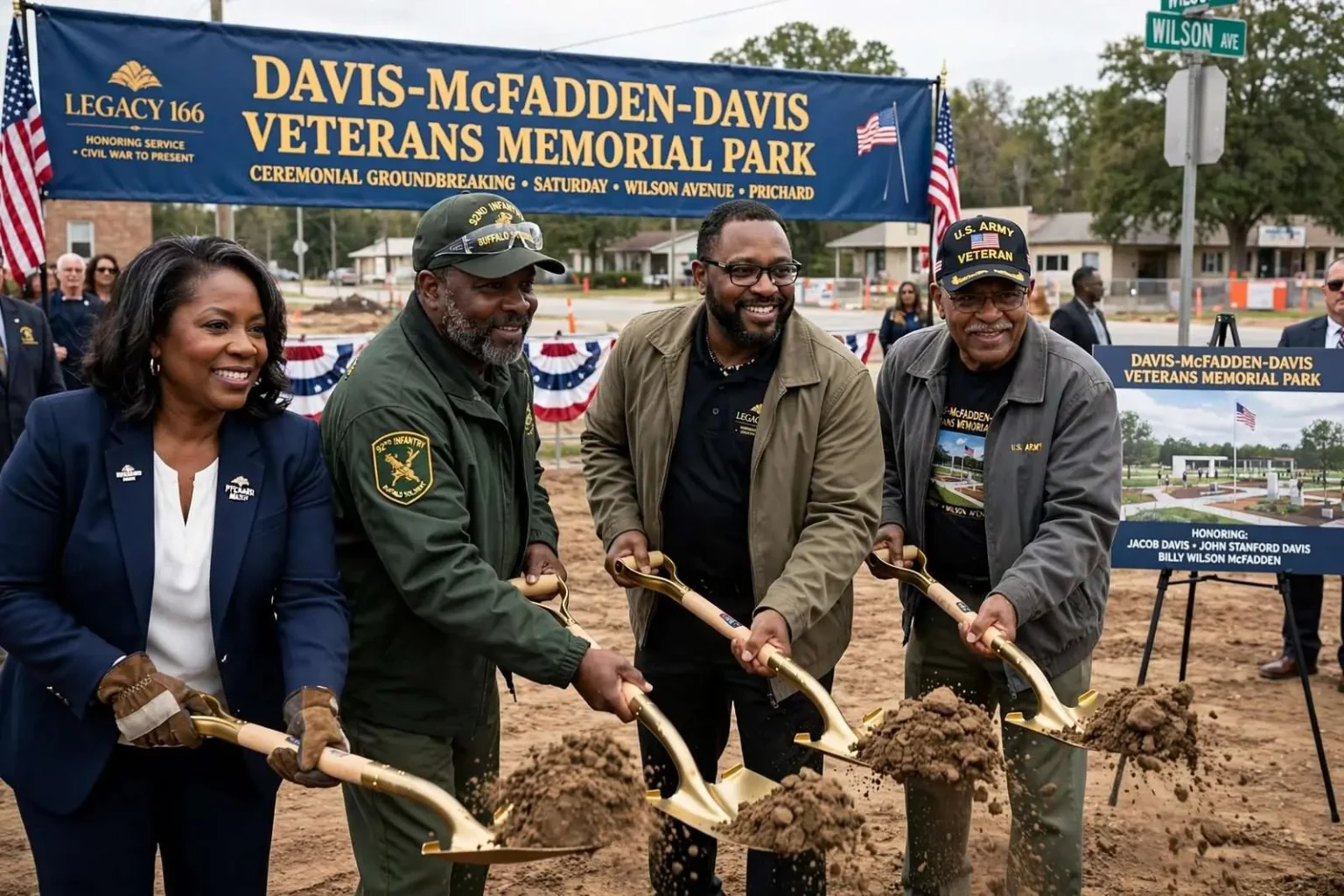
PRICHARD — Clumps of dirt went into the air Saturday morning for the ceremonial groundbreaking of the Davis-McFadden-Davis Veterans Memorial Park, a project organizers hope will do more than honor three Mobile County veterans.
The new park is planned for a site along Wilson Avenue, one of Prichard’s major thoroughfares, and its backers are betting the location does as much work as the memorial itself.
Three Names
The park is named for three Mobile County veterans: Jacob Davis, John Stanford Davis and Billy Wilson McFadden.
Greg Cyprian, executive director of Legacy 166, framed the memorial within a much longer local military history.
“The great thing about Prichard and Mobile is all the way [from] the Civil War to the present, you have men and women who were part of very legendary organizations,” Cyprian said.
That claim is well founded. Mobile County has supplied service members to every American conflict since the nineteenth century, and the region’s Black communities in particular produced generations of veterans whose service is unevenly represented in the area’s public monuments. Naming a park for three specific local men rather than adopting a generic dedication is a deliberate choice to make that history particular.
Location as Strategy
Eddie Irby, executive director of the 92nd Infantry Buffalo Soldiers, was blunt about why the site matters.
“When you do something like this, you want to tell people to go to our park. You don’t have to go around the corner, through the ditch, and over here. Come get off the interstate, and 30 seconds later, you’re right in front of it,” Irby said.
That is an argument about visibility, and it reflects hard experience. Memorials tucked into interior neighborhoods, behind other development or at the end of poorly marked routes tend to be visited by people who already knew they were there. A site 30 seconds off an interstate exit is reachable by people who did not plan the trip.
The reference to the 92nd Infantry is itself significant. The 92nd Infantry Division — the Buffalo Soldiers Division — was a segregated Black unit that served in combat in both World Wars, most notably in the Italian campaign during World War II. Preserving that history has fallen substantially to local organizations rather than to national institutions.
A Corridor With History
Prichard Mayor Carletta Davis placed the project in the context of what Wilson Avenue once was.
“If anybody knows the history of Prichard, this area was the area that everyone in Mobile County came to, and so this is a very significant rebirth of that area,” Davis said.
Prichard was, for much of the twentieth century, a substantial commercial and residential center in its own right rather than a suburb of Mobile. Wilson Avenue was one of its principal corridors, and residents from across the county came to it to shop and do business.
The decades since brought a familiar sequence: population decline, disinvestment, retail migration to newer commercial corridors elsewhere in the county, and a shrinking tax base that made it progressively harder to maintain infrastructure. The city has faced acute fiscal pressure in recent years, including a well-documented water system crisis and, more recently, a corruption investigation that reshaped its police department and left the Mobile County Sheriff’s Office handling patrol duties during a rebuild.
Against that backdrop, a veterans park is a modest intervention. But corridor revitalization tends to begin with anchor projects that give people a reason to stop, and a memorial park is a low-maintenance, high-visibility anchor that does not depend on attracting a commercial tenant.
Legacy 166
Legacy 166 is among the organizations behind the effort. Cyprian’s framing — Civil War to the present — suggests a mission oriented toward continuity rather than a single conflict or era.
Projects like this typically depend on exactly this kind of partnership. A city under fiscal strain rarely has capital budget available for new parkland; nonprofit and veterans organizations bring fundraising capacity, volunteer labor and institutional persistence that can outlast individual political terms. The municipality contributes land, permitting and long-term maintenance commitments.
The Timeline
Organizers aim for construction work to begin next summer, with completion targeted for 2028.
The gap between a ceremonial groundbreaking and the start of actual construction is normal for a project of this type. The interval is typically spent on design development, final fundraising, permitting and site work. A roughly two-year build-out from groundbreaking to completion is a realistic schedule for a memorial park with landscaping, hardscape, monument elements and site infrastructure.
For a corridor that has waited a long time for investment, 2028 is close enough to plan around and far enough away that the intervening work will determine whether the schedule holds.
What It Would Mean
A completed park would give Prichard something it has had few of in recent decades: a new public amenity built specifically for the city, named for its own people, positioned where visitors can find it.
It would also give Mobile County a dedicated space for veterans commemoration outside the city of Mobile — in a community that has sent a great many of its residents into military service and has comparatively little public recognition of it.