Prichard Municipal Court Has Run a Deficit Four Straight Years, State Reports Show
State reports show Prichard Municipal Court has collected less than it costs to operate for four straight fiscal years, a gap of more than $265,000 since 2022.
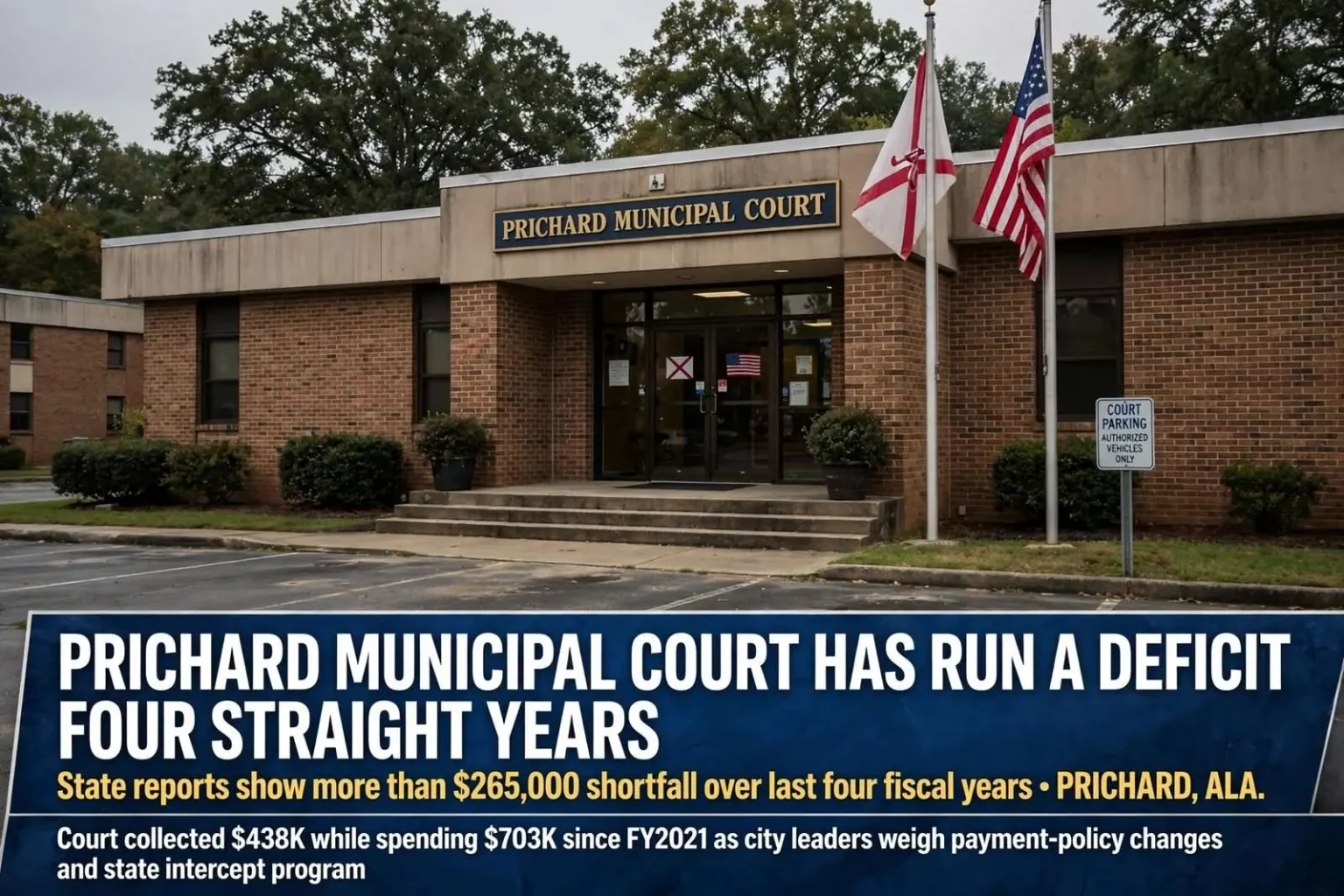
PRICHARD, Ala. — Add the municipal court to Prichard’s list of money problems. New figures filed with the state show the court has cost the city more to operate than it has collected in revenue for each of the last four fiscal years — a gap of more than $265,000 over that stretch.
The numbers came under scrutiny during a recent Public Works and Public Safety committee meeting as city leaders, already confronting a broader budget crunch, search for ways to stretch every dollar. Prichard is one of Mobile County’s larger cities, and small operating shortfalls at agencies like the municipal court add up quickly when the city is already operating on tight margins.
The Numbers
According to annual reports filed with the state, Prichard Municipal Court collected just over $104,000 in revenue during fiscal year 2025 while running on an operating budget of more than $165,000 — a shortfall of about $61,000 in a single year.
Zoom out, and the picture is similar. Over the past four fiscal years, the court collected about $438,000 while reporting more than $703,000 in operating expenses, leaving a cumulative gap of more than $265,000. That shortfall has had to be made up out of the city’s general fund, which is already strained by public-safety costs and routine operating expenses.
The figures come from annual reports that Alabama municipal courts are required to file with the state court system. Auditors compare revenues and expenses across jurisdictions to flag courts whose collection rates appear out of step with their peers, which is how Prichard’s gap came to light in the committee discussion.
Why Collection Is Lagging
Mayor Carletta Davis blames part of the problem on generous payment timelines handed out by the court.
“You know why? Because our judge gives people so much time to pay. They give them a whole year to pay $300. You know, it’s crazy,” Davis said. Long payment windows give defendants time to lose jobs, move out of the area or simply forget about the debt, all of which reduce the odds that any given fine is eventually collected.
She also pointed to a years-deep backlog of unpaid tickets and municipal fees that the city has lacked an effective way to collect. Her solution: route old debts to the Municipal Intercept Service, a state-level program that can intercept money owed to debtors — such as state tax refunds — to satisfy court debts.
“In other words, if you go into the courts office, they have years and years worth of tickets and municipal fees they should be collecting. I’m just now sending them to MIS, we should have been doing that, because the state will intercept that money,” Davis said. Other Alabama cities have used the same program to recover large backlogs of unpaid fines.
The mayor argued that consequences matter, too. “That could help out a great deal because if people would know they could go to jail for not paying the fees, that would help,” she said.
Last in the Region Per Case
The collection figures stand out when compared with other municipal courts in the region. Among the 22 courts in Mobile, Baldwin, Clarke, Washington, Escambia, Monroe and Conecuh counties that reported at least 1,000 cases in fiscal year 2025, Prichard ranked last in revenue collected per case.
Prichard collected about $78 per case — below Semmes at roughly $82 and Bayou La Batre at about $87. Mobile collected about $112 per case, while several Baldwin County courts pulled in several hundred dollars per case. The wide gap reflects differences in fine schedules, payment-plan policies, and how aggressively each court pursues unpaid fines.
The state report also breaks out costs by category, including judge and clerk compensation, prosecutor and indigent-defense contracts, probation and interpreter services, and supplies. Prichard’s per-case expenses are not unusually high relative to its peers — the gap is primarily on the revenue side.
Amnesty Day on the Table
The state reports do not show how much Prichard currently holds in outstanding fines or how many warrants are tied to unpaid cases. But during the committee meeting, one council member floated an amnesty day — a window in which people with unpaid court fines could come forward, settle what they owe and potentially have warrants recalled. Other Alabama cities have used similar one-time events to clear thousands of cases off their dockets at once.
The city has not announced whether it will move forward with that idea. For now, the court’s finances join a growing list of fiscal pressure points in Prichard, where leaders are also wrestling with how to fund police protection and other public-safety services amid a standoff with the Mobile County Sheriff’s Office.
Council members are expected to take up the municipal court numbers again at the next budget hearing, with potential votes on whether to send more old debts to the Municipal Intercept Service, tighten the court’s payment-plan policy, or schedule an amnesty event. Any of those steps could produce a noticeable bump in collections, but none of them will solve the structural gap between what the court costs to run and what it brings in.
What State Court Auditors Typically Recommend
State court auditors reviewing reports like Prichard’s often recommend a mix of changes: tighter payment-plan windows, more aggressive use of collection programs like the Municipal Intercept Service, clearer warrant policies for repeat offenders, and periodic amnesty events to clear old dockets. Prichard’s review is likely to surface many of the same recommendations, with the council deciding which to adopt.
Why Court Revenue Matters More Than It Looks
Municipal court revenue is one of those line items that is easy to overlook in a city budget, but it can add up quickly. In some Alabama cities, fines and fees generate several hundred thousand dollars a year that goes directly into the general fund. For Prichard, closing even part of its $265,000 four-year gap would free up money that could go toward street repairs, code enforcement or other basic services that have been squeezed in recent budgets.
How Other Alabama Cities Have Closed Similar Gaps
Several Alabama cities facing municipal court shortfalls have turned to a mix of measures: tighter payment-plan windows, more aggressive use of the Municipal Intercept Service, amnesty days that bring people in to clear old tickets, and clearer bench policies on warrants. Some have added online payment portals that make it easier for defendants to pay on time, which has reduced the share of cases that go to warrant in the first place. Prichard’s leaders are studying those approaches as they consider their own next steps.
Why Bench Policies Matter
A court’s bench policy — the rules the judge uses to decide who gets a continuance, who gets a payment plan, and when a failure-to-pay becomes a failure-to-appear warrant — has an outsized effect on the bottom line. Courts that issue warrants quickly and that allow defendants only short payment windows tend to collect more, while courts that allow year-long payment plans on small fines tend to collect less. Davis’s comments suggest Prichard leans toward the more lenient end of the spectrum, and any change to that policy would likely have to come from the judge rather than from the council.
What Happens Next With the Backlog
Council members have asked for a specific accounting of how many cases are currently in the court’s backlog, how much is owed in unpaid fines, and how many of those cases are tied to active warrants. That information is expected to come out of the committee meeting in the coming weeks, and it will help shape the discussion about whether to pursue amnesty, send more debts to the Municipal Intercept Service, or change the court’s bench policy. Each of those approaches has trade-offs, and the council will need to weigh them against the city’s other priorities heading into the next budget cycle.
What to Watch in the Coming Weeks
Several Prichard council committees are expected to take up the court’s finances in the coming weeks, with potential votes on whether to send more old debts to the Municipal Intercept Service, change the bench policy, or schedule an amnesty event. The committee meetings are open to the public, and the council has encouraged residents with unpaid fines or warrants to follow the discussion closely. Whatever the council decides, the goal is to bring the court’s revenues closer in line with its expenses, and to reduce the share of cases that end up as long-running unpaid fines.
How the Conversation Could Affect Future Court Budgets
Whatever the council decides about the court’s finances, the conversation is likely to continue into next year’s budget cycle. The court’s expenses — judges, clerks, prosecutors, indigent-defense contractors and interpreter services — are largely fixed, and revenue is the variable. The council’s challenge is to find a combination of policies that brings revenue closer to expenses without imposing fines so punitive that they create additional hardship for low-income defendants. Striking that balance is something courts across Alabama continue to wrestle with, and Prichard’s experience is unlikely to be the last word on the issue.