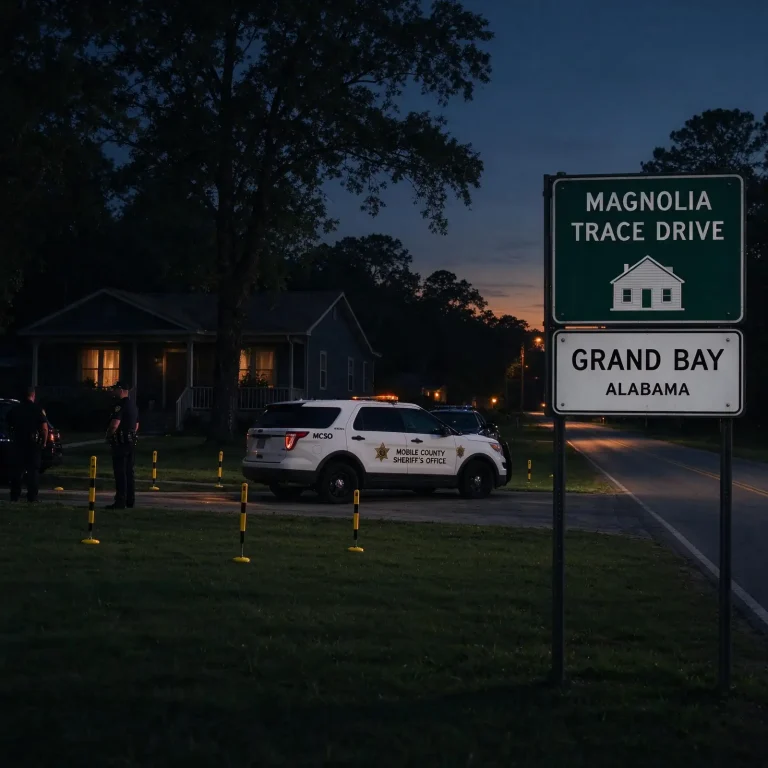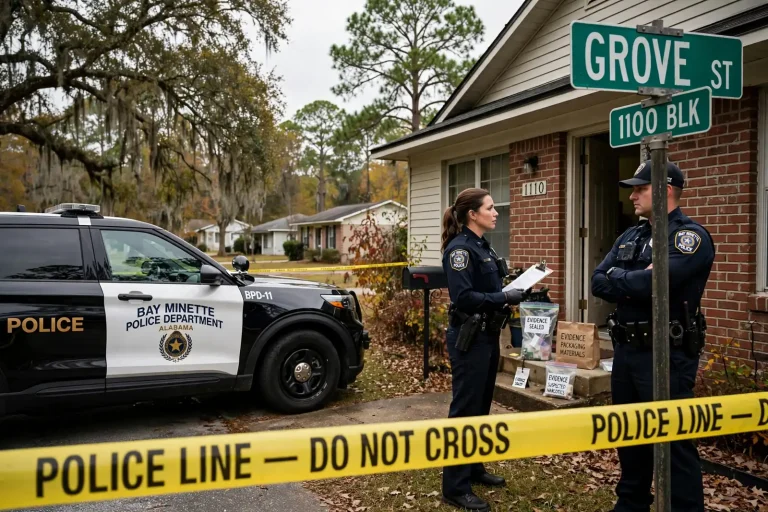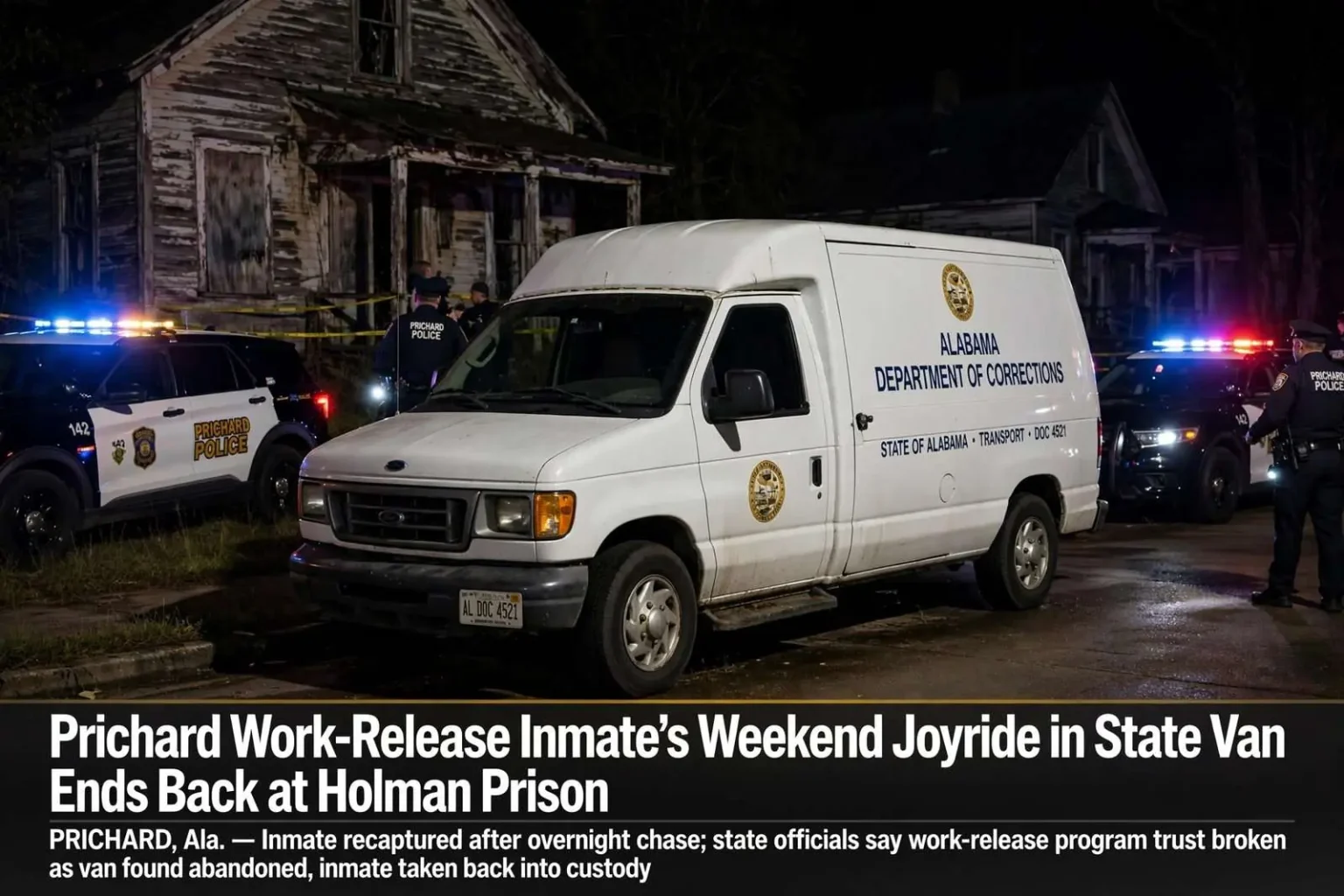
PRICHARD, Ala. — A Prichard work-release inmate is headed back to Holman Correctional Facility in Atmore after taking off over the weekend in a Department of Corrections van, a brief escape that could cost him any chance of an early release. The incident, which began as a routine Friday-night transport and ended with police tracking a runaway state vehicle through the streets of this Mobile County city, unfolded in a matter of hours but may follow the inmate for the remainder of his sentence.
Inmates are typically placed in work-release programs like the one in Prichard once they are nearing the end of their sentence, giving them a supervised path back into everyday life before their release date. The programs hold real value for the state: participants hold jobs, pay toward their obligations and return to the community with a work history, while Alabama’s chronically crowded prison system reclaims a bed. But the arrangement rests on an exchange of trust — the inmate keeps moving within a strict schedule, and the state allows comparatively unsupervised days.
But the man involved in this weekend’s incident may now be looking at additional time behind bars because of the failed escape. Thirty-three-year-old Fernando Finklea had been serving as a work-release inmate in Prichard with a relatively low-security job as a driver. He had already served 14½ years of a 20-year sentence for robbery — more than three-quarters of his term, and precisely the point in a sentence where release is supposed to be coming into view.
Authorities said Finklea took off in a state-owned Department of Corrections van rather than returning as scheduled after dropping off a fellow inmate around 10:45 p.m. Friday. When he failed to come back, corrections officials realized something was wrong around 1:30 a.m. Saturday and went to Prichard Police headquarters to enlist local officers’ help finding him. The gap between the missed return and the alarm gave Finklea a head start of nearly three hours, but it also meant he was moving through a city in the small hours when witnesses, cameras and patrol coverage could work against him.
The stakes of the timing were considerable. A transport window on a Friday night, a driver’s job that carried built-in mobility, and a city whose streets the inmate knew well all combined into an opportunity that prison administrators design their procedures to prevent. What followed over the next three hours — a missed check-in, a quiet alarm and a phone call to Prichard police — would determine whether the escape lasted a night or became a regionwide search.
Tracking the van through Prichard
Prichard Police Chief Jerry Speziale said his department worked closely with the Department of Corrections to track down the missing van. “We knew that there was a location in the area of Hart’s Chicken that this individual might be frequenting. As a result of that, they canvassed the area, they came up with the address,” Speziale said. The chief’s account described a collaboration between state investigators who knew the inmate’s habits and local officers who knew the streets — the kind of joint work that often determines whether a short escape stays short.
Officers eventually located the large white van parked in front of an abandoned house. “They then went and noticed the home next door that had the door cracked. The van was running, the vehicle was parked with nobody in it,” the chief said. The running engine suggested Finklea had arrived only moments before, a detail that sharpened the urgency as officers moved on the neighboring house with the door ajar.
When officers approached the neighboring house, another man answered the door. He told police that Finklea had come by to borrow some money and use his cell phone. Finklea had called for a ride, but it was police, not a friend, who arrived. The account painted a picture of an escape improvised rather than planned — a driver with a state vehicle, a phone call to an acquaintance, and no clear destination beyond the neighborhood he knew.
“I was sitting in here and I opened the door, and when I opened the door they was coming right there like where she is, and they said who driving this van, and I said here he is right here,” the man told officers. Within minutes of the knock, the search was over. Finklea was taken into custody without the manhunt stretching into daylight, and the van was recovered where it sat, still running, in front of the abandoned house next door.
Corrections officials said Finklea will face a disciplinary hearing over the escape. Depending on the outcome, he could receive additional time added to his sentence and end up serving out the remainder of his original robbery conviction rather than finishing his term through work release. Under the state’s disciplinary system, an escape or attempted escape from a work-release assignment ranks among the most serious violations, and the loss of good time and program standing can push a release date back by years — a price far heavier than the crime’s remaining balance alone.
What the incident says about work release
The incident is a reminder of the trust — and risk — built into work-release programs, which rely on inmates nearing release to follow strict schedules with comparatively little direct supervision in exchange for a gradual reintegration into the community. Alabama’s centers house inmates who work at private employers across their host cities during the day and report back in the evening, and the programs have been credited with reducing recidivism for participants who complete them. They have also, over the years, produced incidents like this one — inmates who walk away, fail to return or, in rare cases, take state property with them.
For the host communities, the calculus is complicated. Prichard, a city of roughly 20,000 residents north of Mobile, has hosted the work-release center for years, and local police routinely find themselves assisting when a participant breaks the rules. Chiefs in cities that host such facilities have generally supported the programs for the employment and structure they provide, while pressing the state for quick notification when something goes wrong — a standard the Department of Corrections met in this case by reporting to police headquarters within hours of the missed return.
Work-release centers occupy a distinctive place in Alabama’s corrections landscape. The state has used the centers for decades as a bridge between prison and freedom, placing inmates in jobs with local employers — restaurants, warehouses, trades, driving routes — while deducting room, board and court obligations from their wages. Participants are screened and usually within a few years of release, and the centers depend on that proximity to freedom to keep the population compliant. Every successful participant eases the state’s overcrowding crisis; every walk-off becomes a test of the program’s credibility.
That credibility is fragile in the communities that host the centers. Residents near the facilities follow news of incidents closely, and city councils periodically debate whether the programs bring more benefit than risk. In Prichard, as in other host cities, the answer has generally been to keep the program with tighter expectations — clearer notification protocols, faster cooperation between state and local authorities, and consequences swift enough to deter the next inmate who weighs the odds. The weekend van incident gave both sides of that debate an example to cite.
The quick recovery spared the region a longer search, but the paperwork ahead is more consequential. A disciplinary hearing will sort out the formal finding, and corrections officials indicated Finklea’s work-release status is finished regardless of the outcome. The van’s brief disappearance also prompted the usual internal review — how the keys were controlled, whether transport procedures were followed, and what checks exist to catch a no-show sooner — questions the department revisits after every walk-off from its minimum-custody facilities.
For Finklea, the arithmetic is unforgiving. A man who had served 14½ years of a 20-year robbery sentence, with release within reach and a job assignment that most inmates in the system never get, now faces the possibility of added time on top of what remains. Prosecutors may review the escape for new charges; the disciplinary process will certainly strip whatever good time and program credits he had accumulated. What began as an unscheduled detour in a state van after a Friday-night drop-off will instead be remembered as the decision that extended his time behind bars.
The episode ends, for now, where it began — in Prichard, where a state van sat running in front of an abandoned house until officers closed the door on one inmate’s last free night and returned him to the custody of the state. For the work-release program and the community that hosts it, the case stands as a demonstration of both the risk and the response: trust extended in daylight, tested after midnight, and enforced by police who knew where to look.