Prichard’s 100-Day Plan Update Shows Progress on Public Safety, Infrastructure and Community Engagement
Prichard's latest 100-Day Plan performance update details progress across community engagement, economic development, government operations, infrastructure and public safety.
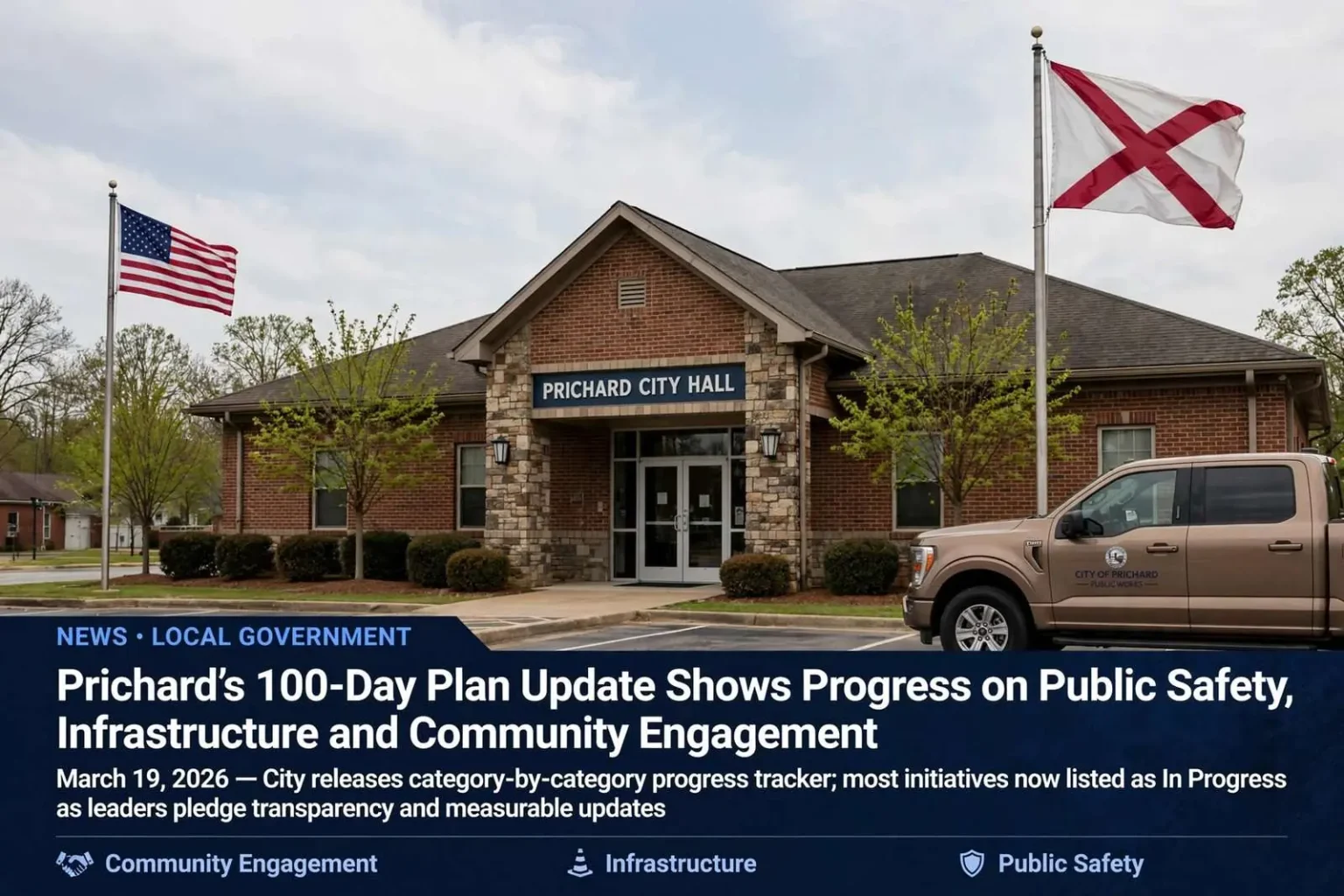
Prichard officials have released the latest round of updates on the city’s 100-Day Plan, offering residents a detailed, category-by-category look at where the administration says it is making progress and where work is still underway across community engagement, the local economy, government operations, infrastructure and public safety. The update is part of an effort to run city government against measurable commitments rather than general promises, publishing a checklist that residents can read, question and hold against the calendar.
The performance tracker uses a four-tier rating system for each initiative: On Track, In Progress, Needs Attention, or Scheduled. According to the latest update, the large majority of tracked items currently fall under In Progress, with a smaller number marked On Track or Scheduled. The distribution itself is telling: “In Progress” is the middle tier, meaning most of the plan’s work is underway but not yet complete, while only a handful of items have reached finished or on-schedule status and none dominate the “Needs Attention” column in this round.
Community Engagement
City leaders say they are working to establish a consistent public format for 100-Day Plan updates, with the most recent version posted March 19, 2026. A fixed cadence matters for a small city whose residents have often learned about city decisions after the fact; publishing updates on a predictable schedule turns the plan from a press release into a running public record.
Officials are also planning a series of “Traveling City Hall” sessions designed to bring city leadership directly into neighborhoods to gather early feedback from residents. The concept moves the meetings out of City Hall and into the community, on the theory that residents who will not travel to a council chamber will turn out in their own neighborhoods. Each session is intended to collect concerns city by city, ward by ward, feeding them into the administration’s priorities.
A volunteer sign-up form has already been added to the city’s website, allowing community members to register for notice of upcoming volunteer opportunities, and an event calendar has likewise been added to improve visibility of city events. Both items are marked as delivered rather than merely planned — small pieces of digital infrastructure, but the kind that make city government easier to follow for residents who rely on the website for information.
A survey or feedback form is also being developed to formally capture resident input gathered during the Traveling City Hall sessions and other community events. Without a structured intake, feedback collected at public meetings tends to vanish into notes; the planned form is intended to turn those conversations into a record the administration can track and respond to.
Economic and Workforce Development
On the economic front, the city says it is actively reaching out to local businesses to understand their needs, tracking each outreach effort to ensure follow-through and accountability. The tracking element distinguishes this round of engagement from typical business visits: rather than informal conversations, the administration says it logs each contact so that promises made to owners can be checked later.
Officials are also reviewing the city’s permit and licensing process with the goal of removing unnecessary delays and confusion for residents and business owners alike. Permitting is one of the most common complaints against small-city governments — long waits, unclear requirements, repeated trips to City Hall — and streamlining it is one of the few economic measures a city can deliver without external funding. A clearer process also improves the city’s image with the small businesses that anchor commercial corridors like Main Street.
Separately, the city is holding ongoing conversations with community and business partners across the region to identify new job and training opportunities, and has begun evaluating major corridors throughout Prichard to identify where redevelopment potential is strongest. Corridor evaluation is the groundwork for longer-term planning: identifying which commercial strips have the vacancy rates, lot sizes and traffic counts that make reinvestment realistic. Prichard’s economic position — a small city inside the Mobile metropolitan area with limited commercial tax base — makes corridor-level strategy one of its few practical levers.
Government Operations
Within the government operations category, the administration continues work on internal processes aimed at making city services more reliable and responsive. Items in this tier typically include personnel matters, records and communication practices, and the routine administrative machinery that residents encounter when they call or visit City Hall. The tracker’s rating shows most of these items moving through the middle tiers as well, with work underway but not yet reported complete.
The value of publishing these internal items is transparency of a specific kind: residents can see that the administration counts routine government performance as part of its plan, not just visible projects. For a city that has faced recurring questions about management capacity, putting internal operations on the same public scoreboard as streets and policing is itself a statement.
Infrastructure
Infrastructure remains the category residents watch most closely, and the update reflects work on the city’s streets, drainage and public facilities. Prichard’s aging infrastructure — decades-old drainage systems, worn pavement and aging public buildings — has been a persistent strain on the city’s budget, and any plan that addresses it faces the same arithmetic: small tax base, large deferred needs. The tracker’s ratings in this category show the administration cataloging and advancing specific projects rather than promising blanket repairs.
Publishing item-level status helps residents know whether a particular street or drainage problem is on the list, where it sits in the queue, and whether it has stalled. That granularity is the point of the four-tier system: a resident can locate their street’s item, see whether it is Scheduled or In Progress, and ask a specific question at the next council meeting or Traveling City Hall session.
Public Safety
In public safety, the update reflects the administration’s ongoing coordination with regional partners while the city works through the structural questions facing its own police services. Public safety in Prichard has been the city’s most closely watched responsibility, and the tracker items in this category cover the day-to-day components — response, prevention, community policing relationships — that operate regardless of the larger institutional questions.
The rating system’s value shows most clearly here: rather than a general assurance that the city takes safety seriously, residents get item-level status on the specific initiatives the administration committed to. If an item sits in “Needs Attention” in a future update, that will be visible to every reader of the tracker, which is precisely the accountability the plan’s format is designed to create.
How the 100-Day Plan Format Works
The 100-Day Plan format borrows a practice from the private sector and higher levels of government: an incoming administration publishes a set of specific commitments, then reports against them on a fixed schedule. The four-tier rating — On Track, In Progress, Needs Attention, Scheduled — gives each item a legible status rather than a narrative claim. Items marked Scheduled have a defined future start; In Progress items are underway; On Track items are proceeding as planned; Needs Attention flags items that have slipped or stalled.
The format’s strength is also its exposure. A city that publishes ratings invites comparison between rounds: items that stay in In Progress for several cycles without advancing will be noticed, and items upgraded to On Track or completed become public record of delivery. For Prichard, a city working to rebuild public confidence, the willingness to grade its own work publicly is as significant as any single item on the list.
What to Watch Next
Several markers will show whether the plan is converting from activity into results. The Traveling City Hall sessions moving from planning to actual neighborhood meetings will be the most visible test of the community engagement items. The survey or feedback form’s launch will show whether public input is being captured systematically. On the economic side, the permit review’s completion — and any published changes to the process — will be the first item residents and business owners can experience directly.
The next scheduled update should also reveal whether items advance between tiers. A plan’s credibility rests on movement: items that climb from Scheduled to In Progress to On Track demonstrate momentum, while items that hold still across successive reports will draw the questions the format is designed to provoke. Published on a consistent schedule, the tracker becomes a running ledger of the administration’s first commitments.
For residents of Prichard, the March 19 update and the ones that follow are the administration’s own accounting — open to reading, questioning and comparison. The city’s leadership has committed to showing its work in public, one category and one rating at a time, and the next rounds will show whether the In Progress items of this round become the completed items of the next.