

Pulitzer Prize-winning historian Jack E. Davis brought an unusually hopeful story to Fairhope in early March 2022, when he introduced his new book, The Bald Eagle: The Improbable Journey of America’s Bird, at Page & Palette. After years of writing about the natural world, Davis told his audience he wanted this book to be a positive one.
“I wanted positive reinforcement,” he said. “Not everything is tragic in our relationship with the natural world.”
Davis, an environmental writer who holds the Rothman Family Chair in the Humanities at the University of Florida, divides his time between Gainesville, Florida, and New Hampshire. He is best known on the Gulf Coast for The Gulf: The Making of an American Sea, which won the 2018 Pulitzer Prize for History and remains a favorite among readers who live along the water.
A Historian With a Soft Spot for the South
Davis’ ties to this part of the country run deep. Work on his dissertation took him to Mississippi, and he fell in love with the region. “There is something about the South,” he said. “A sense of place that you don’t find in the North. It’s a powerful sense of place and literary strength.”
Asked how the area has inspired his work, Davis pointed to its natural environment, noting that the northern Gulf Coast is one of the most biologically diverse places in the United States. That richness is well documented. The Mobile-Tensaw Delta, just north of Mobile Bay, is often called America’s Amazon for its extraordinary variety of plants, fish, reptiles, amphibians and birds, and the coastal wetlands, pine savannas and river systems of Alabama and Northwest Florida support species found almost nowhere else.
The Gulf traces the origins and development of the Gulf of Mexico and weaves in the stories of the communities that grew up along its shores, from fishing villages to resort towns. Readers who loved that book found a familiar approach in The Bald Eagle, which blends natural history, politics and culture to explain how Americans’ relationship with one animal changed over more than two centuries.
The Eagle and the Great Seal
Davis opened his talk with a history lesson. Within hours of declaring independence from Britain on July 4, 1776, the Continental Congress formed a committee to design a Great Seal for the new nation, an emblem needed for signing treaties and other official documents. The process dragged on for six years. In 1782, Congress finally adopted a seal with the bald eagle on its face.
Yet for most of American history, the bird on the seal was not officially the national bird. At the time of Davis’ 2022 talk, the United States had never formally designated one. That changed in December 2024, when federal legislation officially named the bald eagle the national bird of the United States, capping a campaign that had built for years.
From Nuisance to National Treasure
For all its symbolic glory, Davis explained, the bald eagle has been relatively unstudied and was not popular during the first half of the nation’s existence. Many Americans considered eagles a nuisance, and the birds were hunted extensively. Twice pushed toward the brink of extinction, the species got its first moment of redemption in 1940 with passage of the Bald Eagle Protection Act.
A new threat soon followed. Around 1945, the pesticide DDT came into widespread use to kill disease-carrying insects. It had the unintended consequence of devastating fish-eating birds such as brown pelicans, ospreys and bald eagles. DDT accumulated in waterways and in the fish the birds ate, and it caused eggshells to thin so badly that many broke before hatching. The pesticide was banned for most uses in the United States in 1972, a turning point for the species.
Many people who grew up in the Southern states in the mid-20th century rarely, if ever, saw a bald eagle in the wild. Florida remained a stronghold, and restoration programs later relocated young eaglets, including birds from Florida nests, to other states, where they were raised and released to establish new populations. The approach worked remarkably well.
The white-headed raptor’s comeback exceeded all expectations. The bald eagle was removed from the federal list of endangered and threatened species in 2007, though it remains protected under federal law. A 2021 estimate by the U.S. Fish and Wildlife Service found that the population in the lower 48 states had roughly quadrupled since 2009.
A Symbol of the Conservation Movement
The eagle’s recovery is closely tied to the rise of the modern environmental movement. Rachel Carson’s 1962 book Silent Spring drew national attention to the damage pesticides such as DDT were doing to birds and other wildlife, and the public debate that followed helped lead to the federal ban a decade later. The bald eagle, already protected by the 1940 law, became one of the most visible faces of that fight.
The Endangered Species Act of 1973 added another layer of protection, and the bald eagle was listed as endangered across most of the lower 48 states. Recovery efforts combined habitat protection, nest monitoring, enforcement against shooting and poisoning, and captive rearing and release programs. Biologists often used a technique known as hacking, in which young birds are raised in artificial nesting towers with minimal human contact and released once they are ready to fly, so they imprint on their new surroundings and return there to breed as adults.
Because the bald eagle is both a national emblem and a success story, conservationists frequently point to it as proof that coordinated protection can reverse steep declines. That message fit Davis’ goal of writing a book that celebrates what people have done right, rather than cataloging only what has gone wrong.
The bird’s story also shows how public attitudes can change. The same species once shot as a pest by farmers and ranchers is now celebrated on currency, in sports logos and in countless community festivals. For Davis, that transformation, from nuisance to beloved national symbol, is part of what makes the bald eagle’s journey so improbable.
Fascinating Facts About Bald Eagles
Davis shared a number of details about the bird’s life history that surprised many in the audience:
- Bald eagles are found only in North America.
- They typically mate for life and return year after year to the same territory, often adding material to the same nest.
- Because nests are reused and enlarged over time, some can last 30 to 40 years, provided they survive storms and the trees holding them remain standing. Old nests can grow to enormous size and weigh hundreds of pounds or more.
- Most pairs lay two eggs a year, and eaglets leave the nest roughly 8 to 14 weeks after hatching.
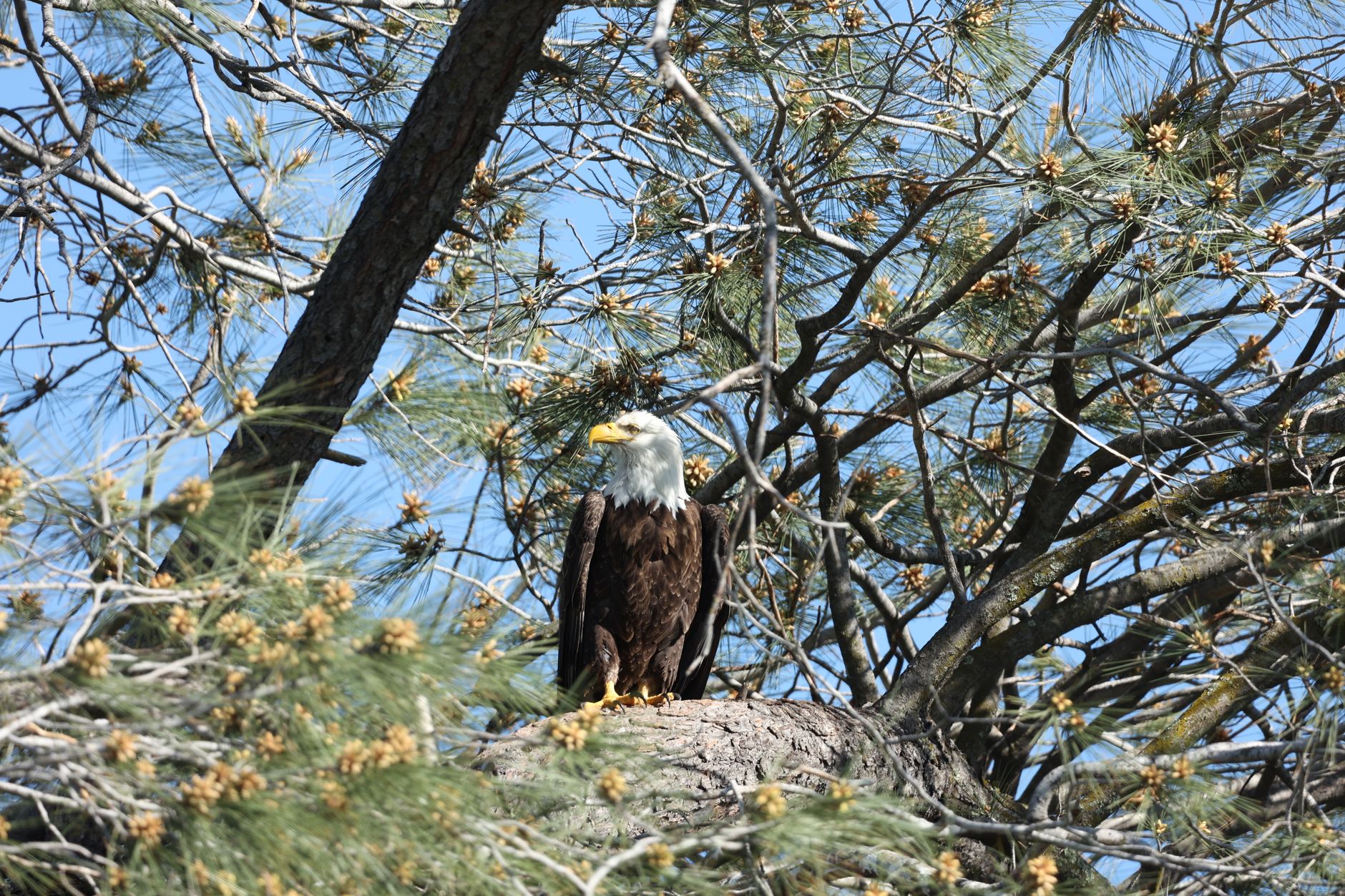
- It takes about five years for a bald eagle to reach maturity and develop its full white head, the “bald” crown that gives the species its name. Young eagles are mottled brown and are often mistaken for other raptors.
- Wildlife rehabilitation centers that care for injured raptors now operate across the country.
Eagles Return to the Gulf Coast
Davis’ optimism is easy to share along the Alabama coast, where bald eagles have become a far more common sight than they were a generation ago. Residents are increasingly seeing eagles living and raising young around Mobile Bay and the Eastern Shore, as well as along rivers, lakes and the Mobile-Tensaw Delta.
In the Southeast, bald eagles generally nest during the cooler months, with courtship and nest building in the fall and eggs laid in winter. By late spring and early summer, once the young have fledged, many of the region’s eagles drift north for the hot season before returning. That timing means winter and early spring are often the best times for local birdwatchers to spot eagles near their nests.
For those hoping to see one, a few general guidelines help:
- Look near large bodies of water with tall trees, especially pines and cypress, where eagles perch and nest.
- Bring binoculars or a spotting scope, and watch for the bird’s massive size, white head and tail, and flat-winged soaring posture.
- Keep your distance. Bald eagles remain protected by federal law, and disturbing a nest is prohibited. Federal guidelines recommend giving nests a wide buffer.
- Check with local Audubon chapters, wildlife refuges and state conservation agencies for guided outings and reported sightings.
Author Events and Music at Page & Palette
Davis’ visit was part of a long tradition of author events at Page & Palette, the family-owned independent bookstore on Section Street in downtown Fairhope. The store regularly hosts book signings, readings and talks with nationally known and regional writers, making it one of the literary hubs of the Eastern Shore.
Below the bookstore, the Book Cellar offers a cozy spot for coffee, drinks and live music throughout the week, giving visitors another reason to linger downtown. Readers interested in upcoming author appearances can check with Page & Palette for current dates and times.
For a writer who spent years documenting environmental loss along the Gulf, The Bald Eagle offered something different: evidence that people can change course. The sight of an eagle soaring over Mobile Bay is proof enough that, as Davis put it, not everything in our relationship with nature is tragic.