Push Underway to Open Downtown Mobile Transit and Amtrak Terminal
Work is underway to finish and open a downtown Mobile transit and Amtrak terminal.
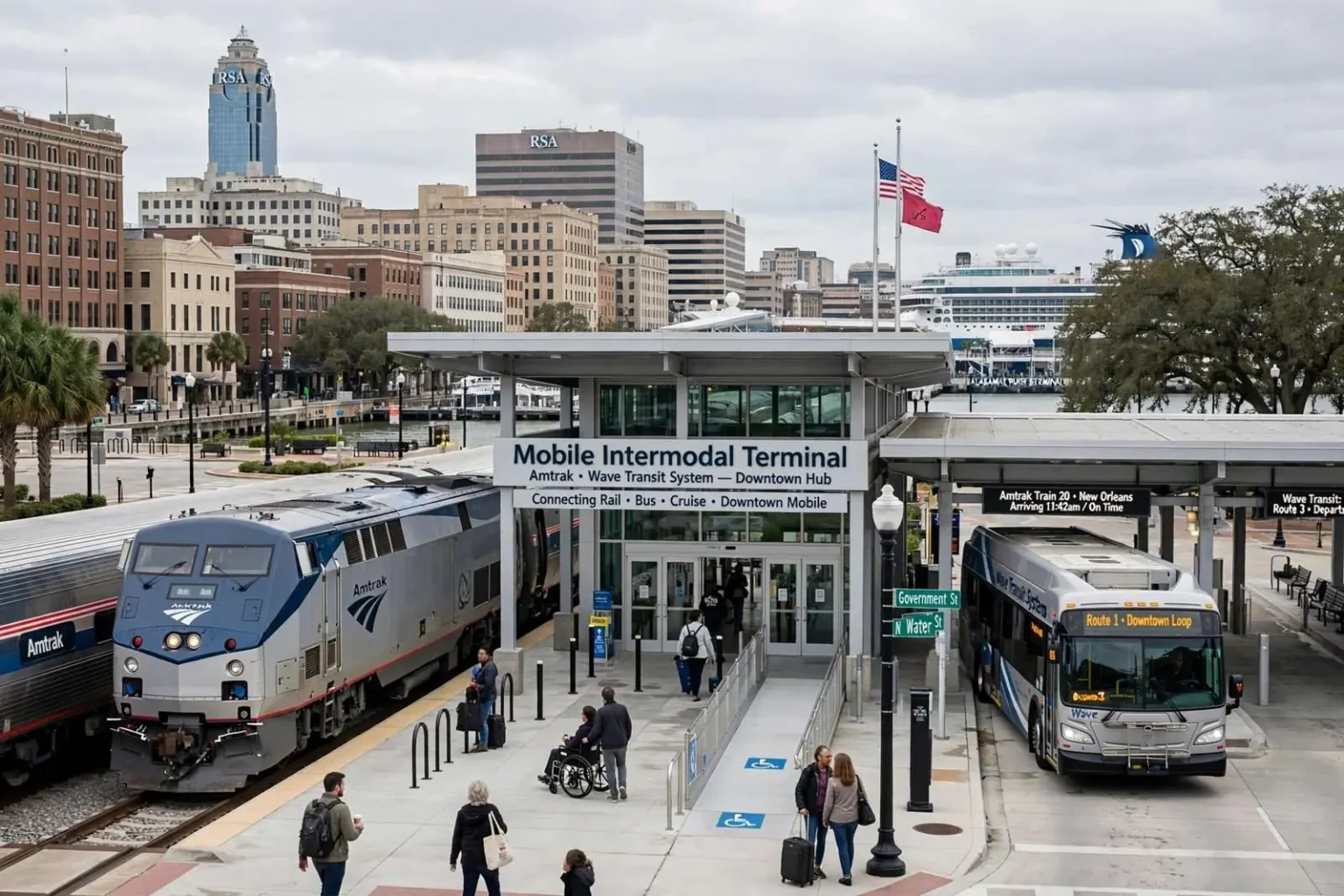
Efforts are underway to complete and open a downtown Mobile transit and Amtrak terminal, a project that would give the Port City a single hub where intercity passenger rail and local bus service meet. The push brings together long-running threads of Gulf Coast transportation planning: the restoration of passenger rail service to Mobile, the modernization of the city’s local bus network, and the revitalization of downtown as a place where people live, work, and visit without relying entirely on a car. For residents and visitors alike, a working intermodal terminal in the heart of downtown would change how the city connects to the rest of the Gulf Coast.
Mobile has been without regularly scheduled Amtrak service for years, ever since passenger rail operations that once passed through the city were suspended in the aftermath of Hurricane Katrina. The storm devastated rail infrastructure along the Gulf, and while freight traffic recovered, passenger service east of New Orleans never returned. In the years since, restoring service along the Gulf Coast corridor between New Orleans and Mobile has become one of the region’s most persistent transportation goals, championed by passenger rail advocates, local governments, and the regional rail commission that represents the Gulf states in Washington.
The proposed downtown terminal is central to that vision. A station in the core of the city, within walking distance of hotels, restaurants, offices, and attractions, gives passenger rail a far better chance of success than a station on the outskirts. Transit planners across the country have learned that station location can make or break ridership, and Mobile’s leaders have consistently pointed to a downtown location as the right one. The terminal would let an arriving passenger step off a train and reach the convention center, the cruise terminal, or the historic districts without needing a car or a lengthy transfer.
Why a Downtown Hub Matters
The local side of the equation is just as important as the intercity one. Mobile’s public bus system, operated by the Wave Transit System, uses a downtown transfer point as the center of its route network, as most systems of its size do. Concentrating routes at a central hub allows riders to connect between neighborhoods, and placing that hub alongside the Amtrak platform means a single facility serves both. A rider could arrive by train from the west and continue to a job, an appointment, or a neighborhood across the city on a local bus, all from one location.
Downtown Mobile provides a natural anchor for such a facility. The area around Government Street and the waterfront holds the city’s tallest office buildings, government offices, museums, theaters, and the convention center, along with a growing number of restaurants and entertainment venues. The Alabama Cruise Terminal, from which cruise ships sail to the western Caribbean and beyond, sits on the river downtown, and thousands of passengers pass through it each year. A rail and bus terminal nearby would give cruise passengers another way to reach the port and would give downtown workers another commuting option.
Transportation connectivity has become a competitive issue for cities of Mobile’s size. Employers considering the area weigh whether their workforce can get around, and young professionals increasingly look for places where a car is not the only option. Convention planners and tour operators similarly favor destinations with visible, usable transit. A completed intermodal terminal would not solve every mobility challenge in a city built largely around automobiles, but it would give Mobile a piece of infrastructure that peer cities along the Gulf Coast have lacked since the mid-2000s.
The Long Road Back for Gulf Coast Rail
Restoring passenger rail to Mobile has been a stop-and-start affair shaped by forces far beyond the city limits. Passenger service along the Gulf Coast dates back more than a century, when trains connected Mobile to New Orleans, Biloxi, and points beyond, and the route remained a working passenger corridor into the early 2000s. Hurricane Katrina changed that. The storm damaged tracks, bridges, and signaling along the coast, and the passenger trains that once ran through the region were rerouted or discontinued. In the years that followed, the freight railroads that own the tracks focused on rebuilding freight capacity, and passenger service became a question of money, infrastructure, and negotiated access.
The effort to bring trains back has involved Congress, the states, and the railroads in a long negotiation over who pays for track upgrades, stations, and operations. Gulf Coast lawmakers have repeatedly pointed to the corridor’s potential, citing the population centers it would link and the tourism economies along the Mississippi Sound. The Southern Rail Commission, a federally created body representing Louisiana, Mississippi, and Alabama, has made restoration of the New Orleans to Mobile route one of its signature priorities, and its advocacy has kept the project in front of federal planners and funders through multiple administrations.
For Mobile, the stakes are straightforward. A restored corridor would reconnect the city to New Orleans by rail for the first time since before Katrina, giving residents an alternative to the drive along Interstate 10 and linking the city’s downtown to a chain of Gulf Coast destinations. Business and civic leaders have argued that the service would support tourism in both directions, bringing visitors to Mobile’s historic districts and festivals while letting Mobile residents reach the casinos, beaches, and cultural attractions of the Mississippi coast without fighting tunnel and bridge traffic.
What the Terminal Would Mean for Riders
The practical benefits of a completed downtown terminal reach every category of rider. Commuters who live along transit corridors could use the hub to connect between local routes, shortening trips that now require circuitous transfers. Older residents and riders with disabilities, for whom driving is not always an option, would gain a more reliable way to reach medical appointments, government offices, and employment centers downtown. Visitors arriving for cruises, conventions, or festivals would find a clearer path from train or bus to hotel and waterfront.
Students are another important group. Mobile is home to the University of South Alabama, Spring Hill College, and Bishop State Community College, and thousands of students move around the city each week without cars. A downtown hub that ties local routes together, and that someday connects to intercity rail, gives those students a practical transportation network. Similarly, workers in the city’s service and tourism economy, many of whom already depend on the bus system, would benefit from any improvement in the frequency and reliability of connections at the central transfer point.
The terminal also carries symbolic weight for a city whose identity was built on transportation. Mobile grew as a port, a railroad town, and a crossroads of the Gulf South, and its historic rail lines helped make it the economic center of the region. Restoring passenger rail service to a downtown terminal reaches back to that heritage while serving a modern purpose. Civic leaders have often framed the project as both practical infrastructure and a statement about the kind of city Mobile intends to be: one that invests in connections rather than letting them lapse.
Completing a project of this kind involves more than construction. An intermodal terminal must coordinate schedules between two operators, one local and one national, so that bus connections actually align with train arrivals and departures. It must provide accessible platforms, waiting areas, ticketing, and security, and it must be designed so that a facility serving hundreds of riders a day can function in the middle of a downtown street grid. Funding typically comes together from multiple sources, including federal transit and passenger rail programs, state contributions, and local investment, and each piece carries its own requirements and timelines.
The track itself is another part of the work. Passenger service on a corridor owned by a freight railroad requires agreements governing access, scheduling, and the condition of the line. Corridors that have carried only freight for two decades may need signal upgrades, track improvements, and station infrastructure before passenger equipment can run safely and on time. Those improvements are precisely the kind of capital projects that federal passenger rail programs were created to support, and Gulf Coast officials have pursued that funding for the New Orleans to Mobile route for years.
Supporters of the project point to comparable successes elsewhere as evidence of what Mobile could expect. Along the west coast of Florida, the restoration of passenger service between Miami and Orlando has shown that a revived corridor can attract riders in car-oriented regions when stations are placed in downtown centers. Closer to home, the Crescent, the Crescent Star corridors, and other long-distance routes that pass through Alabama demonstrate the demand that exists for rail travel in the Southeast. Each restored service began as a planning effort like the one Mobile is engaged in, and each depended on a viable station in a central location.
Regional Context Along the Gulf
The corridor Mobile would anchor is a chain of Gulf Coast cities with deep transportation ties. New Orleans, Slidell, Bay St. Louis, Gulfport, Biloxi, Pascagoula, and Mobile stretch along roughly 130 miles of coastline, and their residents already travel the route constantly for work, medical care, gambling, beaches, and family visits. Driving that distance means navigating the I-10 corridor, with its bridge and tunnel bottlenecks and its vulnerability to storms and accidents. A rail alternative along the same path would serve a travel market that already exists, which is why planners have consistently identified the corridor as one of the strongest candidates for new intercity service in the country.
The Mississippi coast communities along the route have made their own investments in station facilities, keeping alive the physical infrastructure that passenger service would need. Those preparations reflect a regional understanding that the corridor functions as a single market, and that service will succeed or fail based on the strength of the entire chain rather than any single city. Mobile, as the eastern terminus, is a critical link. Without a working station in downtown Mobile, the route ends short of the population and economic base that Alabama’s third-largest city provides, weakening the case for the whole corridor.
State and local leaders in Alabama have increasingly joined the effort. City officials in Mobile have expressed support for completing the terminal as part of broader downtown investment, and the city’s delegation in Montgomery and Washington has pushed for Alabama’s share of the project. The state’s participation matters because federal programs generally expect state and local partners to share costs and because the terminal itself, unlike the tracks, is primarily a local responsibility. Progress on the downtown facility signals to federal partners that Alabama is prepared to do its part.
Connecting the Terminal to Downtown Life
The location of the terminal within downtown determines how much of the city it can serve on foot. A site within the core business district puts riders within walking distance of major employers, the convention center, museums, and the waterfront parks along the Mobile River. The city’s historic districts, with their antebellum architecture and their restaurants and galleries, are nearby as well. Every block of additional walkable distance between the station and these destinations expands the practical value of the terminal for visitors and residents who arrive without cars.