Ralph Lauren Partners With Gee’s Bend Quilters on Limited-Edition Collection
Ralph Lauren has partnered with quilters from Gee's Bend, Alabama, on a limited-edition apparel and home goods collection inspired by the community's generations-old quilting traditions.
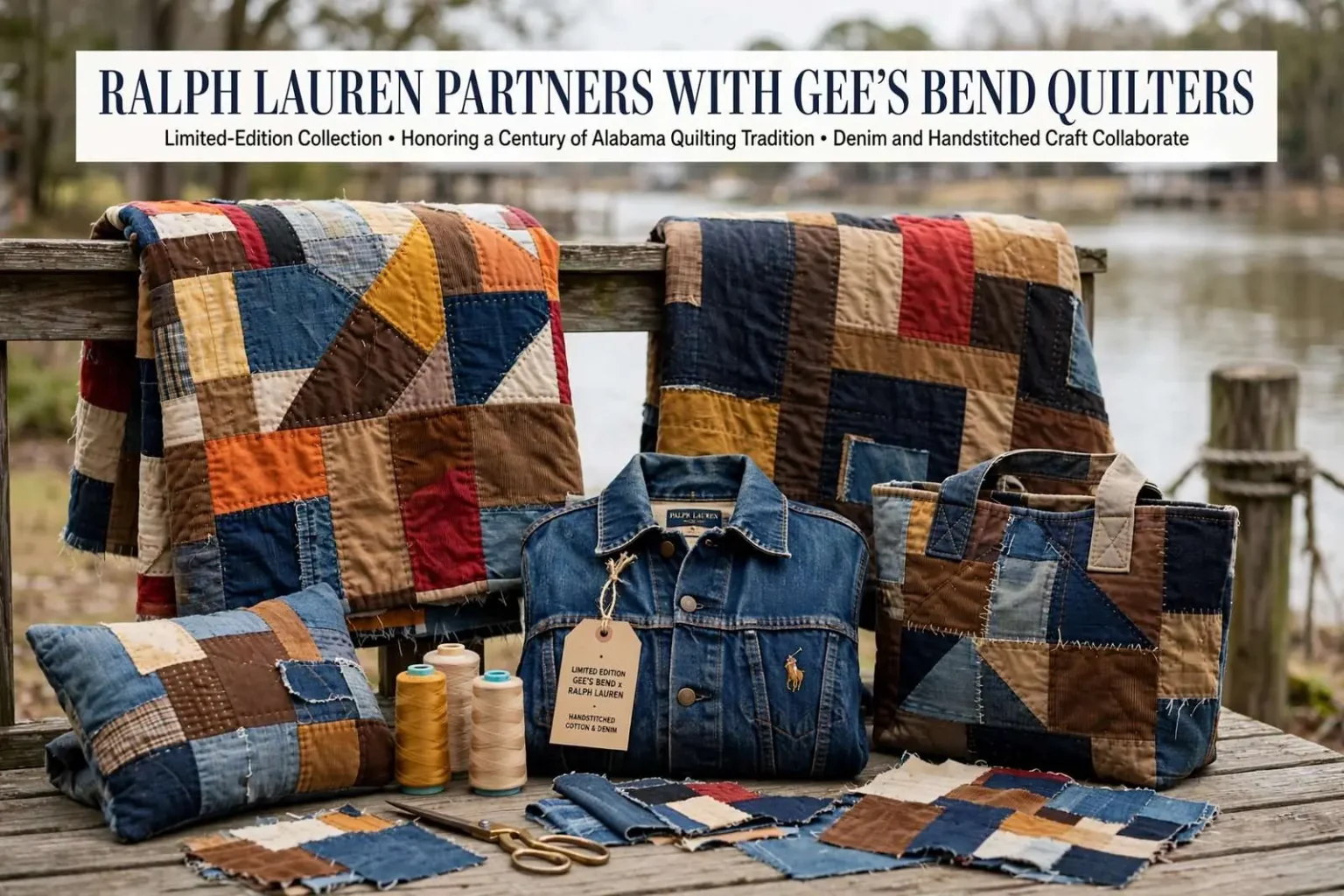
Fashion house Ralph Lauren has announced a collaboration with the renowned quilters of Gee’s Bend, translating the community’s century-old textile traditions into a limited-edition collection of contemporary apparel and home goods. The partnership pairs one of the most recognizable names in American fashion with one of the most celebrated quilting communities in the United States, a small Alabama river town whose handmade quilts have traveled from front porches and church halls to museum walls across the country.
The collection features the work of two quilters whose family lines run deep in the community: fourth-generation textile artist Claudia Pettway Charley and fifth-generation artist Loretta Pettway Bennett. Both women carry forward patterns and techniques handed down through their families, and their contributions anchor a collection built on the visual language of Gee’s Bend quilting, where bold color combinations and improvisational geometry have defined the craft for generations.
Denim serves as a central element of the collection, bridging Ralph Lauren’s aesthetic with Gee’s Bend’s long tradition of using durable workwear fabrics. The connection is more than thematic. Many of the community’s most famous quilts were stitched from worn jeans, work shirts, and corduroy, materials that carried the marks of daily labor and gave each quilt a texture and history of its own. Putting denim at the center of a modern fashion line is, in that sense, a return to the original spirit of the craft.
The announcement drew attention well beyond the fashion press. Gee’s Bend occupies a singular place in American art, and collaborations that bring its quilters’ work to new audiences carry weight in both the design world and the communities of south Alabama that have long claimed the Bend as a cultural treasure. For Wilcox County, the collection represents a rare moment when international fashion attention turns toward one of its smallest communities.
A Style Built on Improvisation
The designs reflect the bold, improvisational style characteristic of Gee’s Bend quiltmaking, featuring freeform lines, visible topstitching and geometric patterns. Rather than working from printed templates, Gee’s Bend quilters have traditionally composed as they sewed, arranging fabric pieces by eye and instinct until the pattern resolved itself. The approach produces quilts that share a family resemblance while never duplicating one another, and it is precisely that unpredictability that has made the work so compelling to collectors and curators.
Visible stitching, uneven spacing, and irregular blocks, which might read as flaws in a more formal tradition, are embraced in Gee’s Bend as evidence of the maker’s hand. The quilts are often compared to abstract paintings for their confidence of composition, yet they emerged not from art schools but from practical need: the necessity of keeping families warm through Alabama winters with whatever fabric was on hand.
That history of necessity shapes the collaboration’s materials as well. Durable workwear fabrics like denim, corduroy, and cotton twill were the raw materials of the community’s earliest quilts, salvaged from clothing that had outlived its first purpose. Ralph Lauren’s use of denim in the collection echoes that resourcefulness, translating a tradition born of thrift into fabrics chosen for their association with American work and wear.
An Isolated Bend in the River
Gee’s Bend, officially known as Boykin, is an isolated rural community in Wilcox County, situated along a bend in the Alabama River roughly 50 minutes from Clarke County. The river does more than give the community its name; for generations it has defined the Bend’s relative isolation, shaping who came and went and how the community’s traditions survived intact. That separation from larger towns helped the quilting practice develop on its own terms, passed from mother to daughter without much outside influence.
Home to about 300 residents, the community sits roughly 20 minutes from Alberta along Alabama Highway 5 and about 30 minutes from Camden, the Wilcox County seat. A local ferry carries residents and visitors across the river for a fee, restoring a connection to the wider world that generations of Bend families once relied upon. The ferry crossing has become part of the visitor experience, a reminder that geography once made Gee’s Bend one of the more remote corners of the Black Belt region.
The community’s setting in Alabama’s Black Belt, a band of counties named for the rich dark soil that made them the agricultural heart of the old South, matters to the story. The same soil that drew planters to the region generations ago left behind communities that remained largely agricultural, close-knit, and self-reliant. Gee’s Bend’s quilting tradition grew out of that world, and the collaboration with a global fashion house highlights how far the community’s art has traveled from its river-bend origins.
Despite its small size, the community is internationally known for a quilting tradition rooted in history, storytelling and cultural preservation passed down through generations. Quilts in the Bend have long served purposes beyond warmth: they recorded family memories, marked milestones, and preserved pieces of clothing belonging to loved ones. Every quilt is, in a sense, a family archive assembled from fabric.
From Feed Sacks to Fine Art
While the origins of quiltmaking are ancient, the craft took its distinctive form in Gee’s Bend in the early 1900s, when local women gathered in homes to piece together found materials, old clothes, feed sacks and fabric scraps during hard economic times. Nothing usable was discarded. Flour sacks were dyed and cut, overalls were deconstructed for their strongest panels, and dresses worn thin at the cuffs found new life as quilt tops. The practice turned scarcity into artistry, and the constraints of available material became the tradition’s signature look.
Inspired by both African traditions and Southern heritage, the quilters developed a visual vocabulary unlike anything else in American craft. Textile historians have traced parallels between the Bend’s improvisational style and textile traditions of West Africa, filtered through generations of Southern life. The resulting quilts defy the tidy geometry of textbook American patchwork, favoring asymmetry, scale shifts, and rhythmic patterns that feel closer to music than to arithmetic.
For decades the work stayed close to home, made for beds and family rather than markets. That changed as the wider art world discovered what the Bend’s women had been doing all along. Exhibitions brought the quilts to major museums, and the quilters themselves traveled with their work, becoming ambassadors for a community that few Americans could place on a map but few art lovers could forget once they had seen the quilts.
Community organization helped carry the tradition forward. In the 1980s, quilters moved from small home gatherings to organized community meetings aimed at mentoring younger generations, ensuring that techniques and family patterns would not fade as older makers passed on. The structure gave the practice continuity, turning an inherited household skill into a deliberate, taught tradition.
The community held its first official quilting show in 1983, drawing visitors from across the country. The show marked a turning point of sorts, establishing that the Bend’s quilts could draw an audience on their own merit and giving the quilters a public platform for work that had previously been seen mostly by family and neighbors.
What It Means for the Region
The Ralph Lauren collection arrives in a region where the economy is diversified across sectors including aerospace, shipbuilding, healthcare, tourism, agriculture, and port-related commerce. The Port of Mobile is among the largest in the nation by tonnage and supports a wide range of logistics and industrial activity, while major employers include military installations, hospitals, universities, and manufacturing facilities. Economic development organizations at the city and county level work to attract investment and retain jobs, and state incentive programs frequently play a role in site-selection decisions.
Against that industrial backdrop, the cultural economy of places like Gee’s Bend plays a different but meaningful role. Heritage tourism, craft sales, and high-profile collaborations bring income and attention to rural communities that the region’s larger employers often overlook. When a global brand puts Gee’s Bend designs on apparel sold nationwide, the ripple effects reach Wilcox County in the form of recognition for the quilters and renewed interest in the community’s history.
For the quilters themselves, collaborations of this kind continue a long arc: from sewing rooms along the Alabama River, to community shows in the 1980s, to museum exhibitions, and now to the racks of an American fashion institution. Each step has widened the audience for work rooted in one of the state’s smallest communities, while the tradition itself remains in the hands of the families who built it.
The limited-edition nature of the collection underscores the point. These are not mass-produced prints of quilt patterns but pieces built around the work and legacy of named artists from the Bend, including Claudia Pettway Charley and Loretta Pettway Bennett. For a community of about 300 residents, seeing its art presented at that scale is both a milestone and a reminder of how distinctive the Gee’s Bend tradition remains.
For south Alabama, the collaboration is a showcase of homegrown artistry on an international stage. The quilts of Gee’s Bend were made for warmth, assembled from whatever the household could spare, and created by women whose names were rarely recorded in the early decades. That they now share billing with one of the most famous names in American fashion says as much about the enduring power of the craft as it does about the quilters who kept it alive through five generations.