Rare Gulf Sturgeon Found in Mobile Bay Becomes Hands-On Science Lesson for Clark-Shaw Students
A Clark-Shaw teacher's discovery of an endangered Gulf sturgeon on Mobile Bay led to a dissection lesson with USM researchers.
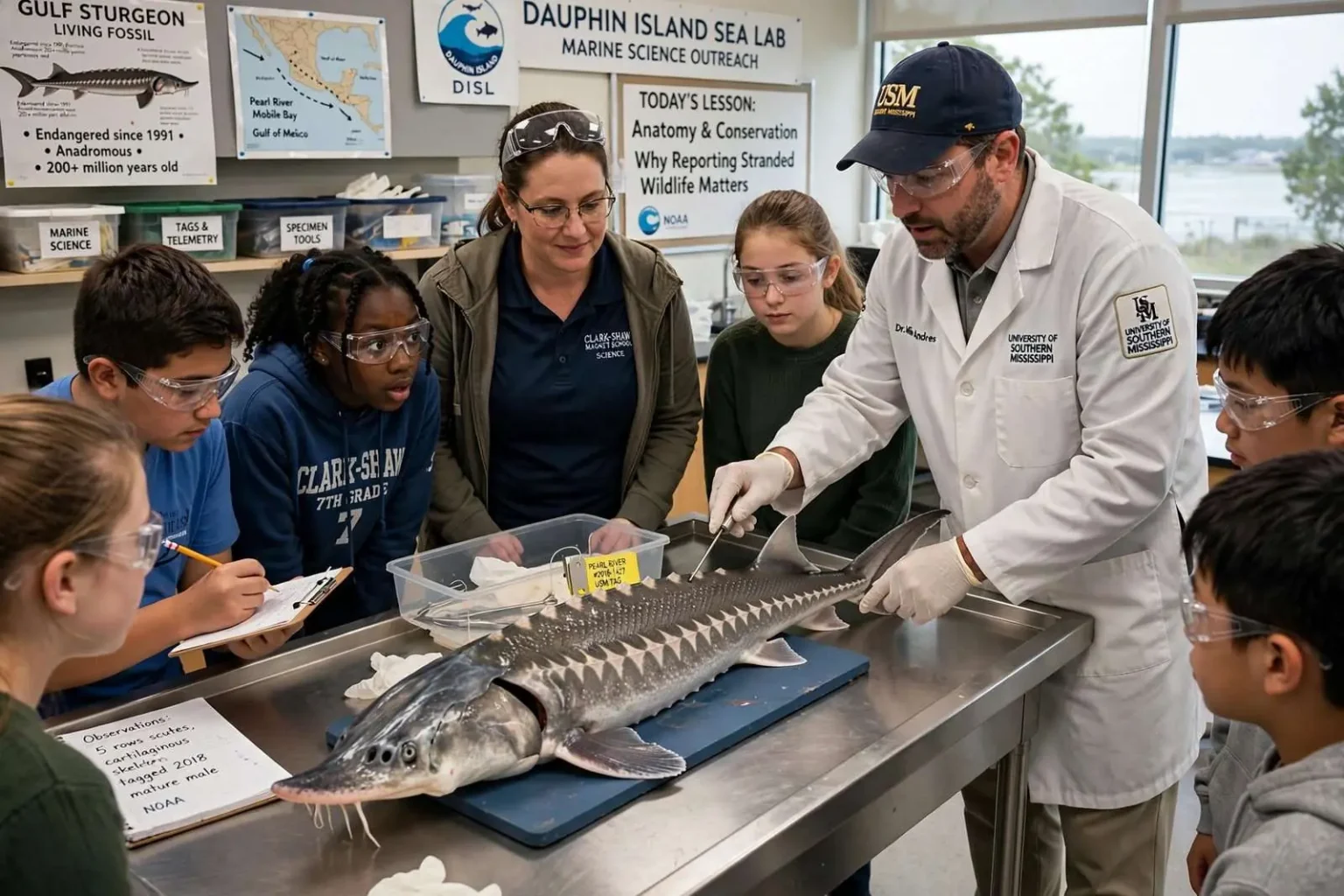
A dead fish on the shores of Mobile Bay has turned into a full-circle science lesson for middle schoolers in Mobile. Tami May, a science teacher at Clark-Shaw Magnet School, stumbled on the unusual carcass while out fishing earlier this month and reported it to NOAA, setting off a chain of events that ended with a rare Gulf sturgeon on a dissection table in front of her students.
At first glance she mistook it for an alligator gar because of its distinctive mouth — until a friend identified it as something far rarer: a Gulf sturgeon. The mistake is an understandable one. Both fish share a prehistoric profile, but the sturgeon’s rows of bony plates, vacuum-hose mouth, and long snout mark it as something that has no business turning up on an Alabama bayshore — and yet there it was.
A 200-million-year-old species with a story
The Gulf sturgeon is a living fossil that has existed for more than 200 million years. In 1991 it became one of the first Gulf of Mexico species placed on the endangered species list, largely because overfishing for their eggs — caviar — devastated populations. The fish that once supported a caviar industry in Gulf Coast rivers was reduced to a remnant of its historic range, which stretched across the rivers emptying into the northern Gulf, from the Florida panhandle to Louisiana.
Dr. Mike Andres, a research professor at the University of Southern Mississippi, visited Clark-Shaw to speak with students and dissect the fish. Internal tags revealed the adult male had originally been captured in the Pearl River back in 2018, allowing researchers to trace where it had traveled and how much it had grown since.
“It was great because I mean a science teacher found a dead sturgeon, reported it and we were able to track everything through together and bring it full circle while also providing class experience for a lot of folks,” Andres said.
That six-year-old tag turned a beachcombing curiosity into a genuine data point. Gulf sturgeon spend most of their lives in the rivers where they spawn, then migrate into the Gulf and its bays to feed during the cooler months before returning upstream. A fish tagged in the Pearl River turning up on the shores of Mobile Bay told researchers something concrete about how far these animals roam once they leave their home river — the kind of movement data that is difficult and expensive to collect and that usually depends on chance encounters exactly like this one.
The sturgeon’s appearance in Mobile Bay is unusual enough that biologists paid attention. The species is most closely associated with the Suwannee, Choctawhatchee, Yellow, Escambia, and Pearl river systems, and the eastern Sound region of the Gulf. A specimen on the Alabama side of Mobile Bay suggests either that the animal ranged farther west than researchers expected or that it had strayed during its feeding migration — either way, a detail worth recording in a species whose recovery is tracked closely by federal agencies.
Bringing real science into the classroom
May also invited the Dauphin Island Sea Lab to take part, giving students a look at how working marine scientists actually do their jobs. The Sea Lab, located on the eastern end of Dauphin Island, is Alabama’s marine science research and education center, and its staff regularly leads classroom outreach across the coastal counties. For the Clark-Shaw students, the visit offered a glimpse of a career path that many had likely never considered — researchers who spend their days tagging fish, reading telemetry data, and piecing together the lives of animals like the one on the table in front of them.
Seventh graders who watched the dissection came away impressed — one marveled at how the sturgeon migrates along the Gulf Coast, another at anatomy surprisingly similar to humans. The dissection gave the class a hands-on anatomy lesson no textbook could match: the sturgeon’s cartilaginous skeleton, its rows of armored scutes, and its underslung mouth are features shared with fish lineages far older than anything else the students had ever examined up close.
May said she hopes the experience pushes students to get outside and explore, because you never know what you’ll find. It is a lesson with a serious underside, too — an endangered species washing ashore is a reminder that the health of Mobile Bay and the rivers that feed it shapes what lives in and around the water. Clark-Shaw, a magnet school with a science and mathematics focus, is exactly the kind of setting where a single day’s discovery can steer a student toward years of study.
Why the Gulf sturgeon nearly disappeared
The sturgeon’s endangered listing in 1991 capped decades of decline. Demand for caviar made sturgeon eggs among the most valuable in the world, and commercial fishing pressed the Gulf sturgeon hard through the late nineteenth and twentieth centuries. Habitat loss compounded the damage: dams and navigation projects on the rivers where sturgeon spawn blocked access to the gravel stretches the species needs to reproduce, degrading the very habitat any recovering population would depend on.
Recovery efforts have moved slowly since the listing. Gulf sturgeon mature late and reproduce infrequently — females may go several years between spawning runs — so populations rebuild over decades, not seasons. Federal recovery plans emphasize protecting spawning habitat in the rivers, managing fishing restrictions, and studying movement patterns with tagging programs of exactly the kind that produced the Pearl River data behind the Clark-Shaw specimen. Each recaptured or recovered tagged fish adds a thread to a picture that researchers are still assembling about where these animals go and how far their populations have come.
The Pearl River, where this male was first captured in 2018, flows through Mississippi and Louisiana and empties into Lake Borgne near the eastern New Orleans area. It holds one of the Gulf sturgeon’s better-studied populations, and researchers working there have tagged hundreds of fish over the years to follow their seasonal shuttling between freshwater spawning grounds and Gulf feeding areas. A 2018 tag still pinging relevant data six years later is a small victory for the program’s longevity — and a demonstration of why researchers will drive hours to dissect one dead fish found by a science teacher in Mobile.
A teachable moment that started on the water
May’s find also illustrated the unusual role everyday residents play in coastal research. Federal and university scientists cannot patrol every mile of Alabama’s shoreline, and discoveries like a stranded sturgeon depend on people who know enough to recognize something unusual and report it through the right channels — in this case NOAA, the federal agency responsible for endangered marine species. A timely report preserved the specimen, the tags, and the teaching opportunity that followed.
For the students at Clark-Shaw, the sequence was the point: a teacher went fishing, noticed something strange, made a call, and within weeks a rare prehistoric fish was on a dissection table with working scientists explaining what it could tell them. That is the scientific method as it actually operates — opportunistic, collaborative, and dependent on careful observation by ordinary people.
The students’ reactions captured the range of what the fish offered. Migration stories connect to geography and oceanography lessons; anatomical comparisons connect to biology; and the endangered-species framework connects to law and environmental policy. A single carcass, handled well, becomes a semester’s worth of material.
Andres’s “full circle” framing suited the occasion. A fish tagged in the Pearl River in 2018, recovered on the Mobile Bay shoreline by a Clark-Shaw science teacher, and dissected before her seventh graders with help from the Dauphin Island Sea Lab turned one more mortality into data, education, and — if May gets her wish — perhaps a few future marine scientists who will be the ones answering the phone the next time somebody finds something remarkable on the shore.
Gulf sturgeon are anadromous, meaning they live the double life of fish that spawn in freshwater and feed in the sea — the same pattern followed by salmon, though without the die-off at the end. Adults typically enter the rivers in spring as water warms, hold over gravel bars through the summer spawning period while fasting for months, and then move back into the Gulf and its bays in fall to feed through the winter. A fish found on the Mobile Bay shoreline in the season it was discovered fits the pattern of a feeding-season wanderer away from its home river system.
The species’ anatomy tells its ancient story in every feature the students saw. Sturgeon are covered not in scales but in bony plates called scutes, giving them an armored appearance; their skeletons are mostly cartilage; and their spiracles, sensory whiskers called barbels, and extendable mouth place them among the most primitive bony fish alive. Adults can reach eight feet in length and weigh well over 200 pounds, though this specimen’s measurements will now live in the research record rather than a fisherman’s tale.
A reminder of what reporting discoveries accomplishes
Marine biologists along the northern Gulf Coast routinely ask the public to report stranded or unusual sea life — dead sea turtles to the state’s sea turtle stranding network, dolphins and whales to the marine mammal stranding network, and unusual fish to NOAA or university researchers. Each report feeds databases that scientists use to track the health of Gulf ecosystems, and each depends on someone with enough curiosity to make a phone call instead of walking past.
May’s report did more than log a data point. It created a collaboration between a middle school classroom, a university research lab, and Alabama’s marine science education center — the kind of partnership that educators say is hardest to arrange and most valuable when it happens organically rather than by design.
Clark-Shaw Magnet School draws students from across Mobile County into its science- and mathematics-focused program, and its teachers regularly look for ways to connect coursework to the Gulf environment that surrounds the city. Few opportunities will match a 200-million-year-old endangered species with a Pearl River tag inside it, dissected on campus by the researchers who study the species for a living.
May said she hopes the experience pushes students to get outside and explore, because you never know what you’ll find. Judging by the seventh graders’ reactions — wonder at the migration, surprise at the familiar anatomy — the lesson landed. The Gulf sturgeon that ended its life on a Mobile Bay shore may have done more for its species in death, as an ambassador to a gymnasium full of potential scientists, than most fish manage in a century of anonymous swimming.