
Red maples and live oaks now line part of McGregor Avenue in Mobile
The Village of Spring Hill has planted red maples and live oaks along South McGregor Avenue and Bit and Spur Road as part of its fall tree-planting effort.
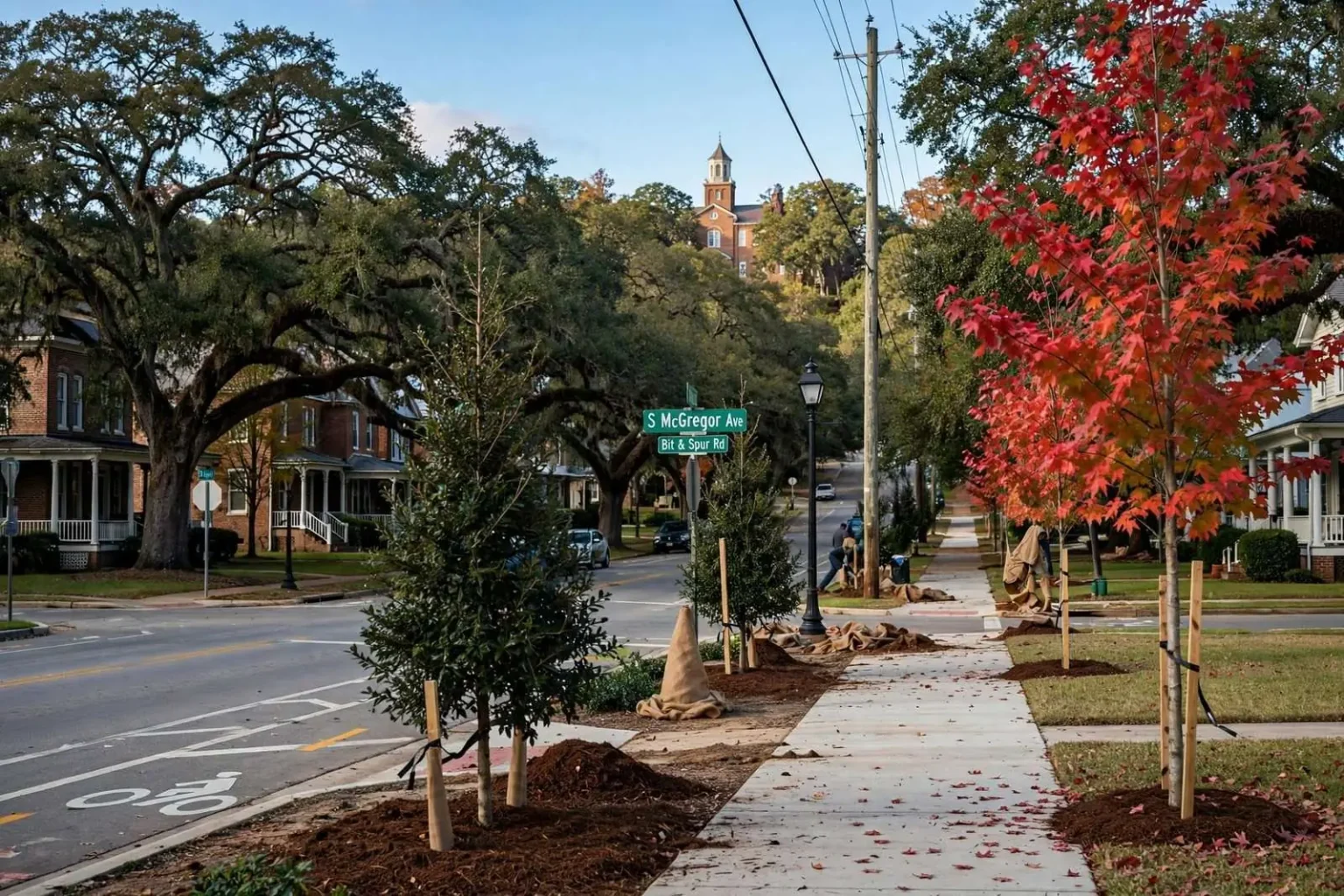
MOBILE, Ala. — Red maples and live oaks now line part of McGregor Avenue, the result of a planting effort by the Village of Spring Hill. The organization has planted Native Red Maple trees and live oaks along the newly completed sidewalks on South McGregor Avenue and Bit and Spur Road. According to a post on the organization’s Facebook page, the nonprofit is working to improve the “tree canopy” of the Village by planting trees each fall.
The planting ties together two projects that shape how the neighborhood looks and functions: the new sidewalks that now run along South McGregor Avenue and Bit and Spur Road, and the trees set alongside them. Sidewalks and street trees are companion pieces in neighborhood design — the walkway gives pedestrians a place to be, and the canopy gives them shade, a buffer from traffic, and the streetscape character that has defined Spring Hill since the era when the area was a separate village serving Mobile’s western edge.
The Village of Spring Hill
Spring Hill is one of Mobile’s oldest and most identifiable neighborhoods, perched on the high ground west of downtown where the city’s earliest residents built summer homes to escape the fever season down on the bayou. Spring Hill College, founded there in 1830, gave the area its institutional anchor and made it a landmark of the city’s history — the college is the oldest college in Alabama and among the oldest Catholic institutions in the South. Over the twentieth century, Mobile grew out to meet and absorb the village, and today Spring Hill is a leafy residential district within the city, known for the college, its established neighborhoods, and a commercial core along its main corridors.
The Village of Spring Hill — the organization behind the planting — is a nonprofit devoted to that district’s identity and improvement, and its Facebook announcement of the new trees carries the group’s longer-term ambition in one phrase: improving the tree canopy of the Village. Canopy work is slow, patient stewardship. Trees planted this fall will take years to deliver the shade that makes a sidewalk usable in July, and the organization’s stated plan to plant each fall builds the canopy incrementally, street by street, in a way that residents will see accumulate over decades.
The choice of species reflects both local conditions and local identity. Live oaks are the signature tree of the Gulf Coast — the broad-crowned, evergreen oaks that arch over Mobile’s oldest streets and give the city its postcard canopy — and they are famously long-lived, growing for generations once established. Native red maples bring a different contribution: faster growth, strong fall color unusual in a region dominated by evergreens, and tolerance for the wet soils that south Alabama’s climate delivers. Together they give the new sidewalks both immediate structure and a long-term shade canopy.
Why street trees matter
The case for urban tree canopy has grown well beyond aesthetics, and neighborhoods like Spring Hill illustrate the practical side. Street trees shade pavement, which measurably cools the sidewalk and roadway beneath them — a real benefit in a city where summer pavement temperatures make walking uncomfortable and where shade can reduce the heat a pedestrian experiences by a meaningful margin. Trees also intercept rainfall, and in Mobile’s climate, where annual rainfall is among the highest of any city in the country, canopy that slows stormwater runoff is part of how older neighborhoods manage the drainage burdens that heavy Gulf storms deliver.
The traffic benefits are equally concrete. Streets lined with mature trees tend to see slower, more careful driving — drivers respond to the visual narrowing that a canopy creates — which is one reason pedestrian-oriented design standards treat street trees as a safety feature rather than a decoration. Along the newly completed sidewalks on South McGregor Avenue and Bit and Spur Road, the trees and the walkway together create a corridor where walking becomes both safer and more pleasant, connecting the neighborhood’s homes, schools, and shops on foot.
There is also the long-term environmental ledger. Canopy trees absorb carbon dioxide, filter air pollution, reduce the urban heat island effect, and provide habitat for the birds and pollinators that inhabit the city’s older neighborhoods. Municipalities across the Gulf Coast have adopted urban forestry programs in recent decades precisely because the accumulated benefits are substantial, and Mobile’s own tree-protection ordinances reflect how much value residents place on the mature oaks that predate most of the city’s development. The Village of Spring Hill’s fall plantings work in the same direction, adding to the canopy at the neighborhood scale.
Planting each fall
The organization’s stated rhythm — planting trees each fall — follows the standard wisdom of Gulf Coast horticulture. Fall is the planting season in south Alabama because trees set out in autumn spend the cooler months growing roots rather than supporting leaves, then face their first summer with established root systems that help them survive the heat and the dry stretches of early summer. Fall planting, combined with watering through the first seasons, gives a young tree its best chance of reaching the size at which it delivers real shade.
Species selection at the neighborhood scale is also a lesson in resilience. Canopies built from a single species are vulnerable to the pests and diseases that sweep through — the losses that devastated American elms and, in south Alabama, have threatened various oaks and pines over the years. A mix of live oaks and native red maples, with the potential for other native species in future plantings, distributes that risk while suiting the soils and climate of the Spring Hill ridges. Native species, in particular, support the local ecosystem of insects and birds that evolved with them.
The new trees along South McGregor Avenue and Bit and Spur Road will take years to match the great oaks that shade the older streets nearby, but every mature canopy in Mobile began exactly this way — with trees set out by people who would see them small. The Village of Spring Hill’s Facebook post describes the work plainly: improving the tree canopy of the Village, one fall planting at a time, along sidewalks built for the residents who walk them.
The sidewalks that came first
The trees follow infrastructure, and the completed sidewalks along South McGregor Avenue and Bit and Spur Road represent years of work by the organization and its supporters. Sidewalk projects in older Mobile neighborhoods involve coordination with the city on rights-of-way, drainage, and construction, along with the fundraising and planning that nonprofit-led improvements require. The finished walkways along those streets give the Spring Hill district what its commercial core and dense residential blocks need: a continuous, safe pedestrian route along corridors that carry steady vehicle traffic.
McGregor Avenue is one of the main streets of the Spring Hill area, running north-south through the district and connecting its neighborhoods to the commercial nodes along Old Shell Road and Airport Boulevard. Bit and Spur Road threads through the heart of the Village, past the shops and businesses that give the district its walkable center. Sidewalks along these two corridors change daily patterns — students walking to school and to Spring Hill College, residents walking to dinner or to shop, and the general traffic of a neighborhood where people have always walked but where modern street design had, for decades, favored the automobile.
The pairing of sidewalks and trees is deliberate streetscape practice. Walkways without shade go unused in Mobile’s climate for half the year, and trees without walkways serve mainly the people in passing cars. Designed together, they create the conditions where walking is a real alternative for short trips, which is the stated aim of most neighborhood-scale improvement efforts in the city’s older districts. The Village of Spring Hill’s project brings both elements to the same corridor at the same time.
Nonprofits and neighborhood stewardship
The Village of Spring Hill’s approach — announce the work on its Facebook page, plant in the fall, build year over year — is characteristic of the neighborhood organizations that maintain Alabama’s older districts. These nonprofits operate on memberships, donations, and volunteer labor; they coordinate with city departments on the infrastructure that belongs to the public right-of-way; and they take on the long-horizon work that municipal budgets rarely fund on their own. Tree plantings, streetscape improvements, and beautification projects are their most visible products, and the canopy they build becomes their most lasting one.
The organization’s use of Facebook to report the plantings reflects how neighborhood groups now communicate. A post with photographs of the new maples and live oaks reaches the residents most affected, documents the work for donors, and invites volunteers for the next planting — all in one update. For a nonprofit working a defined geographic district, that direct line to the neighborhood is the difference between projects residents support and projects residents merely notice.
Annual plantings also create the cadence that canopy work requires. A single planting is a gesture; plantings every fall, on corridors where sidewalks have just been completed, build a system. The young red maples along South McGregor Avenue will grow quickly — that is the species’ virtue — and will deliver visible shade within years rather than decades, while the slower, longer-lived live oaks mature into the arching canopy that defines Mobile’s most beloved streets. Residents who walk the new sidewalks each season will watch that progression happen overhead.
A canopy for the next generation
Every tree planted along South McGregor Avenue and Bit and Spur Road this fall is a commitment measured in decades. The live oaks now standing at young, slender sizes will be the shade trees of a generation of Spring Hill residents who are not yet walking those sidewalks, and the red maples will color the neighborhood’s autumns in hues that Gulf Coast streets rarely show. That long horizon is precisely why canopy work attracts the nonprofits, garden clubs, and civic groups that invest in it — the beneficiaries of the work are, mostly, people other than the ones doing it.
Mobile’s identity as a city of trees owes everything to that pattern repeating across its history: streets designed with oaks, institutions that planted and protected them, and neighborhoods that treated the canopy as shared inheritance. The Village of Spring Hill’s fall plantings along the newly completed sidewalks on South McGregor Avenue and Bit and Spur Road continue that inheritance — native red maples and live oaks, planted each fall, improving the tree canopy of the Village one season at a time.


