Reid Cummings Launches District 6 Council Bid With Business Community Behind Him
Commercial real estate executive Reid Cummings kicked off his Mobile City Council District 6 campaign with a show of support from business colleagues and a notable guest: former Mayor Mike Dow.
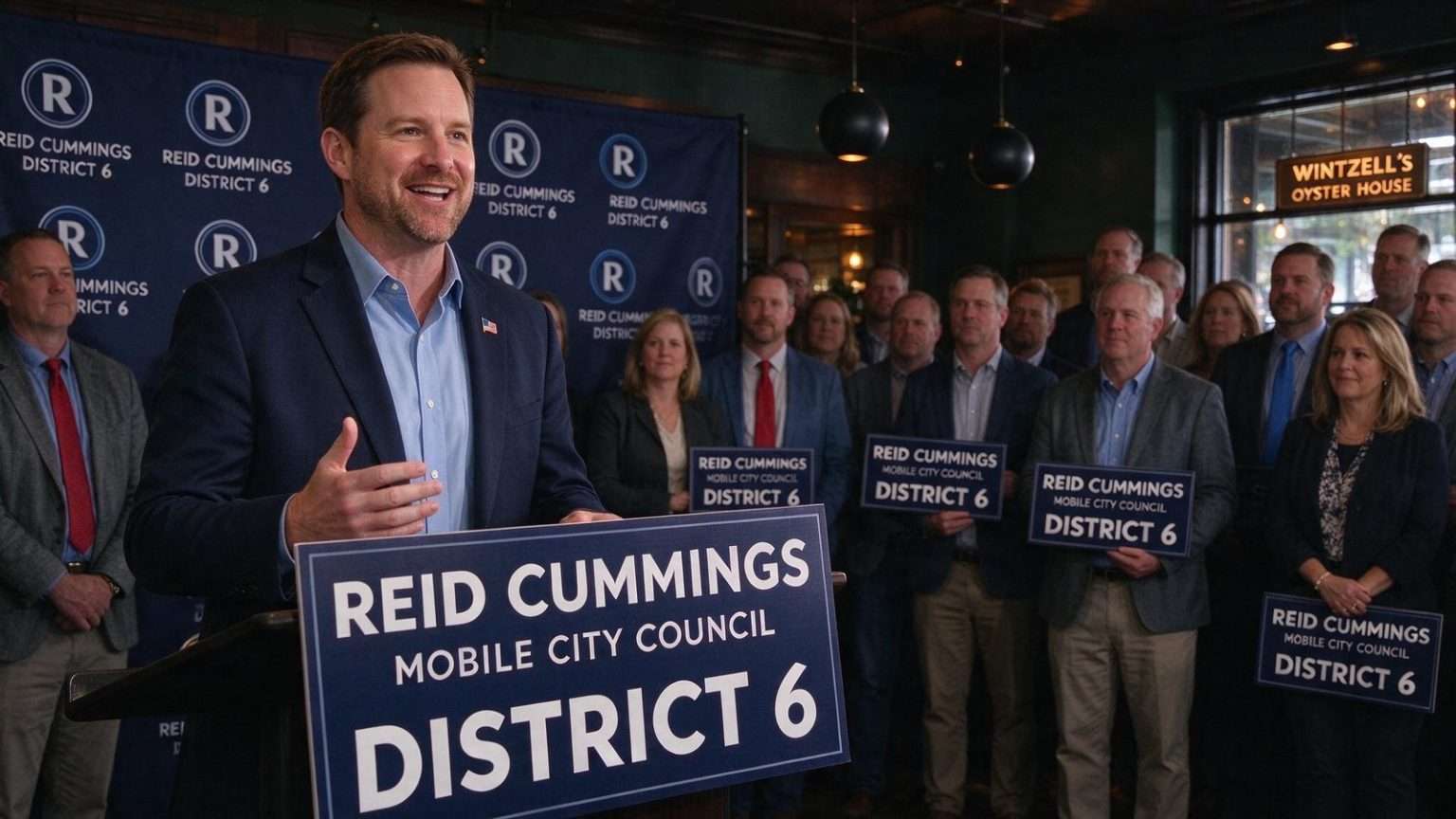
Commercial real estate executive Reid Cummings opened his campaign for the Mobile City Council District 6 seat Wednesday evening with a strong turnout from his colleagues in the local business community and a headline guest from the city’s political past, former Mayor Mike Dow. The kickoff gave the special-election contest its first real introduction to voters — and gave Mobile’s business establishment an early look at the candidate it appears inclined to embrace.
The race carries more weight than a typical council vacancy. District 6 takes in much of west Mobile — established neighborhoods, medical and office corridors, and some of the city’s strongest retail districts — and its council seat has long been a platform for the city’s fiscal and development debates. Whoever fills it will inherit a role in shaping how the city grows westward and how it pays for that growth.
A crowded reception downtown
Cummings gathered supporters at Wintzell’s on Airport Boulevard, where the crowd included insurance executive Jeff Adams, CPA Mike Thompson and a roster of commercial real estate figures such as Merrill Thomas, John Vallas, Burton Clark and Richard Weavil. The gathering had the feel of a professional association meeting crossed with a political rally — largely because, for Cummings, those audiences overlap almost completely.
The candidate described himself as a consensus builder with the business skills to help Mobile maintain and build on its appeal as a community where people want to live, work, raise families and invest. The framing was aimed squarely at the district’s self-image: a part of the city where property values, schools and commercial corridors matter personally to voters who own homes and businesses in them.
Cummings, 49, and his wife, Rebecca, own The Cummings Company, LLC, a real estate, financial services and consulting firm. A graduate of the University of North Carolina, he also holds a master’s of business administration from the University of Mobile, where he finished with honors. His campaign planned to roll out an official website soon, according to spokesman Brian Mishkin.
The biography is the message. In Mobile council races, candidates in the western districts have traditionally competed on competence and development savvy, and Cummings’ rollout — a commercial real estate principal, flanked by the brokers, appraisers and accountants who populate the city’s growth debates — was designed to present that competence as self-evident. His work in commercial real estate also gives him a natural command of the subjects the District 6 seat spends most of its time on: zoning cases, incentive negotiations and infrastructure demand.
The seat and the field
The District 6 vacancy opened when Connie Hudson won a special election to the Mobile County Commission, District 2. That seat had come open after Stephen Nodine, facing impeachment and other legal problems, resigned about three months earlier. Hudson’s move from the council to the commission seat set off the dominoes that put District 6 on the ballot, and it left the council without one of its most experienced members at a moment when the city faced weighty budget and development questions.
At the time of Cummings’ kickoff, he and former Councilwoman Bess Rich were the only two announced candidates. The special election was set for Nov. 2 to coincide with the general election, with a runoff, if needed, to follow on Dec. 14. Running alongside a general election changes the shape of a council race: turnout swells with voters who came out for other offices, which rewards candidates with name recognition and organized networks — and punishes those who planned to win with a small, devoted electorate.
Rich’s presence in the race gave the contest an immediate contrast. A former District 6 representative known for her attention to the city budget and her willingness to stand alone against spending, she built her reputation as the council’s conscience on fiscal matters. Cummings’ business-first launch positioned him as the district’s growth candidate — the same constituency, read through a different lens. The distinction between a budget watchdog and a development builder would likely become the race’s organizing theme.
An old rivalry in the room
The presence of Mike Dow gave the reception an added layer of political intrigue. A four-term mayor from 1989 to 2005, Dow had clashed regularly with Rich during his middle terms, when she served as the District 6 council representative. Dow won re-election to a fourth term in 2001, defeating Rich in a bitter contest, and the two remained figures on opposite sides of the city’s political memory. His appearance at the Cummings kickoff was read as more than a courtesy call — it was an old mayor signaling where he stood in the race to replace his old rival’s old seat.
Dow’s legacy still shapes Mobile politics. His administrations presided over the city’s downtown revival, the convention center and the expansion years that remade the city’s skyline, and he remains popular among the business constituency Cummings courted Wednesday night. An endorsement in substance, if not yet in form, from a four-term mayor is a genuine asset in a district where that constituency votes reliably.
For Rich, the Dow sighting cut the other way: a reminder to her supporters of the establishment alignments lining up against her, and a callback to a rivalry that a generation of newer Mobile voters knows only as history. If the race became a referendum on the city’s past, each candidate would claim a different lesson from it.
What the race means for Mobile
Beyond personalities, the District 6 contest arrives at a consequential time for city government. The council that takes shape after the election will weigh the city’s budget priorities, the pace of infrastructure spending in the fast-growing western districts, and the incentive packages that determine which projects get built where. District 6’s seat on those questions has historically been influential, because the district generates much of the sales tax base the city runs on.
The special election also serves as an early test of Mobile’s political winds ahead of the next full municipal cycle. Candidates, donors and observers watch these contests for signals — about which coalitions hold together, which endorsements move voters and whether the city’s business establishment can still deliver a result. Cummings’ kickoff, with its crowded room of brokers and its visiting former mayor, was the first such signal of the season.
For voters in the district, the choice as it stood after Wednesday night came down to two experienced-sounding but very different profiles: a commercial real estate executive promising consensus and growth management, and a former councilwoman promising scrutiny of every dollar. The field could grow before qualifying closes, but the two announced campaigns had already drawn the race’s main contours.
The road to Nov. 2
Between the kickoff and the election lay the standard work of a council campaign: neighborhood association meetings across west Mobile, fundraising events built on the business network on display at Wintzell’s, and the unglamorous block-by-block effort of turning professional respect into personal votes. Campaigns at the council level are won at that scale — a few thousand voters, many of whom will meet the candidate only once, if at all.
Cummings’ campaign team said the website rollout and a fuller platform would follow the kickoff, giving voters specifics to attach to the consensus-builder framing. His spokesman, Brian Mishkin, indicated the campaign intended to move quickly, aware that a November date beside a general election leaves less runway for a slow build than a standalone special election would.
Whatever the outcome, the special election will seat a new voice for District 6 — the successor to Connie Hudson’s council tenure, chosen by an electorate enlarged by the general election ballot. Wednesday night’s kickoff was the first argument for the job, made by a candidate who brought his professional world with him, and who hopes the business community’s confidence translates into the district’s.
The Nov. 2 election, and a Dec. 14 runoff if no candidate secures a majority, will settle it. Until then, District 6’s campaign season has begun exactly the way its candidates’ histories suggested it would: with old rivals watching from the sidelines and the city’s business tables turned into staging areas.
The Nodine aftermath and Hudson’s climb
The chain of events that emptied the District 6 seat began with one of the stranger chapters in Mobile County politics. Stephen Nodine’s resignation — delivered amid impeachment proceedings and a stack of legal problems — left the County Commission’s District 2 seat vacant and set the county’s political machinery in motion. Connie Hudson, then a District 6 councilwoman with a reputation for constituent service and fiscal steadiness, entered the special election for the commission seat and won it, jumping from city hall to the county level in a single move.
Her departure created the vacancy the current race must fill, and it set a standard as well: District 6 has grown accustomed to a representative who wins countywide confidence. Whoever succeeds her inherits a constituency that expects attentiveness on the neighborhood basics — potholes, drainage, zoning protests — alongside a seat at the table on the city’s big fiscal questions.
For Cummings, the example of Hudson is also a blueprint. A candidate with business credibility and a measured, non-combative style won the district and then the county; his kickoff consciously borrowed the posture, if not yet the record. For Rich, the comparison is more complicated — she and Hudson represented the same district from different philosophies, and their tenures offer voters two reference points for what District 6 representation can look like.
West Mobile’s stake in the outcome
The district itself deserves attention in any account of the race. West Mobile’s neighborhoods — from the established streets around Spring Hill and the medical corridor to the newer subdivisions spreading toward Cottage Hill and Schillinger roads — have absorbed much of the city’s population growth, and with it much of the demand for police presence, drainage spending and road widening. The district’s council representative is the first stop for residents whose streets flood, whose intersections need signals and whose neighborhoods are pressing against the county line.
The district is also home to much of the commercial development that funds the city: the airport corridor’s retail strip, the office parks and the medical offices that draw patients and payroll from across the region. Development decisions made by the council — rezonings, traffic impact requirements, tax abatements — land first and heaviest in District 6, which is why the district’s races so often turn on growth questions and why a commercial real estate executive enters the race with an argument that fits the district’s daily experience.
Cummings’ consensus-builder pitch speaks to that experience directly: voters in fast-growing districts want someone who understands the mechanics of development without being owned by it. Whether he can convince them that his professional ties are an asset rather than a conflict will be one of the race’s central tests, alongside the evergreen question of whether the district prefers a builder’s optimism or a watchdog’s scrutiny. Between now and Nov. 2, both candidates will get the chance to make that case in person, neighborhood by neighborhood, in the district where the city’s growth and its governance meet.