Reid State Community College to Host Nonprofit Training Series in Evergreen
Reid State Community College in Evergreen will host a one-day nonprofit training series Sept. 23 covering funding, marketing and technology.
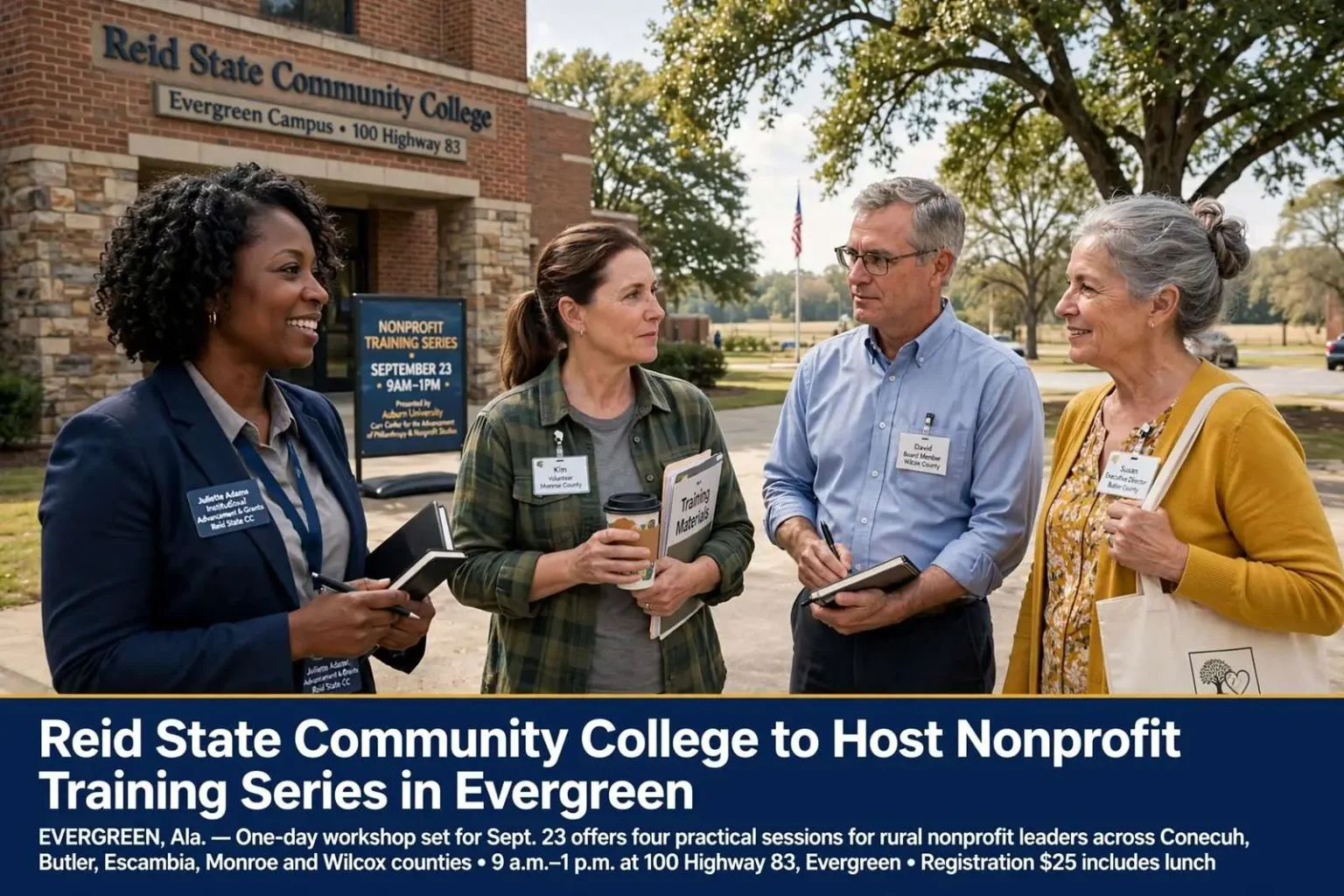
EVERGREEN, Ala. — Reid State Community College will host a one-day training series for nonprofit organizations on Sept. 23, presented by Auburn University’s Cary Center for the Advancement of Philanthropy and Nonprofit Studies. The event runs from 9 a.m. to 1 p.m. at the college, 100 Highway 83 in Evergreen, and is aimed at nonprofit professionals, executive directors, board members, volunteers and community leaders. Organizers describe it as a working morning rather than a conference, built so that people who run small organizations across rural South Alabama can leave the same day with ideas they can put to use immediately.
The half-day format is deliberate. Nonprofit leaders in rural counties routinely travel an hour or more for professional development, and many small organizations cannot spare either the time or the money that larger, urban training events assume. By compressing four sessions into a single morning on a community college campus in the middle of the region, the program is designed to let a board member or executive director arrive, learn, network over lunch, and be back at work by mid-afternoon.
Four Sessions in One Morning
It will include four interactive sessions: “Funding That Works: Practical Strategies for Small Nonprofits,” “Getting the Word Out: Marketing That Builds Community Support,” “Building Capacity Through People & Partnerships,” and “Working Smarter, Not Harder: Technology for Today’s Nonprofits.” Each session is structured to be interactive rather than a lecture, with presenters drawing on the specific situations attendees bring to the room.
The funding session addresses the most persistent problem small organizations face: money that is either too unpredictable or too narrowly restricted to sustain operations. Rather than chasing large grants that small staffs cannot manage, the session’s practical strategies are aimed at matching an organization’s real capacity to realistic funding sources, from community foundations to local businesses to small-dollar individual donors who can become reliable year after year.
The marketing session confronts a quieter challenge. Small nonprofits in rural counties often do important work that nobody outside their immediate circle knows about, which makes both fundraising and recruiting volunteers harder than it needs to be. The session covers low-cost ways to build community visibility, from local media relationships to the kind of word-of-mouth storytelling that spreads through churches, civic clubs and school networks in small towns.
The capacity session looks at people and partnerships. In sparsely populated counties, no organization can thrive alone, and the session focuses on how nonprofits share volunteers, borrow expertise, cooperate on events, and pair with schools, municipalities and churches to stretch limited staffs. Partnerships are frequently the only realistic path to expansion for a small-town organization, and the session is designed to give attendees concrete models to copy.
The technology session closes the morning with tools rather than theory. Free and inexpensive software for scheduling, bookkeeping, donor tracking and communication has transformed what a two-person nonprofit can manage, but many small organizations still run on paper and memory. The session presents technology options that fit small budgets and small staffs, with an emphasis on systems that do not require specialized training to maintain.
“Without Asking Them to Drive for Hours”
“We are thrilled to be able to offer this kind of training to our local nonprofits without asking them to drive for hours to attend,” said Juliette Adams, institutional advancement and grants assistant for Reid State Community College. Her point speaks to the geography that shapes nonprofit life in the region: the nearest large cities with established nonprofit training calendars are hours away by car, and a round trip to one of them consumes an entire workday for a volunteer board member who has a regular job.
Adams said the idea grew out of her own experience attending an Auburn nonprofit training session in Montgomery. “I had an overwhelming urge to create something at Reid where local nonprofit leaders could meet regularly, share updates, exchange ideas and learn from one another,” she said. That sentence describes the gap she identified: not a shortage of willing leaders in the region, but a shortage of any regular venue where those leaders could find each other. In counties as small as Conecuh, Butler or Wilcox, there may be only a handful of professional nonprofit workers, and without a deliberate gathering point they rarely learn what their counterparts in the next county are doing.
The emphasis on regular meeting is worth noting. Adams’ language suggests the September event is intended as a beginning rather than a one-time offering, an anchor that could become a recurring network of nonprofit leaders across the region. Community colleges have increasingly taken on that kind of convening role in rural Alabama, using their neutral, trusted position to pull together people who otherwise have no institutional reason to sit in the same room.
Who the Event Is For
The event is open to participants from across South Alabama, particularly Conecuh, Butler, Escambia, Monroe, Wilcox and surrounding counties. The county list maps the immediate service area around Evergreen: Conecuh County, of which Evergreen is the county seat; Butler County to the east, anchored by Greenville; Monroe County to the south, home to Monroeville; Wilcox County to the southwest; and Escambia County to the southeast, along the Florida line. Each of those counties carries the same underlying condition — small populations spread across large rural areas, with nonprofit services often delivered by organizations operating on budgets that would not cover a month of payroll at a larger institution.
The invited audience is correspondingly broad. Nonprofit professionals, executive directors, board members, volunteers and community leaders are all encouraged to attend, a grouping that recognizes how blurred the lines are in small organizations, where the director may also write the grants, keep the books and drive the van. Board members in particular are a target audience, because in small nonprofits the board frequently does the fundraising, and training that reaches a single board member can change an entire organization’s direction.
Community leaders — the chamber officials, elected leaders, ministers and civic club officers who shape how a town organizes its voluntary energy — round out the invitation. For them, the value is partly in learning what services already exist in neighboring counties and where the gaps are, information that is hard to assemble without exactly the kind of cross-county meeting this event creates.
Cost and Logistics
Registration is $25 and includes lunch provided by the Greater Conecuh County Chamber of Commerce. The fee is set deliberately low, consistent with the event’s premise that cost should not be the barrier that keeps small-organization leaders at home, and the included lunch turns the midday break into the informal networking session that Adams described as part of her original vision.
The Chamber’s involvement also signals local buy-in. The Greater Conecuh County Chamber of Commerce works with businesses and civic groups across the county, and its participation connects the nonprofit audience to the business community that many small organizations depend on for sponsorships, in-kind donations and volunteer referrals.
The venue itself reflects the region’s practical geography. Reid State Community College’s Evergreen location sits on Highway 83, putting the campus within easy driving distance of the county seats surrounding it. Attendees from Monroe, Butler, Wilcox and Escambia counties can reach Evergreen in well under an hour from most of their county’s population centers, which is precisely the accessibility the event was designed around.
Reid State’s Role in the Region
Reid State Community College serves a multi-county stretch of rural South Alabama, and its institutional mission has long included workforce training and continuing education alongside its academic programs. Hosting a nonprofit training day extends that mission in a natural direction: the college’s classrooms, meeting spaces and staff are a resource that small counties can draw on for exactly this kind of community capacity building, without the expense of building something from scratch.
For the college, the event also deepens its ties to the organizations it serves. Nonprofits across the region partner with community colleges on adult education, health outreach, food assistance coordination and workforce pipelines, and a trained, better-organized nonprofit sector in the surrounding counties ultimately strengthens those partnerships on both sides.
The Cary Center’s Expertise
The presenter, Auburn University’s Cary Center for the Advancement of Philanthropy and Nonprofit Studies, is a university-based center devoted to nonprofit management education and the study of philanthropy. The center has built its programming around the realities that small and mid-sized organizations actually face — volunteer boards, thin budgets, and communities where fundraising depends on relationships rather than institutional machinery — which makes its sessions well suited to a rural audience rather than a big-city nonprofit scene.
Bringing Cary Center instructors to Evergreen rather than sending South Alabama leaders to Auburn or Montgomery inverts the usual direction of expertise in the state, and that inversion is the core of the event’s appeal. The center’s faculty and staff will lead the four sessions, adapting their established curriculum to questions and circumstances the attendees bring with them from Conecuh, Butler, Escambia, Monroe and Wilcox counties.
For the nonprofit leaders expected to attend, the morning offers something that is otherwise scarce in the region: a room full of peers who understand the specific economics of running a charitable organization in a small Alabama county, taught by professionals whose entire focus is making such organizations more effective. Registration information is available through Reid State Community College, and organizers encourage early sign-up given the limited morning schedule.