Rep. Alan Baker Presents Atmore Public Library With $2,000 Grant
State Rep. Alan Baker presented the Atmore Public Library with a $2,000 discretionary grant on Aug. 10 to support the library's needs.
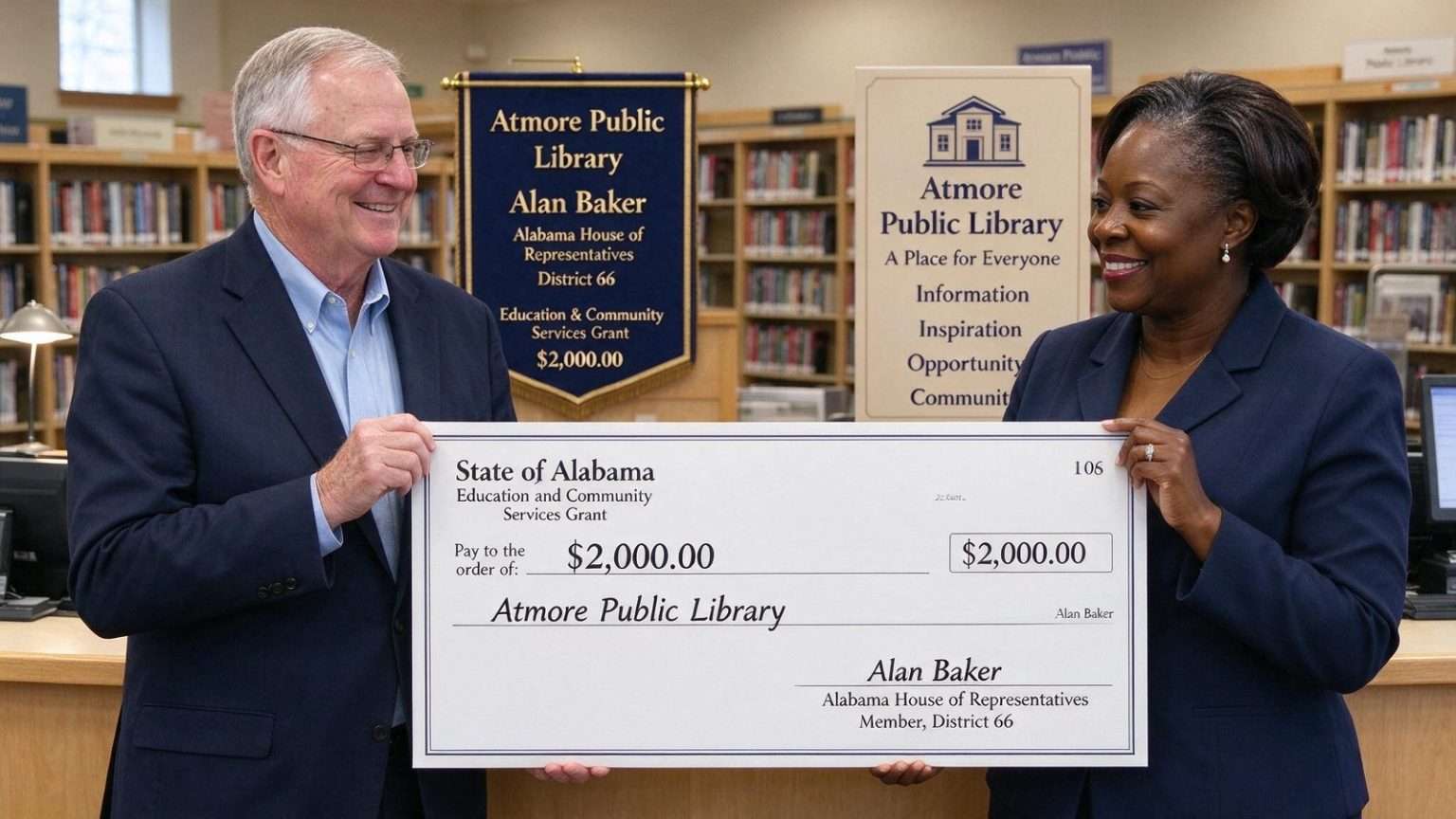
ATMORE, Ala. — The Atmore Public Library received a $2,000 check from state Rep. Alan Baker on Aug. 10, funding that library officials say will go toward meeting the facility’s ongoing needs.
Baker presented the check in person at the library, where he was photographed alongside Atmore Public Library Director Hope Lassiter. The money comes from Baker’s discretionary Education and Community Services Grant fund, a pool of money state lawmakers can direct toward local schools, libraries and community organizations within their districts.
Library officials did not specify exactly how the funds will be spent, saying only that the money would go toward the library’s needs. For a small-city library, gifts at this scale typically translate into practical improvements — new titles for the collection, updated computer equipment, supplies for children’s programming, or maintenance work that the regular budget cannot always absorb.
The presentation was a brief one, but it reflects a steady channel of state support that reaches communities like Atmore every year, often without much public attention.
How the discretionary grant program works
Each member of the Alabama Legislature receives an annual discretionary allocation that can be directed toward qualifying public purposes within the member’s district. The Education and Community Services Grant fund, as it is formally known, is administered through the state budget process, and lawmakers designate recipients such as schools, public libraries, volunteer fire departments, senior centers, municipal governments and civic organizations.
The grants are not personal funds, and they are not handed out at the lawmaker’s sole whim without oversight. Recipients are public or nonprofit entities, the money must serve a public purpose, and the spending is documented. In practice, the program lets a legislator respond quickly to small but real needs — a library’s shelving, a school’s reading materials, a fire department’s radios — that might otherwise wait for the next budget cycle.
Amounts vary widely depending on the request and the year. Some grants fund single pieces of equipment; others help an organization bridge a shortfall. A $2,000 award to a city library is typical of the program’s day-to-day use: modest in state budget terms, meaningful at the local level.
A common form of legislative support
Discretionary grants like this one are a common way Alabama legislators support local institutions between larger state budget allocations, allowing libraries, civic groups and schools to cover costs that might otherwise go unfunded.
The state’s two operating budgets — the Education Trust Fund and the General Fund — move hundreds of millions of dollars to school systems and state agencies each year, but that money is generally earmarked long before it arrives. A city library that needs to replace a worn-out computer or restock a popular series cannot always wait for a formal line item. Discretionary grants exist, in part, to fill exactly those gaps.
Baker, who represents the area that includes Atmore in the Alabama House of Representatives, has directed similar grants to schools, first-response agencies and community organizations across his district over the years. Presenting the check in person, he noted the library’s importance to the community — a point library staff echoed in describing the gift as a boost to the facility’s ongoing needs.
The library’s place in Atmore
Atmore sits in the western part of Escambia County, near the Florida line, and its public library serves as one of the city’s principal community institutions. Beyond lending books, the library provides public internet access, hosts children’s story times and summer reading programs, and offers a quiet space for study and research — services that matter in a city where not every household has broadband or a home computer.
Public libraries frequently rely on a mix of state, local and grant funding to maintain collections, technology and community programming. Municipal appropriations cover basic operations, while state aid distributed through the Alabama Public Library Service supplements collections and services. Grants — whether from legislators’ discretionary funds, foundations, or federal programs funneled through the state — make up the third leg of that support, and they are often what pays for the extras: new computers, large-print editions, genealogy resources, or upgrades to the building itself.
Library directors across rural Alabama routinely describe the same arithmetic: the base budget keeps the doors open, but growth in the collection and improvements in technology depend on outside help. That is why a visit from a legislator with a check in hand is a familiar ritual in towns like Atmore, and why directors such as Hope Lassiter make the case for their facilities during legislative sessions and budget hearings.
What $2,000 can do for a small library
While $2,000 will not fund a building project, it covers the kind of expenses that libraries struggle to fit into tight operating budgets. A few hundred dollars buys a substantial stack of new hardcover releases; a similar amount can replace an aging public-access computer or pay for a year of software licensing and maintenance. Children’s program supplies, audiobook licenses, furniture repair and signage are all common uses.
Library officials in Atmore have not announced specific plans, and they are under no obligation to do so for a discretionary grant of this size. The general commitment — that the money will address the facility’s needs — leaves the staff flexibility to direct it wherever the shortfall is greatest when the funds arrive.
That flexibility is part of the design of the grant program. Unlike money awarded for a narrowly defined project, a discretionary award to a trusted local institution can be applied where it does the most good, and library staff, who see daily which shelves are thin and which equipment is failing, are well positioned to make that call.
Libraries and the state funding picture
Alabama’s public libraries operate in a mixed funding environment that puts pressure on facilities in smaller communities. State aid per library has been constrained for years, and municipal budgets — particularly in cities of Atmore’s size — cover a long list of demands that include streets, public safety and parks. The result is that libraries depend heavily on grants, friends-of-the-library groups and individual donations to maintain and expand services.
The Alabama Public Library Service, the state agency that supports public libraries, distributes both state appropriations and federal Library Services and Technology Act funds, but those dollars come with formulas and conditions. Legislative discretionary grants, by contrast, arrive with few strings and little paperwork, which makes them a practical supplement for small systems.
A pattern repeated across the district
Baker’s presentation in Atmore is one example of a practice that plays out in communities across south Alabama throughout the year. Legislators present discretionary grant checks to school libraries, volunteer fire departments, senior centers, youth sports leagues, historical societies and municipal governments. The individual amounts rarely make headlines — a few hundred dollars here, a few thousand there — but the cumulative effect on small institutions is substantial, and for many of them the grants have become a dependable part of annual planning rather than an occasional windfall.
For recipients, the value is not only financial. A grant visit signals that the community’s needs are being heard in Montgomery, and it often opens a line of communication that helps the institution in later budget cycles. Library boards and city officials routinely follow up such presentations with requests for larger, more structural support — a building renovation, an expanded bookmobile route, a technology overhaul — that must move through the formal appropriations process.
What happens next
For the Atmore Public Library, the immediate next step is routine: deposit the funds, decide among competing needs and put the money to work. Patrons will most likely notice it in small ways — newer books on the shelves, a faster computer, a better-supplied children’s corner — rather than in any single dramatic addition.
The timing also matters. Gifts received late in the calendar year can be applied to the next year’s programming plans, from the summer reading kickoff to collection orders placed with vendors at the start of the fiscal year.
For residents of Atmore and surrounding communities in Escambia County, the grant is a reminder of how their library is funded and of the levers available to them. Requests for discretionary grants typically begin with the local institution contacting the legislator’s office and describing the need. Libraries, schools and nonprofits that make specific, documented requests are the ones most often funded.
The Aug. 10 presentation was, in the end, a simple transaction: a legislator directing a modest state allocation to a hometown institution, and a library director accepting it on behalf of the patrons she serves. But the pattern it represents — state money flowing to small-town institutions through discretionary grants — is one of the quieter ways public services in communities like Atmore stay afloat between budget years, and it is a pattern residents can expect to see again.