Reporter’s firsthand account: Inside the execution of Nathaniel Woods at Holman prison
A journalist selected to witness the execution of Nathaniel Woods describes the process inside Holman Correctional Facility in Atmore on March 5, 2020.
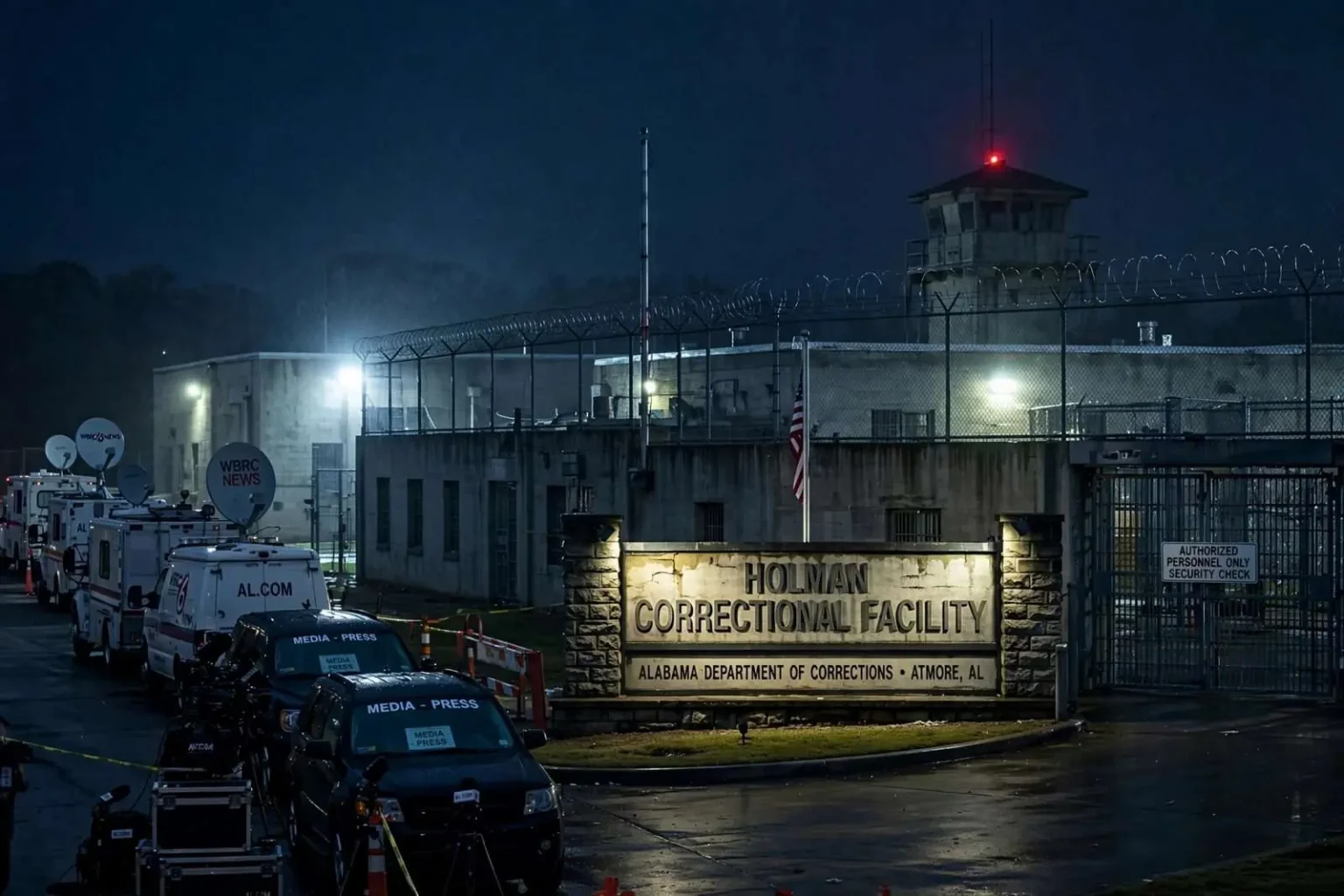
ATMORE — A journalist selected as a media witness has described the hours leading up to and including the execution of Nathaniel Woods at Holman Correctional Facility here on March 5, 2020, offering the public a rare, close-up view of a process that Alabama carries out behind locked gates and tinted glass. Woods, a convicted cop killer, was put to death by lethal injection for his role in the 2004 deaths of Birmingham police officers. His execution had been set for 6 p.m., but the process was delayed after the U.S. Supreme Court issued a temporary stay. The stay was lifted late in the evening, and the execution proceeded.
For the reporters, photographers, and broadcasters who serve as media witnesses, an execution date is unlike any other assignment. Access to Holman — the Alabama Department of Corrections’ facility that houses the state’s execution chamber — is tightly controlled, and the journalists chosen for the witness room go through security screening, property checks, and a detailed briefing on the rules of observation before they are escorted across the prison yard. The account from inside describes those procedures in detail: the long waits in a holding area, the movement of the witness groups in silence, and the positioning of observers in the witness rooms, where members of the media, the victims’ families and other observers watched through a window onto the chamber.
A day of legal uncertainty
The evening’s central tension was legal rather than procedural. Woods’ attorneys had pursued last-minute appeals, and the U.S. Supreme Court’s temporary stay left everyone inside the prison — staff, witnesses, and the condemned man himself — waiting on a decision from Washington. In the witness rooms, that uncertainty translated into hours of stillness. Media witnesses are not permitted to speak, carry phones, or leave and return, so the delay meant sitting with the sight of the chamber, fully prepared, while the courts weighed the case. Witnesses describe the strange quality of time in that room: clocks on the wall, guards at the doors, and nothing to do but wait.
The stay was lifted late in the evening, and the process resumed. Before the lethal drug began flowing, the warden read the death warrant and Woods was given the opportunity to make a final statement, which he declined. Those final moments are the reason the state permits witnesses at all: to have members of the public and the press observe that the sentence handed down by a jury and signed by a governor is carried out as the law requires, without improvisation and without secrecy.
The final moments
Once the lethal drug began flowing, the process moved quickly. Witnesses watched as Woods lost consciousness, and medical staff monitored his vital signs until the end came. He was pronounced dead by a doctor shortly before 9 p.m. — roughly three hours after the originally scheduled time, a span that captured in miniature how many years of appeals, motions, and stays had preceded this single evening.
The reporter’s account makes clear that witnessing an execution is a heavy assignment. Journalists who take the role describe the weight of sitting in a room where a man is put to death on their behalf, as representatives of the public, and the obligation to record what they see accurately for readers who will never stand in that room. The reporter wrote that the goal was to shed light on what occurs on death row — the routines, the staff, the ritual language of the warrant, and the human reality at the center of a policy debate that Alabamians continue to have.
The case behind the sentence
Woods was condemned for his role in the June 2004 shooting deaths of three Birmingham police officers, a crime that shocked the city and ranked among the deadliest single attacks on law enforcement in Alabama history. Prosecutors argued that Woods set in motion the events that led to the ambush; his co-defendant, the man who fired the shots, also received a death sentence. Over more than a decade and a half on death row, Woods’ case became a cause for advocates who questioned his degree of culpability, and it drew attention from national figures in his final weeks. The courts, however, repeatedly declined to overturn his conviction and sentence, and his legal options narrowed steadily as the March 2020 execution date approached.
In the final hours, that legal machinery ran one last time. Woods’ family and attorneys made a final appeal to Gov. Kay Ivey, asking her to commute the sentence to life in prison, but the governor declined to do so. The clemency petition and the Supreme Court stay represented the last two avenues, and when both closed, the state proceeded with the sentence as scheduled — first delayed by hours, then carried out in a matter of minutes.
Who watches, and why
The composition of the witness rooms reflects the competing claims an execution settles. Family members of the victims have a place in one room, representing the people whose loss the sentence answers. The condemned inmate’s family and spiritual advisers observe from another vantage point. Members of the media occupy their own space, serving as proxies for the public. The separation is deliberate: the Alabama Department of Corrections keeps the groups apart from one another before, during, and after the process, and each group leaves the prison through its own route.
Alabama is one of a number of states that authorize media witnesses, and news organizations in Birmingham and across the state have supplied them for decades. The practice dates to a principle that has governed executions since the era of public hangings gave way to enclosed chambers: punishment carried out by the state belongs to the public, and the press stands in for a citizenry that cannot be admitted through the gates. The rules are strict because the stakes are high. Witnesses who violate the observation rules can be removed, and news organizations that misreport what occurs face the judgment of their readers.
What the account adds to the record
Firsthand execution accounts occupy a small but important place in the public record. Court filings describe the legal maneuvers, and Department of Corrections press releases state the essential facts — the name, the crime, the time of death. Only the witness accounts capture the texture: the color of the walls, the sound of the gurney’s straps, the small human moments that a press release never contains. The reporter’s description of the warden reading the death warrant, of the offered final statement and the silence that followed it, and of the medical procedures that ended in a doctor’s pronouncement will remain one of the few windows into a room that almost no Alabamian will ever see.
The account also documents the toll the assignment takes on those who perform it. Reporters who cover executions describe the experience as professionally necessary and personally draining, a duty that ends with a deadline but not with the memories of the room. That weight, the reporter wrote, is part of the story: an execution is not an abstraction argued in courtrooms and editorials, but a physical event witnessed by a handful of people whose job is to tell everyone else what happened.
Holman and the machinery of the death penalty
Holman Correctional Facility, sitting on the outskirts of Atmore in Escambia County, has been the site of every execution in Alabama since the state resumed capital punishment in the modern era. The prison holds both general population inmates and the state’s male death row population, and its execution chamber is a small, self-contained complex within the larger compound. On execution nights, the town of Atmore — a community of a few thousand people near the Florida line — absorbs the attention that comes with the event: extra security on the roads to the prison, small groups of demonstrators for and against the death penalty, and satellite trucks filing reports from the darkened fields outside the gates.
The procedures described in the witness account — the warrant reading, the offer of a last statement, the medical monitoring, the pronouncement by a doctor — follow the script Alabama has refined over decades. The state’s lethal injection protocol uses a sequence of drugs intended to sedate, paralyze, and stop the heart of the condemned, and the department’s staff rehearse the process repeatedly. Everything a witness sees is choreographed, from the moment the curtain is raised to the moment it is lowered, because the state has an interest in demonstrating that its most solemn punishment is administered with order and care.
The debate that outlasted the evening
Woods’ execution came amid a broader national argument about capital punishment that continued long after the curtain fell that March night. Supporters of the death penalty point to sentences handed down by juries, decades of appellate review, and the finality owed to victims’ families. Opponents question whether the system is applied fairly, whether innocent people have been condemned, and whether the methods themselves meet constitutional standards. Executions in Alabama and elsewhere have been delayed, rescheduled, and litigated over exactly those questions, and each witness account becomes part of that record.
For the readers of the reporter’s account, the value lies less in resolving the debate than in grounding it. Every element described — the hours of waiting, the reading of the warrant, the declined statement, the pronouncement shortly before 9 p.m. — is something that happened in a specific room, to a specific man, under the authority of the state, with the public watching through a window and through the words of the journalists seated among them. That is what the witness room exists to provide, and it is what the account delivers.