

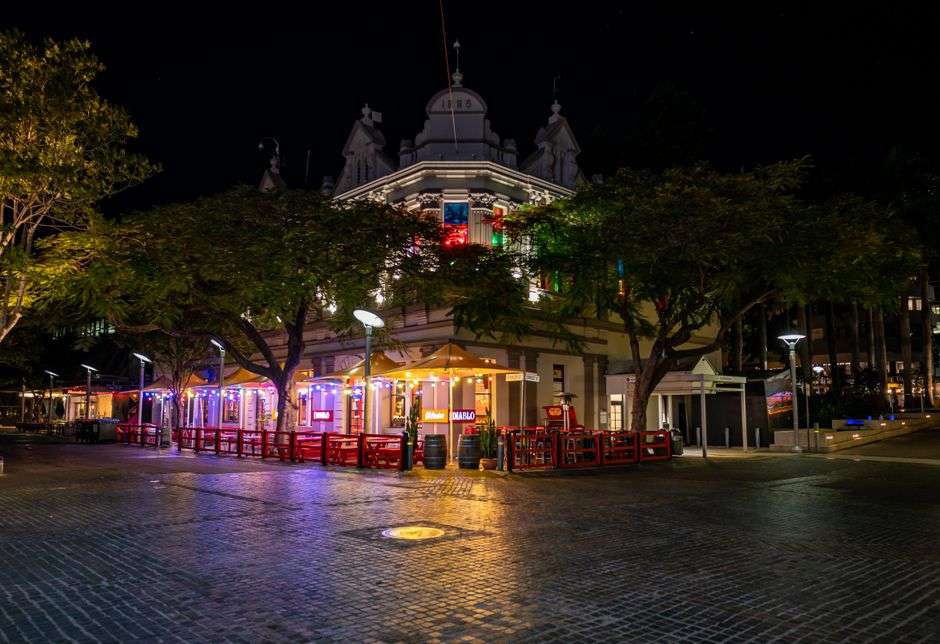
When Charles Morgan talks about downtown Mobile, he talks like a man who has seen this movie before. His restaurant group — Chuck’s Fish, Five, and El Papi among them — operates in cities that other developers passed over, in buildings most of them a century old. He believes the strongest years of Dauphin Street, and of Mobile itself, are the ones just ahead.
A restaurant empire built on fishing boats
Morgan grew up in Atlanta and attended the University of Alabama. While earning his MBA, he picked up a boat captain’s license and began running an offshore fishing boat for a Birmingham company — a job that led him to Destin, Florida, where he opened Harbor Docks on the Fourth of July, 1979, with six picnic tables and a menu of oysters and beer. It rained. At the time, there were only six restaurants in the ten-mile stretch between the Destin bridge and Sandestin.
Forty-plus years later, Harbor Docks is a Destin institution, and Morgan’s second-oldest restaurant, Dharma Blue in Pensacola, turned forty as well. With his business partner Cris Eddings, Morgan now owns and operates restaurants across the South, concentrated in college towns: Tuscaloosa, Athens, Tallahassee, and onward, with a Montgomery location on the roadmap. Camille’s at Crystal Beach in Destin carries his mother’s name.
Seafood wholesale at the core
Restaurants are only half the business. Morgan started Harbor Docks Seafood Market more than four decades ago with a single boat, and today the wholesale operation supplies all of his restaurants plus outside customers, sourcing from 152 boats along the coast. That supply chain — buying straight from working captains — is the quiet engine behind the restaurant group’s seafood programs and its reputation for freshness.
The company’s sushi program traces to Yoshie Eddings, Cris’s mother, who came from Tokyo and introduced sushi to the restaurants years ago; she still trains the sushi chefs. Morgan credits the group’s famously high employee retention — among the best in the industry — to what he calls an unstructured management style, a light touch at each location, and what he calls a livable occupation rather than a transient job.
Downtown Mobile as a project
Morgan’s Mobile locations sit in the heart of the Dauphin Street entertainment district, where historic buildings have been converted to lofts, wedding venues, and small-business incubators over the past decade. The pattern suits him. More than 80 percent of his restaurants occupy buildings at least 100 years old, and he says he prefers cities people have forsaken — places where the rejuvenation process is still underway and the workforce is local.
His read on Mobile is specific. It is, he says, a mid-level city with a well-preserved historic core, improving infrastructure, and rising livability — pedestrian-friendly streets, parks, classic neighborhoods, and a diversified job base spanning the port, shipbuilding, aerospace, law, and accounting. Paradoxically, he argues, focusing on residential life rather than tourism is what makes tourism better.
The new airport terminal, in his estimation, will be the biggest single boost to an economy already on the upswing. He likes the people, the architecture, the relative absence of strip centers, the density of independent restaurants, and — a recurring theme for a seafood wholesaler — a local population that actually knows seafood.
The walkable-city thesis
Underlying the optimism is a demographic bet. “Young people today want to live in town,” Morgan says. “They want walkable communities and to Uber to restaurants and places that aren’t near where they live. They would trade their car for their iPhone if forced to choose.” Restaurants, in that world, cluster where people already are — which is why his group keeps landing in old downtowns rather than new intersections.
A stroll down Dauphin Street supports the thesis. The entertainment district packs independent restaurants, live music venues, and bars into a walkable stretch of historic storefronts, and the evening crowd mixes college students, young professionals, and downtown loft residents. Morgan’s restaurants sit in the middle of it, feeding a recovery they helped along.
Forty-three years after six picnic tables in the rain, the restaurateur who built a business on fishing boats and forgotten downtowns sees Mobile’s future clearly. The transformation of Dauphin Street that architects drew up half a century ago is nearly complete — and Charles Morgan intends to keep serving it dinner.