Rex Dingler returns to Mobile with ‘ReXism: Interactive’ art show and book release
Street artist Rex Dingler returns to Mobile Feb. 10 with 'ReXism: Interactive,' an art exhibition and book release party at Wellborn Ideas on Dauphin.
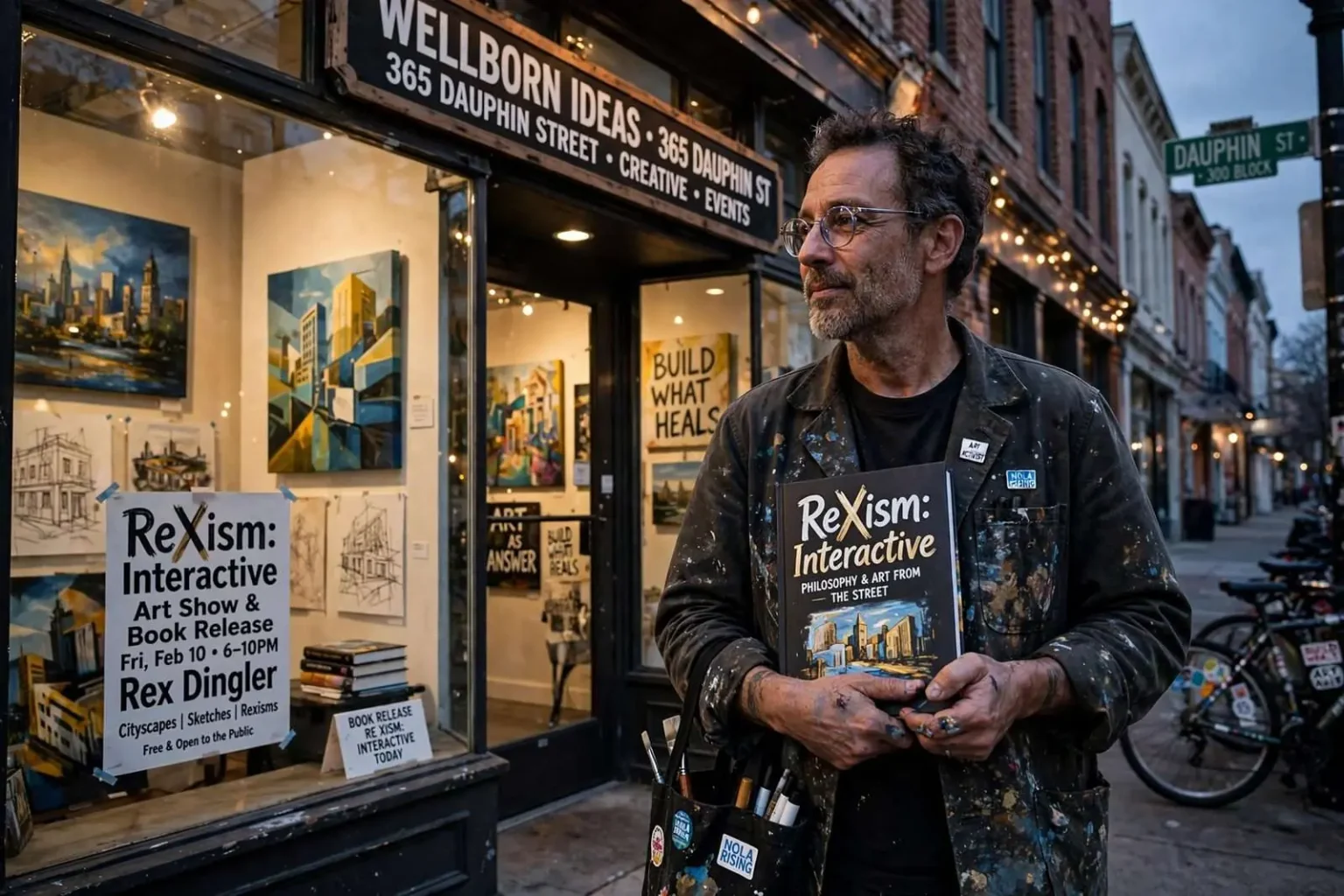
Rex Dingler, the New Orleans-born street artist known for his cityscapes and social-commentary art, returns to Mobile on Friday, February 10, for an art exhibition and book release party titled ReXism: Interactive. The event runs from 6 to 10 p.m. at Wellborn Ideas, 365 Dauphin Street in downtown Mobile. The homecoming brings together two chapters of a career spent straddling the line between studio and street, staged in the city where Dingler first abandoned a conventional path for an artist’s one.
The show highlights Dingler’s cityscapes in both oil and acrylic, an array of his iconic sketches, and oil works listing his “Rexisms” — personal idioms born from years of travel and colorful living. The paintings distill scenes the artist has absorbed across decades of wandering: skyline silhouettes, street corners, the architectural textures of cities that shaped him. The Rexisms, rendered in paint alongside the imagery they accompany, give viewers a direct line into the philosophy behind the work — short, punchy statements that function as the artist’s creed, part manifesto and part diary.
The book release adds a literary dimension to the evening, collecting the philosophy and imagery in a form visitors can take home. For an artist whose practice depends on dispersal — work placed in public view, idioms repeated and passed along — the book extends the same instinct into print, making the ReXism corpus available beyond the walls of a single-night exhibition.
From USA Campus to the Street
Dingler lived in Mobile during the 1990s and studied at the University of South Alabama, where he says he abandoned early ambitions of law school after years on campus. He went on to build a career as what he calls an “art activist” dedicated to social justice. The pivot from legal career to public art defined everything that followed. Where a lawyer works within a system’s rules, the art activist works on the surfaces a city leaves open — walls, utility boxes, boarded windows — and Dingler pursued that work with the seriousness of a vocation rather than the casualness of a hobby.
After the federal levee failures that followed Hurricane Katrina, he founded NoLA Rising, a public art campaign encouraging street art that interacts positively with its community — described by his hometown paper as “a lone wolf braying into the wilderness” for his philosophies on art and its presentation. In the years after the 2005 storm, New Orleans presented an unprecedented canvas: whole neighborhoods of damaged structures, blank fences, abandoned vehicles. Dingler’s campaign argued that art could answer the devastation, that a painted wall could lift a block’s spirit, and that residents should claim the visual landscape of their own recovering city. The project spread images and phrases across the recovering city and made Dingler a recognizable figure in the post-Katrina street art scene.
His work reflects the streets themselves — cityscapes, architecture and geography — explored through architecturally aligned abstracts and panoramic studies of city skylines. The term “architecturally aligned” points to a signature method: compositions that follow the actual lines of the built environment, whether the grid of a downtown or the curve of a bridge, so that a painting seems to grow out of the place it depicts rather than merely picture it. The panoramic skylines extend that logic to whole cities at once, compressing an afternoon of looking into a single sweeping image.
Author Adam Falik said of Dingler: “There is a school of thought bordering on mysticism that divines a relationship between the shape of buildings and the mental and spiritual health of those who reside within them. Dingler, likewise, seeks the balance between a city’s denizens and their capacity to accept, and interact, with art.” The observation frames Dingler’s entire practice as a negotiation between people and their built surroundings — an artist who measures a city’s health by the art its citizens will tolerate, and who works to raise that tolerance one painted surface at a time.
Mobile, in that sense, is both subject and audience for the February exhibition. The city where Dingler studied, and whose downtown streets he came to know in the 1990s, has since undergone its own architectural transformations — a revived Dauphin Street among them — making the venue on the 300 block of Dauphin an apt setting for an artist preoccupied with how cities and their inhabitants shape one another.
An Education Outside the Academy
Though often considered a street artist, Dingler’s formal art education was limited to early guidance from Al Federico, a French Quarter painter of historical street scenes, who encouraged him to approach painting through his mind’s eye rather than traditional styles. The mentorship gave Dingler permission to trust memory and invention over direct copying — a lesson well suited to cityscape work, where the goal is not documentation but the feeling a place produces. Federico’s own specialty, the renderings of historic New Orleans streetscapes that tourists and collectors have long prized, connected Dingler to a lineage of artists who treated architecture as the city’s memory.
Earlier in his career he briefly worked with the late Peter Lobello, assisting on what became Lobello’s final painting, an experience that placed the young artist inside the working method of an established painter at the end of a career. The apprenticeship, like the guidance from Federico, contributed to a formation that ran almost entirely outside the academy — through mentors, streets and studio floors rather than degree programs. That path helps explain the independence that marks Dingler’s work and his insistence on presenting art on his own terms, from the streets of post-Katrina New Orleans to a one-night exhibition and book party on Dauphin Street.
ReXism: Interactive promises both the paintings and the presence. For the duration of the February 10 event, Wellborn Ideas becomes a meeting point between Mobile’s art community and an artist whose career has run from the University of South Alabama’s campus to the walls of a drowning city and back — a return measured not in years but in the painted record of everywhere he has been since.
The Rexisms and the Art of the Statement
Among the works on view in Mobile, the Rexism paintings occupy a category of their own. Each carries one of the artist’s coined maxims — distilled from journals kept across years of travel, late nights and encounters with strangers — rendered in oil alongside the imagery that inspired it. The device turns each canvas into something between a painting and a poster: the image draws the eye, the phrase fixes the thought. Viewers at the show can read the artist’s worldview in sequence, the way one might read a wall of aphorisms, and the book release completes the circuit by gathering the idioms in one portable volume.
The interactive element promised in the exhibition’s title extends that logic to the event itself. Dingler has long treated art as something an audience participates in rather than merely observes — a stance formed on the street, where passersby comment on a work in progress, debate its message and sometimes join in. The February 10 party is structured around that exchange, with the artist present among the paintings and the conversation expected to flow as freely as it would in front of a wall being painted.
For local artists, the show offers a look at a practice built without institutional support. Dingler’s trajectory — university in Mobile, apprenticeship with established painters, then self-directed work in the public realm — represents a path that young Gulf Coast artists have increasingly followed as galleries tighten and public walls multiply. His insistence that art belongs to the streets it comes from has made him a reference point for painters who want their work seen outside the frame trade.
New Orleans, Mobile and the Landscape Between
The two cities anchor Dingler’s imagery. New Orleans gave him his birthplace, his French Quarter mentor, and the post-Katrina mission that made his name; Mobile gave him the university years where law school fell away and the artist emerged. The distance between them — a few hours along the Gulf — is a landscape of smaller towns, bayous and beach highways that recurs in the sketches, where roadside scenes and water towers stand in for the grand skylines of the oils.
The exhibition’s timing, in the depth of winter on Dauphin Street, suits an artist whose shows have always doubled as gatherings. Wellborn Ideas, a downtown venue built around creative work and events, offers the space for both: paintings on the walls, books on a table, and a crowd expected to move between them over four hours. Dingler’s return gives Mobile’s art scene a chance to reconnect with one of its own wanderers, and gives the artist a homecoming measured in the only currency he has ever traded — images, phrases and the reactions of the people who encounter them.
Those who turn out on February 10 will see the full range of a career that has never separated the painting from the place: the skylines, the aligned abstracts, the sketches, and the Rexisms that tie them together. They will also see, in the artist’s return itself, the answer to the question his hometown paper once framed in a single line — whether the lone wolf braying into the wilderness was being heard. Twenty years after he left the University of South Alabama’s campus, the wilderness has answered with an invitation back to Dauphin Street, where the art will hang and the book will be signed, at least for one night, in the city that watched him become what he set out to be.