
Riviera Utilities Customers’ Kids Can Apply for Eight $2,500 Scholarships
Riviera Utilities is offering eight $2,500 scholarships through the 2027 Energy Southeast Power Up Scholarship Program to graduating seniors whose parent or guardian is an electric customer. Applications are due Feb. 12, 2027.
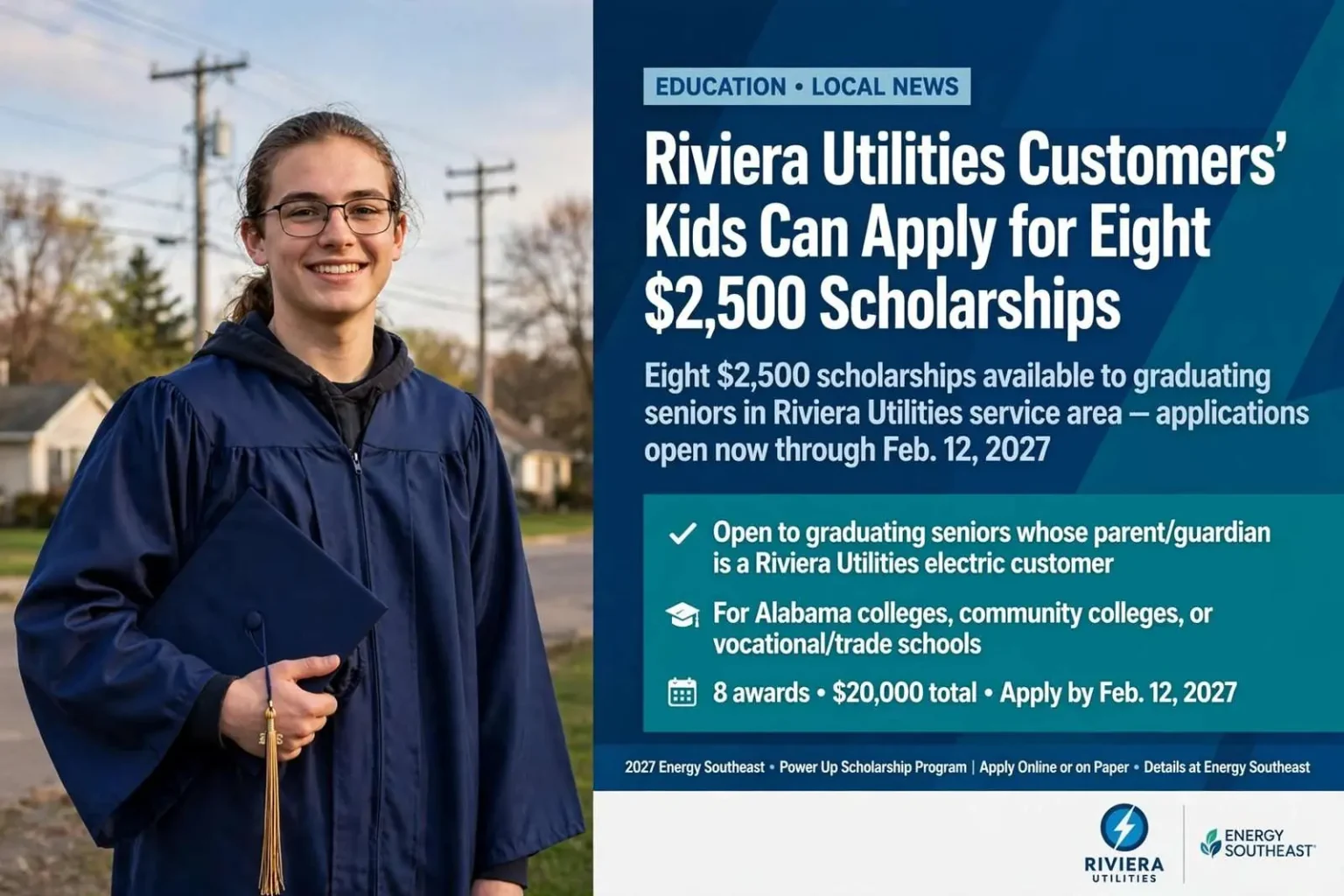
Eight graduating seniors in the Riviera Utilities service area will receive $2,500 scholarships next year, and the application window is open now for a deadline that is still months away.
The 2027 Energy Southeast Power Up Scholarship Program will award eight scholarships totaling $20,000 to students pursuing education after high school.
Who Qualifies
The program is open to graduating high school seniors whose parent or legal guardian is a Riviera Utilities electric customer.
Applicants must plan to attend an accredited institution in Alabama — a four-year college or university, a community college, or a vocational or trade school.
That last category matters. Scholarship programs frequently restrict awards to four-year degrees, which excludes students headed into exactly the skilled trades the Gulf Coast economy is short of. This one does not.
What to Submit
A complete application requires:
- A completed application form
- A high school transcript
- An ACT or SAT score certificate
- A résumé
- Two letters of recommendation
- A copy of the family’s most recent Riviera Utilities electric bill
Applications may be submitted online or on paper.
The Deadline Is Firm
All application materials must be received by Energy Southeast by Feb. 12, 2027.
Incomplete applications and applications received after the deadline will not be considered.
That is worth reading twice. The two letters of recommendation are the component most often responsible for a late or incomplete file, because they depend on someone else’s schedule. Students should request them well before the deadline approaches.
A Program With a Long Record
The Power Up Scholarship Program has provided more than $3.6 million in scholarships to graduating seniors across Alabama since 1992.
Energy Southeast member utilities and participating communities include Alexander City, Dothan, Fairhope, LaFayette, Lanett, Luverne, Opelika, Piedmont, Riviera Utilities and Sylacauga.
The structure — municipal and member utilities funding scholarships for the children of their own ratepayers — ties the award directly to the communities the utilities serve.