Governor Hopeful Bentley to Tour Oil-Threatened Coast by Boat
Republican governor candidate Robert Bentley planned a visit to south Mobile County, including a boat tour of the Bayou la Batre, Coden and Dauphin Island waters, to see firsthand the effects of the Gulf oil spill on the coastal communities.
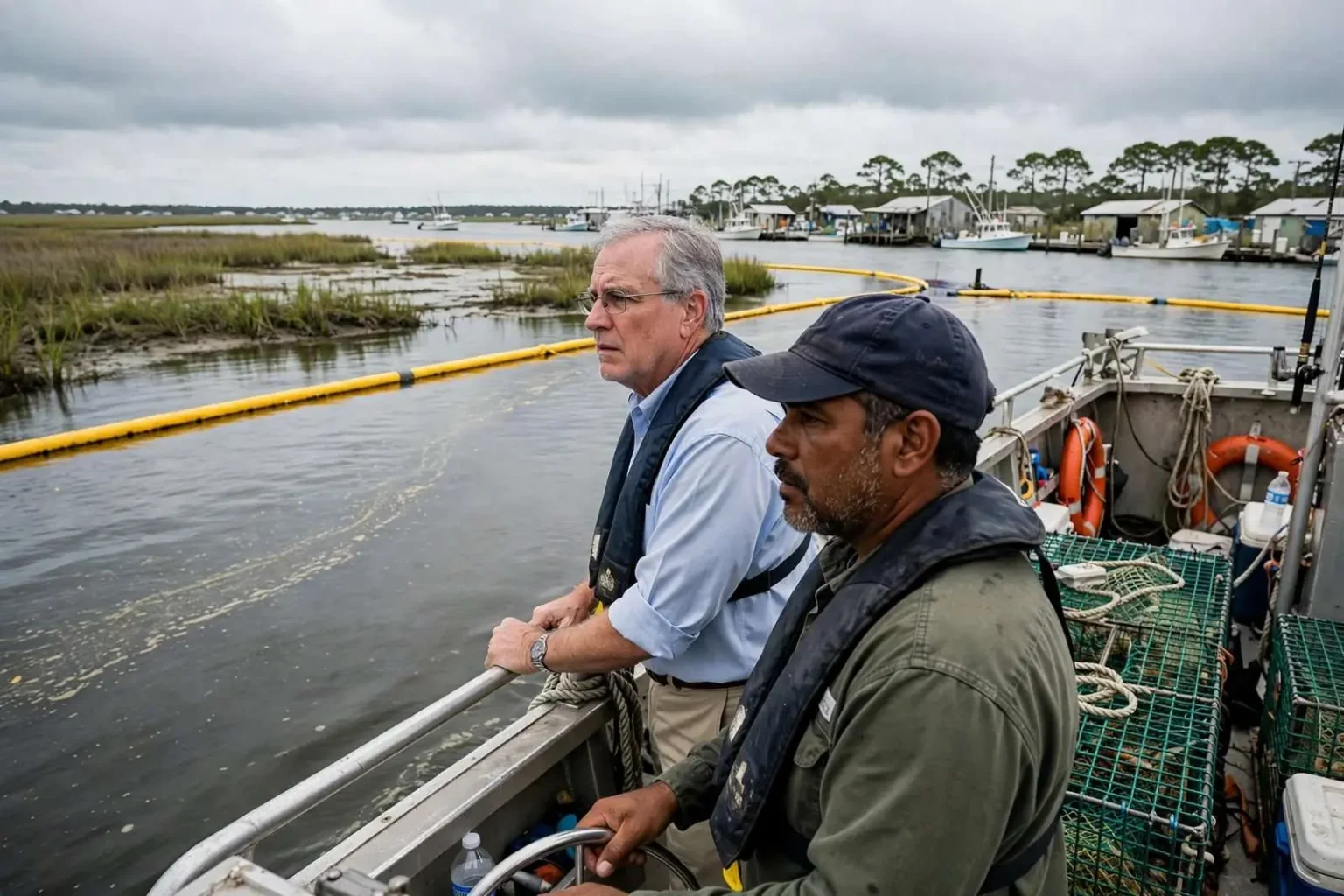
Republican candidate for governor Robert Bentley planned a swing through south Mobile County this week, pairing a public reception with a boat tour of the coastal waters where residents were bracing for the effects of the Gulf oil spill.
Bentley was set to attend a “meet and greet” at 2 p.m. Friday, June 18, at the Lighthouse Restaurant, 12495 Padgett Switch Road, in the Irvington and Bayou la Batre area, according to state Rep. Spencer Collier, who represented the district and supported Bentley’s campaign. The public was invited to the reception. Donations to the campaign would be accepted, Collier said, but they were not required to attend — a deliberate open-door format in a fishing community where the campaign wanted to listen as much as it wanted to talk.
Beyond the handshakes and questions, Collier said, Bentley intended to take a boat tour of the Dauphin Island, Coden, Bayou la Batre and Portersville Bay area. The aim, Collier explained, was to give the Tuscaloosa lawmaker and physician a better feel for the region and a deeper understanding of what the oil spill meant for the people who made their living on the water. Seeing the shrimp docks, the working boats and the bays themselves, the campaign hoped, would teach a candidate from inland Alabama something no briefing book could.
The visit came at an anxious moment for the fishing villages and island communities of lower Mobile County. The April 20 explosion of the Deepwater Horizon drilling rig had unleashed a spill in the Gulf of Mexico that threatened the shrimp boats, oyster reefs and shorelines that anchored the local economy. For places like Bayou la Batre and Coden, long defined by the seafood industry, the disaster was not an abstraction but a direct threat to livelihoods.
A coast on edge
Bayou la Batre, incorporated as a seafood capital and home to one of the largest processing fleets on the Gulf, had already rebuilt once in recent memory — from Hurricane Katrina, which wrecked its docks and boats in 2005 — and its residents were watching the water for signs that oil would repeat the damage. Oyster reefs in Mississippi Sound, shrimp grounds offshore and the marsh edges of Portersville Bay all sat within reach of the spreading slick, and every day of closed waters cost the fleet money it could not recover.
By touring the waters himself rather than reviewing them from a distance, Bentley signaled that the coastal crisis would be central to the closing stretch of his campaign. The communities he planned to visit each had their own character and their own concerns, and local leaders had stressed that outsiders often underestimated how distinct the needs of Dauphin Island, Bayou la Batre and the surrounding bays could be. Dauphin Island, a barrier island town guarding the entrance to Mobile Bay, depended on tourism and fishing; Bayou la Batre on processing and the fleet; Coden and the communities along the Causeway on a mix of both.
The spill had already begun reshaping the summer. Charter captains who could not book fishing trips were signing up for vessel-of-opportunity work, laying containment boom or patrolling for oil under contract to the response effort. Processors were watching supply chains tighten. Boat owners calculated whether the season’s losses would force them to sell. Into that uncertainty came a stream of politicians, and the people of lower Mobile County had developed a practiced wariness about visitors who came for photographs but stayed for an afternoon.
The runoff backdrop
Bentley was competing against Bradley Byrne in a July 13 runoff to decide the Republican nominee for governor. The winner would advance to the general election in the fall. With the primary behind them, both candidates were crisscrossing the state, and the oil-stricken Gulf Coast had become an unavoidable stop for anyone seeking to lead Alabama. Bentley had surprised the political establishment by advancing to the runoff, and every appearance from June onward was a chance to consolidate the support that had carried him there.
For south Mobile County voters, the appearance offered a chance to press a would-be governor on the questions that mattered most to them: how the state would respond to the spill, how it would press for relief for fishermen and coastal businesses, and how it would balance the region’s dependence on both the water and the energy industry. Those questions had no clean answers — the spill’s trajectory changed daily, and the response was run largely by the federal government and the company responsible — but candidates were expected to have a position anyway.
Collier, a former state trooper and legal investigator who represented Bayou la Batre in the Legislature, had emerged as a prominent local voice for Bentley, and the reception at the Lighthouse Restaurant reflected that support. A district representative’s endorsement matters most when it comes with an introduction to the community’s own leaders, and Collier’s role in arranging the boat tour made him the bridge between the campaign and the coast it was courting.
Residents interested in attending or learning more were directed to call the number the campaign provided. As the boat pushed off into the waters off lower Mobile County, Bentley joined a growing list of candidates and officials making the pilgrimage to the coast, where the spill had turned a summer campaign season into a referendum on how Alabama would weather one of the worst environmental disasters in its history.
The runoff’s geography gave the coastal swing added weight. Mobile County votes heavily in Republican primaries, and its southern communities — Bayou la Batre, Coden, Irvington, Grand Bay, Dauphin Island — turn out for candidates who show up. A runoff decided largely by who motivates his voters in June means a June afternoon on the water in Portersville Bay is not just symbolism; it is groundwork in precincts where a few hundred votes can decide the nomination.
Bentley’s own profile shaped what voters wanted to hear from him. A Tuscaloosa physician who had served in the Legislature and had never held statewide office, he was campaigning as an outsider with practical judgment rather than political experience. That message had carried him through the primary in a field of better-known rivals, and appearances in communities built on shrimping and boat work — trades as hands-on as medicine — played to the same argument. Voters along the bay were less interested in résumés than in whether a candidate would answer the phone when the next crisis came.
The broader backdrop was a spill still unfolding day by day. Estimates of the flow rate changed repeatedly, containment efforts moved through trial and error, and the question of when the well would be sealed remained open through the summer. Every campaign event on the coast took place against news from the water: new closures of fishing areas, new extensions of the spill’s reach, new arguments over who would pay for losses that had not yet been counted. For candidates, the tour-on-the-water became the required form of the period — an obligation to see the coast before asking the coast for votes.
Bentley’s swing through lower Mobile County ended where it began, at a restaurant that doubles as the social center of a fishing community. Whether the visit changed any minds was, as always, for the runoff to decide — but the mechanics of it, a public reception with no admission charge and a boat ride arranged by the district’s own representative, reflected a campaign that understood what the coast was asking for: presence, attention and a willingness to learn the water before promising to protect it.
The economic anatomy of the affected coast explains why the spill dominated every conversation there. Bayou la Batre’s economy has been built on the water for generations — shrimp boats, oyster boats and processing houses that supply markets across the Southeast — and the industry supports jobs far beyond the docks: net makers, diesel mechanics, ice houses, trucking companies and fish houses that move the catch inland. When the water closes, the closure travels up that chain within days, reaching workers who never set foot on a boat.
Dauphin Island faces the Gulf directly and carries the first physical risk of any oil coming ashore in the area. Its beaches, rental houses and fishing pier drive a seasonal economy, and its residents had spent years arguing for sand replenishment and storm protection after successive hurricanes. The prospect of oil on its shores threatened both the summer season and the island’s long struggle to keep its coastline intact.
State government’s role in a spill response is narrower than the public often assumes — the federal government directs the offshore response, and the responsible party pays claims — but a governor still matters enormously to coastal residents. The state sets inshore fishing closures, coordinates with the response command, presses the responsible party on claims and damages, and marshals the National Guard and state agencies for boom deployment and shoreline cleanup. Voters asking candidates about the spill were, in practical terms, asking how forcefully they would play that role.
The campaigns of the period treated the coast accordingly. Every candidate who passed through scheduled time on the water, met with seafood industry leaders and toured the docks, because the alternative — staying inland and issuing statements — was noticed. The boat tour Bentley planned with Collier followed the pattern that the summer’s crisis had established: in a year when the Gulf itself had entered the political argument, seeing it from a shrimp boat’s deck was the minimum credential for talking about it.