
Tea Party and Safety Talk Fill Robertsdale Public Library’s Free September Lineup
The Robertsdale Public Library has two free September programs: Miss Spider's Princess Tea Party for 3- and 4-year-olds on Sept. 16, and a Lunch and Learn safety session with Police Chief Daniel Steelman on Sept. 23.
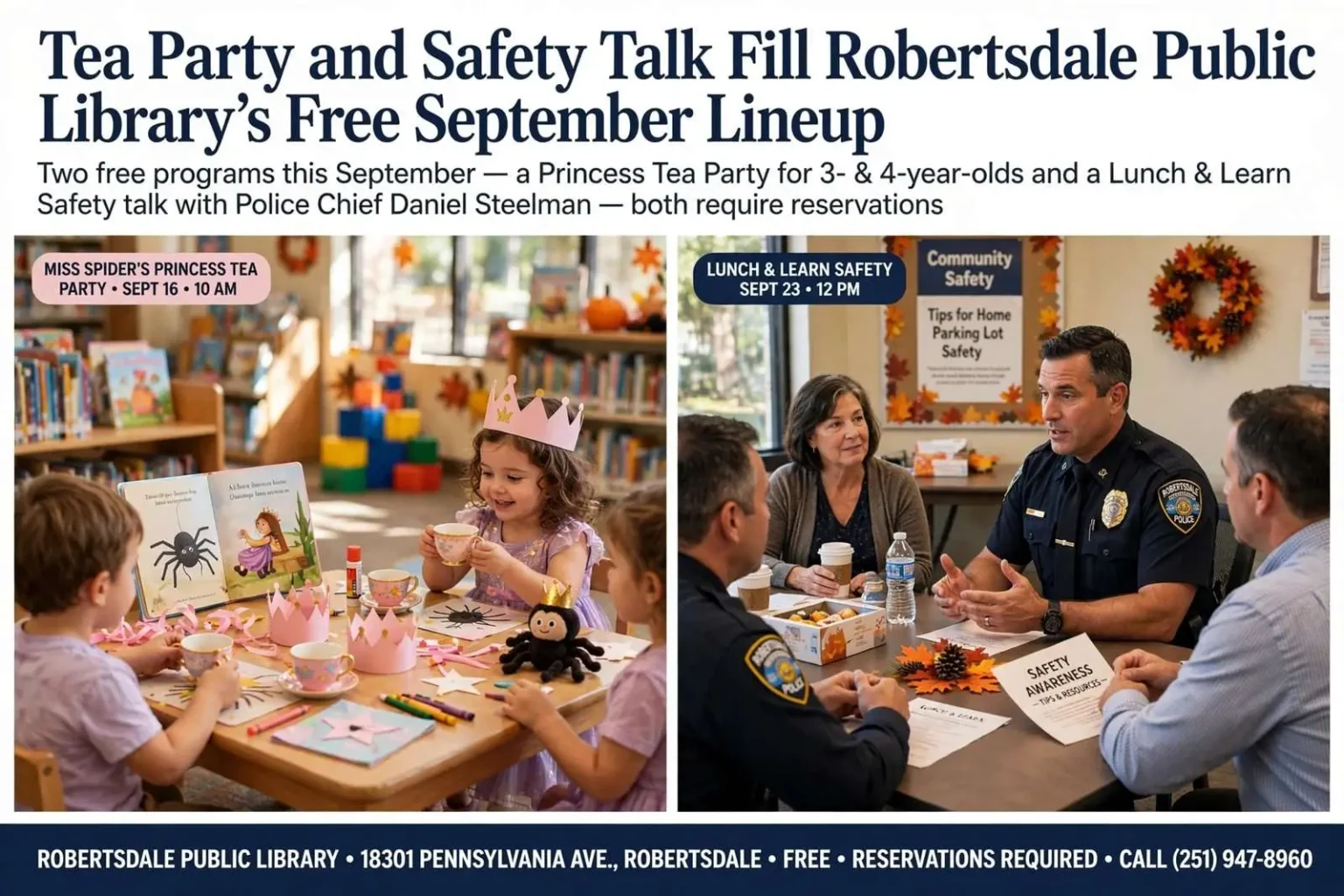
The Robertsdale Public Library has two free programs on its September calendar, one aimed at the youngest patrons in town and one aimed squarely at adults. Both require a reservation, and both are being offered at no cost.
First up is Miss Spider’s Princess Tea Party at 10 a.m. Wednesday, Sept. 16, built for 3- and 4-year-olds. The royal-themed morning combines story time with snacks, tea party activities, games and crafts. A week later, at noon Wednesday, Sept. 23, the library shifts audiences with Lunch & Learn Safety, a presentation by Robertsdale Chief of Police Daniel Steelman focused on increasing safety awareness. Lunch and a fall craft come with it, also at no charge.
Space is limited for both events and reservations are required. Parents, guardians and adults who want a seat can reserve one by calling the library at (251) 947-8960. The Robertsdale Public Library is located at 18301 Pennsylvania Ave. in Robertsdale.
Miss Spider’s Princess Tea Party
The Sept. 16 program is narrowly targeted by design: it is set for 3- and 4-year-olds, a two-year band that libraries often treat as its own developmental group rather than lumping it in with a general children’s story time. The morning begins at 10 a.m. and follows a royal theme, with story time as the anchor and snacks, tea party activities, games and crafts filling out the hour.
There is no cost to attend, but space is limited and a reservation is required. The library asks that parents or guardians call (251) 947-8960 to reserve a spot. The announcement does not state a capacity number or a reservation deadline, which is a practical argument for calling early rather than close to the date.
The announcement also does not detail which stories will be read or what the craft will be, so families should not plan around specifics that have not been published. What is confirmed is the age range, the date, the 10 a.m. start, the mix of activities and the fact that it costs nothing.
Why Programs Like This Matter for Early Literacy
A princess tea party for preschoolers is easy to file under “cute,” but the format is doing real work. Decades of research into early childhood development have established that the years before kindergarten are when the foundations of reading are laid, and that the strongest predictors of later reading success are things a story time is well suited to build.
Vocabulary is the clearest example. Children’s books, even simple ones, routinely use words that rarely come up in ordinary household conversation, which means being read to exposes a child to language they would not otherwise encounter. Repeated exposure to a wider vocabulary before kindergarten correlates strongly with reading comprehension years later.
Read-aloud sessions also build what researchers call print awareness — the understanding that the marks on the page carry the meaning, that English text runs left to right and top to bottom, that a book has a front and a back. None of that is obvious to a three-year-old, and none of it is taught explicitly. It is absorbed by watching an adult handle a book.
Then there is narrative structure: the sense that a story has a beginning, a middle and an end, that characters want things, and that events follow from one another. That framework is what a child later uses to make sense of a text they are decoding on their own.
Group story time adds a layer that reading at home does not. Sitting with other children, taking turns, listening to an adult who is not a parent and following directions in a room full of peers are all school-readiness behaviors, practiced in a setting with no consequences attached. For a child who has not been in day care or preschool, a library program may be the first structured group activity they experience.
The crafts and games are not filler either. Fine motor work — gripping, cutting, gluing, manipulating small objects — develops the hand control that later makes writing physically possible. Pairing that with a story ties the physical activity to the narrative, which helps retention.
Lunch and Learn With the Police Chief
The library’s second September program is aimed at adults. Lunch & Learn Safety is scheduled for noon Wednesday, Sept. 23, and will be presented by Robertsdale Chief of Police Daniel Steelman. According to the library, the presentation will focus on increasing safety awareness. Lunch and a fall craft will be provided, and there is no cost to attend.
As with the tea party, space is limited and reservations are required. The number is the same: (251) 947-8960.
What the announcement does not do is preview the content. It does not say which topics Chief Steelman intends to cover, whether the session includes a question period, or how long the presentation runs. Attendees should go in expecting the chief’s own agenda rather than a specific curriculum, and anyone with a particular concern they hope to raise may want to mention it when they call to reserve.
What Community Safety Talks Usually Cover
Presentations of this kind are a long-standing element of community policing, the general approach that treats regular non-enforcement contact between officers and residents as part of the job rather than an add-on to it. The underlying idea is that a department that residents already know is a department residents are more likely to call, and that prevention delivered in a library meeting room is cheaper than a response call later.
While no two departments present the same material, community safety talks in general tend to draw from a familiar set of subjects. Home and personal security is usually among them — lighting, locks, securing vehicles, and the habits that make a residence a less appealing target. Situational awareness in parking lots, at ATMs and while out walking is another common thread.
Fraud and scam prevention has become a staple of these sessions in recent years, particularly for audiences that skew older, because the tactics change constantly and the losses can be severe. Phone and text scams, impostor calls claiming to be from a government agency or a utility, romance and grandparent scams, and pressure tactics designed to get a target to move money quickly all fall in this category.
Departments frequently use the same forum to explain their own procedures: what actually happens when you call 911, what dispatchers need from you, how to file a report, what a department can and cannot do about a given problem, and which non-emergency number to use. Some sessions cover emergency preparedness, which on the Gulf Coast typically means hurricane season planning, evacuation decisions and what to do about utilities and medications during an extended outage.
Again, none of that is a description of what Chief Steelman has said he will present. It is context on the genre. The specifics belong to the chief and will be delivered on Sept. 23.
Public Libraries as Community Programming Hubs
The two events on Robertsdale’s September calendar illustrate something that regular library users already know and occasional ones sometimes do not: the modern public library is a community programming operation that also lends books.
Over the past several decades, American public libraries have steadily broadened their role. Circulation remains central, but so do public computers and internet access, meeting space, tax and government form assistance, job search help, summer reading programs, digital literacy instruction, and a calendar of free events spanning every age group. In smaller cities, the library is frequently one of the only indoor public spaces that anyone can enter without buying something, and that alone gives it a function no other institution fills.
The library’s role as a neutral convening space is what makes a program like Lunch & Learn Safety work. A police chief presenting at the library reaches residents who would not attend a meeting at the police station and would not think to call the department with a general question. The setting lowers the stakes for both sides.
The free lunch and the free craft serve the same purpose from a different direction. Programming aimed at adults, particularly midday programming, competes against every other demand on a person’s afternoon. Providing a meal turns the hour into something a resident can justify, and a craft component gives an attendee a reason to stay and talk afterward rather than leaving the moment the presentation ends. Those design choices are not incidental.
Reservations, Location and Contact
Both September programs are free, and both require advance reservations because space is limited. The library’s number for reservations and questions is (251) 947-8960.
- Miss Spider’s Princess Tea Party — 10 a.m. Wednesday, Sept. 16. For 3- and 4-year-olds. Story time, snacks, tea party activities, games and crafts. Free; reservations required.
- Lunch & Learn Safety — Noon Wednesday, Sept. 23. Geared toward adults. Presented by Robertsdale Chief of Police Daniel Steelman, focused on increasing safety awareness. Lunch and a fall craft provided. Free; reservations required.
The Robertsdale Public Library is at 18301 Pennsylvania Ave., Robertsdale, in central Baldwin County. Residents who want details the announcement did not include — capacity limits, how long each program runs, what to bring, or whether a parent must remain on site during the tea party — should ask when they call to reserve.
With both programs falling on consecutive Wednesdays and both capped by available space, the practical advice is the same for either one: call (251) 947-8960 sooner rather than later.