Robertsdale Rehabilitation and Healthcare Center Is Baldwin County’s Second-Largest Nursing Home
Robertsdale Rehabilitation and Healthcare Center ranks second in Baldwin County with 152 beds, 121 daily residents and a one-star CMS rating.
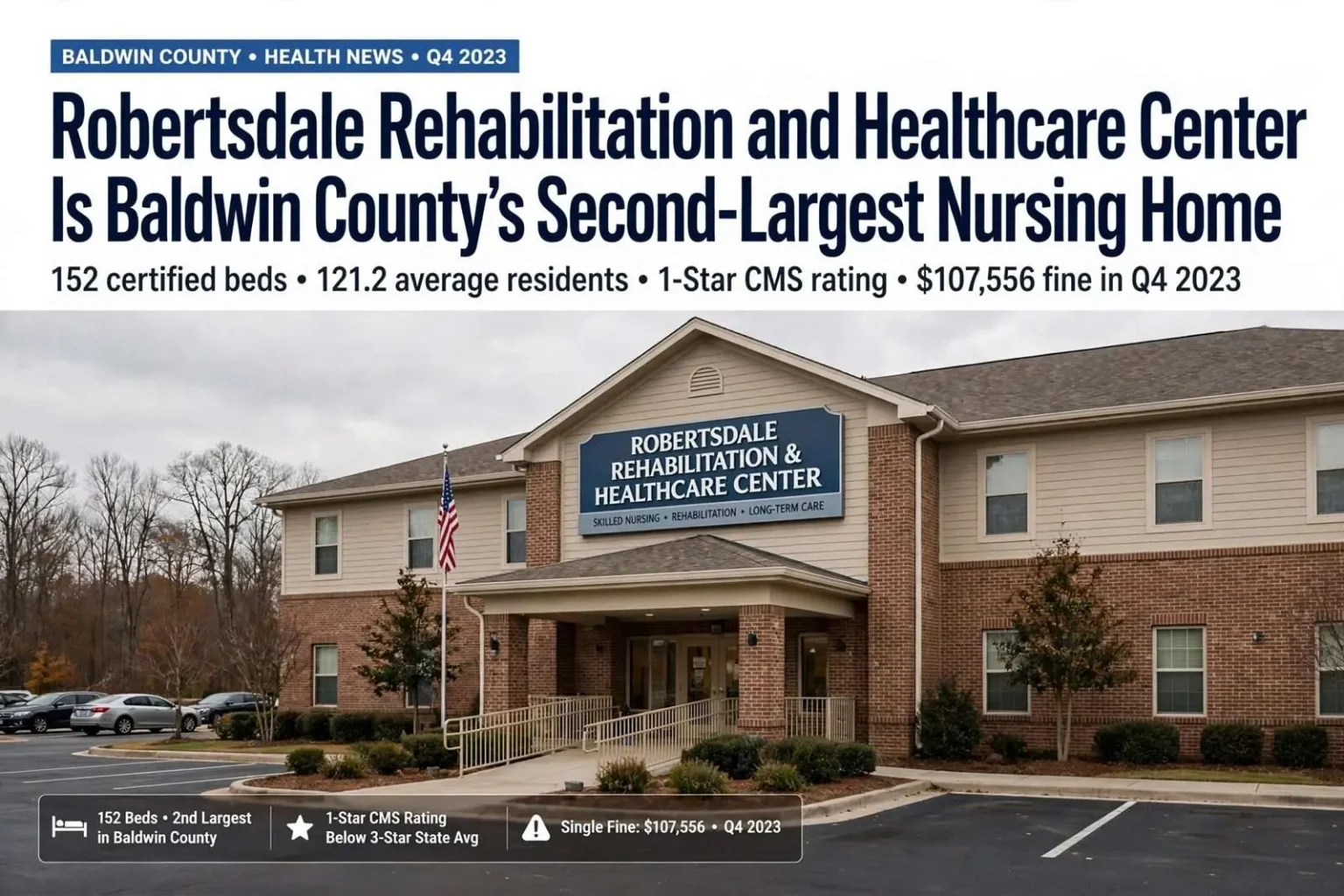
Robertsdale Rehabilitation and Healthcare Center ranked as the second-largest nursing home in Baldwin County as of the fourth quarter of 2023, with 152 certified beds — 42 more than the countywide average, according to federal data.
Only Diversicare of Foley was larger that quarter, with 154 beds. Fairhope Health and Rehabilitation came in third at 131 beds.
High Census, Low Star Rating
The Robertsdale facility ran one of the busiest censuses in the county, caring for an average of 121.2 residents during the quarter.
Its overall rating from the Centers for Medicare & Medicaid Services stood at one star for the period, well below the statewide Alabama average of three stars. CMS scores weigh health inspection outcomes, staffing levels, and quality-of-care measures.
Federal enforcement records for the quarter show the center paid a single fine totaling $107,556 and received one additional penalty — among the larger monetary penalties recorded against a Baldwin County nursing home during the period.
Robertsdale Rehabilitation was one of three for-profit nursing homes operating in Baldwin County at the time.
The five-star system that CMS applies to every certified nursing home in the country is the instrument through which this facility’s quarter is measured, and understanding the rating explains what the numbers mean. The overall star rating synthesizes three separately scored domains: health inspections, which reflect the deficiencies surveyors document on-site; staffing, which measures nurse hours per resident day against expected need; and quality measures, a set of clinical indicators drawn from facility-reported data — falls, pressure ulcers, antipsychotic use, rehospitalizations among them. A one-star overall rating places a facility in the bottom tier nationally, and its distance from Alabama’s three-star average describes a facility whose inspection, staffing, or quality profile — or some combination — trails the state’s already modest norms. Alabama’s nursing homes have historically clustered below the national average in staffing ratings, which makes a one-star facility’s position within that landscape a signal of compounding concerns rather than a single metric’s failure.
The $107,556 fine recorded against the facility in the quarter falls under the enforcement system CMS applies when inspections find deficiencies that place residents in immediate jeopardy or at actual harm. Civil monetary penalties are tiered: the most serious — per-instance penalties for deficiencies at the immediate-jeopardy level — can reach into six figures per violation, with the amount scaled to the facility’s size, the severity and duration of the noncompliance, and the facility’s history. A penalty of that magnitude in a single quarter is what surveyors document when the failures are not paperwork lapses but events — failures of care with consequences for identifiable residents. Enforcement records are public, posted on CMS’s Care Compare site alongside the star ratings, on the theory that families choosing a nursing home deserve to see both the marketing and the record.
The census figure — 121.2 residents on average in a 152-bed facility — describes an occupancy rate near 80 percent, which is characteristic of facilities that draw from both their county’s aging population and the referral pipelines of hospitals and rehabilitation needs. Baldwin County’s growth has made it one of the fastest-aging counties in Alabama, its coastal communities attracting retirees whose eventual care needs concentrate in the county’s nursing facilities. The county’s nursing homes thus operate under a dual pressure: demand for beds from a growing elderly population, and the staffing — certified nursing assistants, licensed practical nurses, registered nurses — that high census requires. Staffing is where the economics of the for-profit model meet the inspection system: labor is the largest cost in nursing home operations, and the hours-per-resident measures that CMS scores are the metric most sensitive to cost discipline.
The for-profit structure noted in the data — one of three for-profit homes in the county — connects to a national research literature that families rarely see when choosing care. Studies comparing ownership types have consistently found that for-profit facilities, on average, score lower on staffing and quality measures and higher on deficiency counts than their nonprofit and government counterparts, a pattern attributed to the profit margin’s claim on revenue that nonprofits redirect to care. The finding is a statistical tendency, not a destiny — well-run for-profit homes exist, and poorly run nonprofits do too — but its persistence across decades of data is why ownership appears in the facility profiles that consumer advocates publish. In Baldwin County, where the majority of facilities are nonprofit, the three for-profit operations carry that comparative weight in the county’s care landscape.
Robertsdale itself — the small city in central Baldwin County where the facility operates — reflects the geography of nursing home placement. Facilities concentrate where land is available, hospital referrals flow, and families from across the county can reach them; Robertsdale’s position along the Highway 59 corridor places it within driving distance of the county’s population centers from Gulf Shores to Bay Minette. For the families of residents, the facility’s location shapes the visits that research links to care quality: residents with regular visitors receive more attention, families observe problems earlier, and the informal oversight that engaged families provide supplements the surveyors’ annual inspections.
The quarter’s data, drawn from CMS’s public reporting system, is the same record that families choosing among Baldwin County’s facilities can consult — the stars, the fines, the inspection reports, and the staffing hours, all searchable by name and location. Consumer advocates recommend reading the underlying inspection surveys, not only the summary stars: the narratives describe what surveyors found, how residents were affected, and what the facility agreed to correct. For a facility carrying a one-star rating and a six-figure penalty in the same quarter, the record invites exactly that deeper reading — and the public availability of the data ensures that the facility’s performance remains visible to the families whose decisions the record exists to inform.
The inspection process that generates deficiencies and penalties operates on a cycle that families can follow. Every certified facility is surveyed at least once every fifteen months — more often where complaints or incidents trigger investigations — by state survey agencies working under CMS contract. Surveyors arrive unannounced, spend days reviewing records, observing care, interviewing residents and staff, and the deficiencies they cite are categorized by scope and severity: from isolated paperwork failures at the lowest level to widespread failures causing actual harm or immediate jeopardy at the top. The penalty structure attaches to the upper levels, and a facility’s penalty history — like the $107,556 recorded against Robertsdale Rehabilitation this quarter — remains in the public record alongside the corrected deficiencies, a permanent footnote to the facility’s inspection narrative.
Staffing measures deserve particular attention in reading any nursing home’s numbers because they are the input most directly tied to care. CMS’s staffing ratings compute nurse hours per resident day — separating registered nurses, licensed practical nurses, and aides — and the expectations rise with a facility’s acuity: residents needing rehabilitation or dementia care require more hands than those who are largely independent. Federal minimums require a registered nurse on duty eight hours daily and a licensed nurse around the clock, but the clinical literature points far higher for good outcomes: the ratio of aides to residents determines whether call lights are answered promptly, whether residents are repositioned to prevent pressure ulcers, whether falls are interrupted. The staffing star ratings that trail in facilities with one-star overall scores are, in that sense, not an administrative detail but the measurable predictor of the daily experience inside.
Alabama’s nursing home landscape gives the county figures their state context. The state’s facilities have historically scored below national averages on staffing and overall ratings — a reflection of Medicaid reimbursement rates among the nation’s lowest, a workforce shortage that predates the pandemic and deepened through it, and the economics of operating facilities whose residents are predominantly covered by public programs. Nursing facility operators in Alabama and across the country have argued that the reimbursement rates make adequate staffing unaffordable; consumer advocates respond that some operators extract comfortable margins at exactly that staffing level. The dispute is the standing policy argument of long-term care — and the reason a county’s facility-level data, showing which homes run higher staffing and cleaner inspections than their peers, is the practical information families can actually use.
The quarter’s numbers also register the seasonal dynamics of the nursing home business. The fourth quarter brings the census pressures of winter illness, the staffing strains of holidays, and the annual recertification cycles of Medicare stays that drive many facilities’ revenue. Facilities’ quality measures — falls, rehospitalizations, pressure injuries — also shift with census and acuity, which is why CMS’s ratings update quarterly and why a single quarter’s data, while revealing, is best read against the facility’s trajectory: a home whose stars have fallen from three to one tells a different story than one that has hovered at one star for years. The public database preserves that history, letting families distinguish a bad stretch from a chronic pattern.
For Baldwin County’s families, the practical takeaway from the data is the same as it is anywhere: the stars are a starting point, the inspection narratives are the substance, and the visit — unannounced, at mealtimes, on a weekend evening — is the test no database replaces. The federal system publishes its record precisely so that the market of families choosing care can see what regulators found; a facility’s response to that visibility — staffing investment, leadership change, measurable improvement across quarters — is the trajectory that matters more than any single quarter’s stars. The numbers for the fourth quarter of 2023 place Robertsdale Rehabilitation at a point of scrutiny; what follows that point is what families considering the facility will want to know.