Bookkeeper for Robertsdale Synthetic Drug Operation Pleads Guilty to Fraud
A bookkeeper for a synthetic drug operation that relocated to Robertsdale pleaded guilty to a federal fraud conspiracy charge.
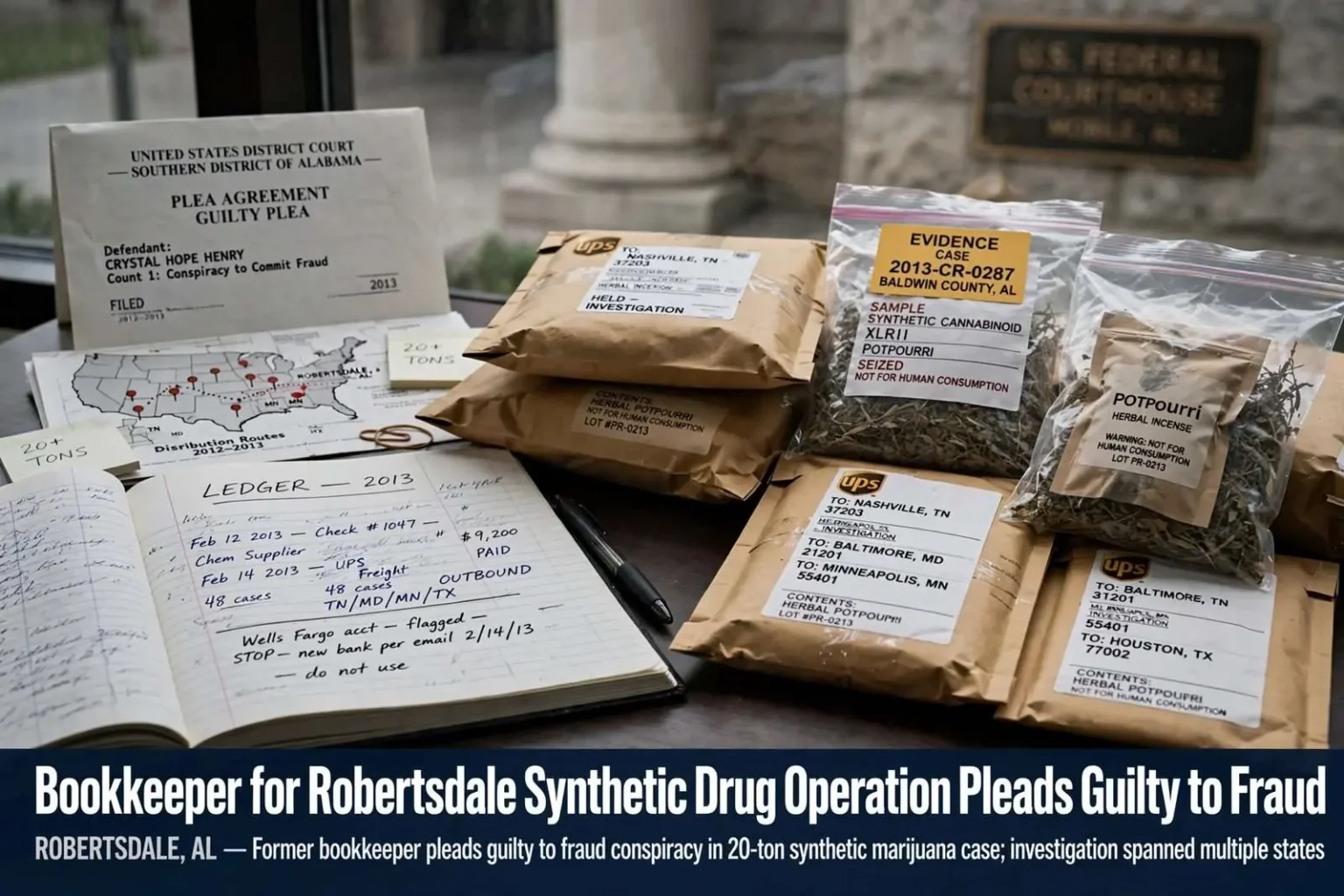
ROBERTSDALE, Alabama — A Pensacola woman who worked as a bookkeeper for a company that shipped tons of synthetic marijuana disguised as potpourri has pleaded guilty in federal court to a conspiracy charge tied to the operation’s Baldwin County ties. Crystal Hope Henry admitted to helping manufacture and distribute more than 20 tons of synthetic cannabinoids, sold under the label of potpourri and marked not for human consumption, then shipped to customers in states including Tennessee, Maryland, Minnesota and Texas.
Prosecutors said Henry worked as the operation’s bookkeeper, writing checks to suppliers and coordinating outbound shipments. Her guilty plea pulls back the curtain on the administrative machinery that kept the enterprise running: behind every package of synthetically treated plant material that reached a smoke shop or online customer was a ledger, a checking account, and someone booking the payments, ordering the chemicals, and scheduling the freight.
The scale of the operation places it among the larger synthetic drug cases prosecuted on the Alabama Gulf Coast. Twenty tons of product is not a garage venture; it is an industrial quantity that requires bulk chemical suppliers, warehouse space, packaging operations, and a distribution network spanning multiple states. Federal prosecutors built their case around that infrastructure, tracing how money moved in and how packages moved out.
Mobile’s police chief has described synthetic cannabinoids, sometimes called spice, as one of the most serious public health threats seen in the region since the crack epidemic of the 1980s. The comparison reflects what emergency rooms and law enforcement agencies along the Gulf Coast experienced during the height of the synthetic drug wave: users arriving with violent reactions, psychosis, seizures, and kidney injuries, with no reliable way for medical staff to know which compound had been ingested or how to counteract it.
What Synthetic Cannabinoids Are
Synthetic cannabinoids are human-made chemicals sprayed onto dried plant material, designed to bind to the same receptors in the brain as THC, the active compound in marijuana. The products were sold openly for years under names like spice and K2, packaged as potpourri, incense, or herbal smoking blends and stamped with the disclaimer “not for human consumption,” a fig leaf that manufacturers used to dodge federal analog laws while everyone involved understood exactly what the product was for.
The danger comes from the chemistry. Unlike plant-grown marijuana, whose potency varies within a known range, synthetic cannabinoids are full chemical agonists, and different batches can carry entirely different compounds at wildly different strengths. Users and dealers alike often had no way to know which substance was in a given bag, and the compounds that emerged as manufacturers raced to stay ahead of emergency bans grew progressively more powerful and more toxic through the early 2010s.
Public health agencies across Alabama and the broader Gulf South documented the consequences in emergency department visits, poison control calls, and overdose deaths, and the state legislature, like legislatures across the country, responded with waves of statutes naming specific compounds as controlled substances. The Robertsdale operation’s choice of location and its customer base stretching from Tennessee to Texas show how the trade operated across state lines even as individual states moved to outlaw it batch by batch.
A Banking Trail and a Move to Robertsdale
Court records included an internal email Henry sent to coworkers in February 2013 instructing them to stop using a Wells Fargo account after the bank began scrutinizing the unusually large sums moving through it, warning that the bank no longer wanted their industry’s business. The email captures the quiet squeeze that eventually drove synthetic drug operations out of the legitimate financial system: as banks recognized the industry and its deposit patterns, accounts closed, and operators moved money through a shifting series of banks, business fronts, and payment methods to stay ahead of the scrutiny.
When Florida outlawed certain synthetic chemicals in December 2012, the company relocated its operations to Robertsdale and rebranded under a new name. The move illustrates the migration pattern that defined the synthetic drug trade of that era: operators set up shop wherever the chemical bans had not yet caught up to the latest formulations, staying in a jurisdiction just long enough for the law to arrive, then relocating across a state line to start the cycle again.
Robertsdale, a small Baldwin County city in the heart of south Alabama’s fastest-growing county, became an unlikely node in that network. The town of modest size and strong agricultural roots offered what the operation needed most: warehouse capacity, proximity to interstate and port shipping lanes, and the low profile of a community where a new business moving into an industrial space attracted little attention.
The rebranding effort extended beyond the name. Product labels changed, packaging shifted, and the company’s paper trail was carefully maintained to present a legitimate potpourri business to any vendor, landlord, or bank that asked. What the operation could not fully disguise was the physical flow of goods, and that flow is what eventually brought it down.
A UPS Store Tip Leads Investigators to Baldwin County
The relocation eventually drew law enforcement attention after the manager of a UPS store in Daphne noticed a pattern of suspicious packages and alerted a U.S. Postal Inspector. The manager’s suspicion grew from details that recur in shipping-fraud investigations: an unusual volume of uniformly sized parcels, a customer paying in cash, sender information that did not hold up, and the distinctive smell that clings to packages of sprayed plant material. Rather than let the pattern continue, the manager reported it, turning a shipping counter in a Baldwin County strip center into the thread that unraveled the operation.
The inspector traced the packages to Henry and found they contained a banned chemical compound known as XLR11, which produces effects similar to marijuana. XLR11 had been temporarily designated a controlled substance by federal authorities as part of the emergency scheduling process, which meant that shipping it in consumable form, whatever the label said, violated federal law. The chemical identification transformed a suspicion about odd packages into evidence of a specific, prosecutable crime.
Federal prosecutors said the conspiracy was built around deceiving the Food and Drug Administration and Drug Enforcement Administration in order to keep distributing the product for human use despite its packaging claims. The fraud, in other words, was not incidental to the business; it was the business. Every element, from the “not for human consumption” stamps to the potpourri labeling to the constant reformulation of chemicals, existed to defeat the regulatory system while continuing to sell a product everyone knew would be smoked.
That framing explains the conspiracy charge Henry pleaded to. By writing the checks, managing the accounts, and coordinating the shipments, she participated in the scheme’s infrastructure regardless of whether she ever handled the chemicals herself, and federal conspiracy law holds every participant responsible for the lawful and unlawful acts of the enterprise in pursuit of its shared goal.
The Bookkeeper’s Role in a Drug Operation
Henry’s position illustrates how financial roles carry real criminal exposure in fraud conspiracies. Bookkeepers occupy the junction of an enterprise’s money and its paperwork: they see the supplier payments, the customer deposits, the shipping invoices, and the inconsistencies between what the business claims to sell and what it actually pays for. In prosecutions across the country, operators’ financial staff have faced the same charges as the principals, and cooperating bookkeepers have often provided investigators their clearest window into how the enterprise functioned.
Her admitted duties, writing checks to suppliers and coordinating outbound shipments, map directly onto the two arteries of the operation, money and product. Cutting off either artery kills the business, which is why financial crimes investigations treat the movement of funds with the same seriousness as the movement of contraband. The February 2013 email about the Wells Fargo account, preserved in court records, gave prosecutors a document tying her directly to the operation’s awareness that its banking was under scrutiny.
The plea also demonstrates the reach of federal fraud statutes into apparently mundane conduct. No one contends that Henry synthesized the chemicals or stood behind a shipping counter; her culpability runs through ledgers and labels, yet the potential penalties attach all the same. For the community of small businesses, accountants, and bookkeepers along the Gulf Coast, cases like this one serve as a standing reminder that serving a client or employer engaged in fraud is participation, not neutrality.
The Case Continues
The case continues for the co-defendant charged alongside Henry, whose proceedings remain pending in federal court while Henry’s sentencing awaits the completion of the pre-sentence investigation process. That sequencing is standard in multi-defendant federal cases, allowing the court to resolve each defendant’s responsibility separately and, where cooperation is involved, to credit assistance at the time of sentencing.
For Baldwin County, the case marked a local chapter in a national story. The synthetic drug wave that swept the country in the early 2010s left its marks everywhere from smoke shops along the coast to emergency rooms in Mobile and Pensacola, and the prosecutions that followed, built on tips from shipping clerks, banking records, and chemical analysis, dismantled operations that had hidden in plain sight behind retail storefronts and rural warehouses.
The more than 20 tons of product Henry admitted helping manufacture and distribute gives a sense of the volume involved, and the destination states, Tennessee, Maryland, Minnesota and Texas, show a distribution web that stretched across half the country from a warehouse in a small Alabama town. Investigators and prosecutors who worked the case have pointed to it as an example of how federal, state, and local agencies can connect when a single alert shipping manager picks up the phone.
Henry’s plea resolves her role in the conspiracy, but the public health concerns she helped fuel have outlasted the prosecution. Synthetic cannabinoids continue to evolve faster than the laws that ban them, and Gulf Coast law enforcement agencies continue to rank the compounds among the most dangerous substances they encounter, a threat measured not in tons shipped but in the emergency room visits that follow each new formulation onto the market.