Salute to Our Military: Remembering Sergeant First Class Howard Ard
This week's Salute to Our Military honors Sergeant First Class Howard Ard of Jay, who served in the U.S. Army and lost his life in Vietnam.
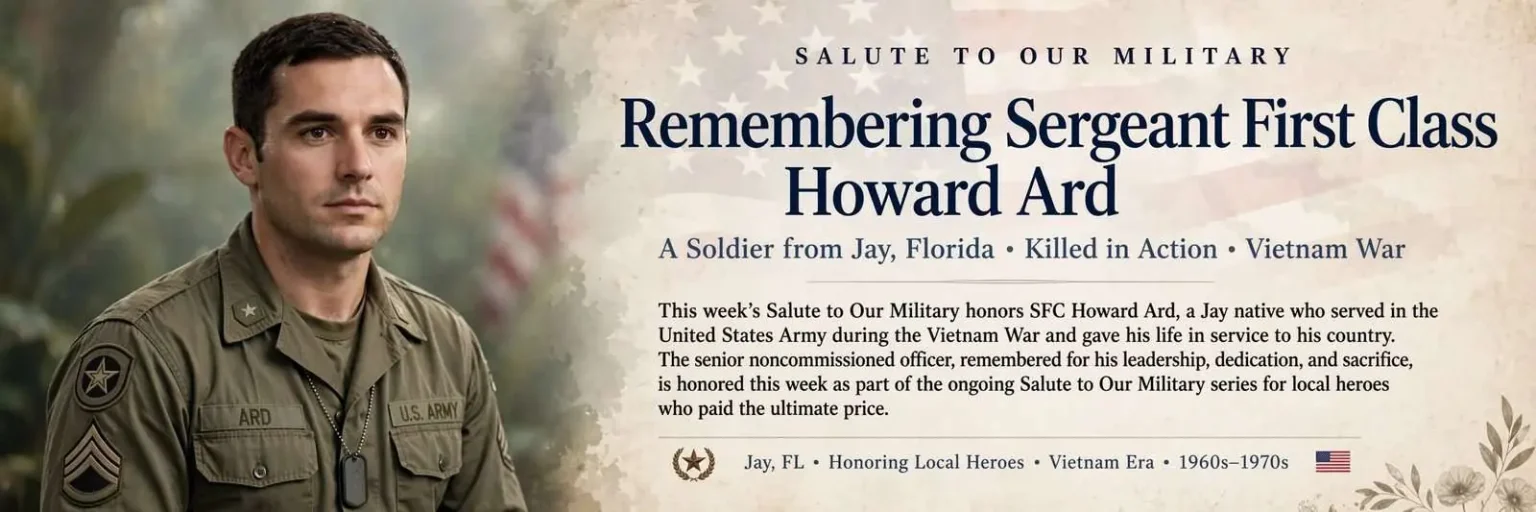
This week’s Salute to Our Military honors Sergeant First Class Howard Ard, a soldier from Jay who served in the United States Army during the Vietnam War and gave his life in service to his country. Ard lost his life while serving in Vietnam, taking his place among the American service members who never came home from one of the longest and most consequential conflicts in modern American military history. His rank of Sergeant First Class placed him among the Army’s senior noncommissioned officers, a position that typically comes with significant responsibility for leading, training and caring for the soldiers under his charge.
Salutes like this one exist to make sure that sacrifices such as Ard’s are not forgotten, particularly in hometown communities where a fallen service member’s name can otherwise fade from public memory over the decades. Behind every name carved into a memorial or recorded in military archives is a person with roots in a specific hometown, a family who waited for word, and a community that continued to carry his memory forward long after the war ended. This week’s recognition is part of an ongoing effort to honor local residents who served in the United States armed forces, especially those who, like Ard, paid the ultimate price while wearing their country’s uniform.
The Making of a Senior Noncommissioned Officer
The rank of Sergeant First Class occupies an important place in the structure of the United States Army. Sitting among the senior enlisted grades, it marks a soldier who has advanced beyond the junior leadership ranks and is entrusted with some of the most demanding duties in the force. Sergeants First Class commonly serve as platoon sergeants, the senior noncommissioned officers who stand beside a platoon leader and manage the day-to-day welfare, discipline and readiness of dozens of soldiers. The position demands years of accumulated experience, and reaching it generally reflects a career of demonstrated competence and commitment.
For the soldiers serving under a Sergeant First Class, the role is often the most personal in the entire chain of command. Officers may set the plan, but it is the senior noncommissioned officer who makes sure the plan can be carried out — who knows which soldier is struggling at home, who needs extra training on a weapon system, and who can be counted on when conditions get difficult. In a war zone, that responsibility carries even greater weight. A Sergeant First Class in Vietnam was frequently the steady hand at the center of a platoon’s daily life, from patrolling and security to the quiet routines that kept morale intact far from home.
That Ard held this rank at the time of his death speaks to a military career of substance. Noncommissioned officers reach that level through promotion systems that measure leadership, technical skill and time in service, and few soldiers rise to it without having already spent a considerable portion of their lives in uniform. While the details of Ard’s individual service record are not recounted here, his rank alone indicates a soldier trusted with the training and welfare of others — a man whom younger soldiers would have looked to for guidance in some of the hardest circumstances the Army can present.
The Vietnam War and Its Weight on American Communities
The Vietnam War remains one of the most costly and divisive conflicts in modern American military history. American involvement grew steadily through the early 1960s and expanded into a large-scale ground war that continued for years before United States forces withdrew in the early 1970s. The war was fought in jungles, rice paddies and village landscapes that bore little resemblance to the battlefields of earlier American conflicts, and it placed extraordinary demands on the soldiers who served there. Service was drawn from communities across the entire country, and the human cost reached into small towns and big cities alike.
Unlike the wars that followed, which have relied heavily on an all-volunteer force, the Vietnam era was defined by the draft. Young men from every kind of background received induction notices and reported for training, and families across the Gulf Coast region and the rest of the nation sent sons off to a war many of them did not fully understand. Tens of thousands of those Americans did not return home. The names of the fallen were eventually etched into the Vietnam Veterans Memorial in Washington, D.C., a wall that has become one of the most visited and most personally affecting memorials in the capital, but the losses registered there began as individual holes in individual hometowns.
For communities in the rural South, including the small farming towns that dot the region along the Alabama line, the war’s reach was deeply personal. Military service was woven into the culture of the region, and it was common for young men to enlist or to answer the draft and head off to basic training within months of finishing high school. When a local soldier was killed, the news traveled quickly through churches, schoolhouses and storefronts, and the community’s grief was shared in a way that only small places understand. Flags were lowered, funeral processions moved slowly down main streets, and a family’s loss became the town’s loss.
Jay: A Small Town That Sent Its Sons to War
Jay, the community Ard called home, sits in the far corner of the Gulf Coast region near the Alabama state line, a small farming town surrounded by cotton, peanut and soybean fields. It is the kind of place where generations of families have lived and worked the land, where the local school is a centerpiece of community identity, and where nearly everyone knows the names of the families who have been there for a century or more. Towns of this size have historically contributed far more than their share of America’s service members, sending their young men and women into every branch of the armed forces and into every major conflict of the past century.
In a community like Jay, the loss of a local resident in combat leaves a mark that does not fade with a news cycle. The fallen soldier is somebody’s classmate, somebody’s son, somebody who played on the same ballfields and sat in the same pews. Military service is honored at American Legion and Veterans of Foreign Wars posts across the region, in school programs that invite veterans to speak, and in the quiet rituals of Memorial Day and Veterans Day, when communities pause to name the people from their own streets who served. Recognitions such as this week’s Salute to Our Military continue that tradition, ensuring that a name like Howard Ard’s remains attached to a story rather than slipping into anonymity.
The towns along this stretch of the Gulf Coast have long maintained a close relationship with the military installations of the region, from the Army and Air Force bases of the Florida Panhandle to the naval and Coast Guard facilities around Mobile Bay. That proximity has made military service a familiar path for generations of local families, and it has also meant that the region’s communities have borne their share of wartime losses. Each of those losses was once a daily presence: a neighbor, a coworker, a friend of the family. Preserving the record of those individual sacrifices is part of preserving the region’s own history.
Why Hometown Recognition Matters
Military records preserve the essential facts of a fallen soldier’s service — rank, unit, date and place of loss — but records alone cannot convey what a soldier meant to the people who knew him. That is the work of hometown remembrance. When a local newspaper or community organization honors a fallen service member by name, it restores the connection between the individual and the place that produced him. It tells younger generations that the names on the courthouse monument or the veterans memorial belong to real people who walked the same roads they walk today.
This kind of recognition also serves the families of the fallen, for whom the loss does not end when the war does. Parents, siblings, spouses and children of service members killed in Vietnam carried their grief through decades of a national conversation that was often more focused on the war’s politics than on the people who died in it. Simple, direct acts of local gratitude — a salute published in the paper, a name read aloud at a ceremony — affirm that the sacrifice was seen and that it is still valued by the community the soldier came from.
The Salute to Our Military series, in which this recognition of Sergeant First Class Ard appears, is intended as an ongoing effort rather than a single gesture. Communities across the Gulf Coast region have produced service members in every branch and in every era, from World War II through Korea and Vietnam to the conflicts of the Middle East. Honoring them one at a time, week after week, builds a cumulative record of local service that might otherwise exist only in scattered family memories and yellowed clippings.
The Legacy of Those Who Did Not Return
The Vietnam War generated a complicated aftermath in American life, but one point of consensus has endured: the men and women who served there deserved to be honored for their service, and those who died there deserved to be remembered for their sacrifice. Over the decades since the war ended, the nation has worked to give Vietnam-era veterans the recognition that was often denied to them at the time. The Vietnam Veterans Memorial, dedicated in the early 1980s, became a national act of remembrance, and communities across the country have held their own tributes — hometown memorials, school dedications, and veteran recognitions of the kind that continues this week in this publication.
Sergeant First Class Howard Ard’s story belongs to that larger history while remaining intensely local. He was a senior noncommissioned officer in the United States Army, a leader of soldiers, and a man from a small Gulf Coast town who went to war and did not come home. The rank he held, the war he fought and the community he came from together describe a life of commitment that deserves to be spelled out plainly rather than reduced to a line in an archive.
This week’s salute is offered with that purpose. Thank you for your service, and for your ultimate sacrifice, Sergeant First Class Howard Ard. The community that remembers you this week does so on behalf of every generation that has followed, so that the name, the rank and the sacrifice remain part of the living record of this region’s contribution to the nation’s defense.