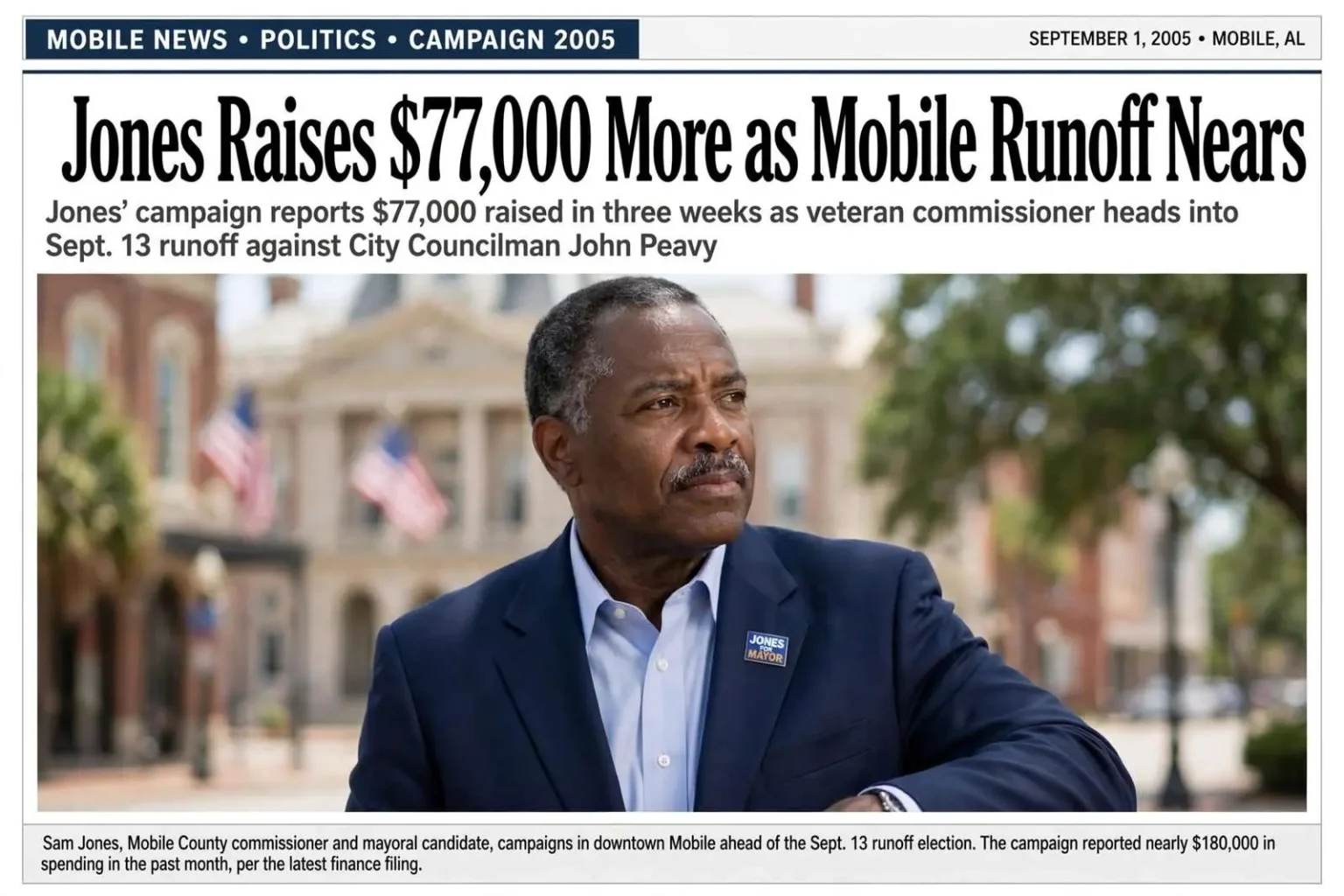
Sam Jones’ campaign for mayor of Mobile kept its financial machinery running at full speed heading into the Sept. 13 runoff, raising more than $77,000 in three weeks and spending close to $180,000 in a month, according to his latest pre-election finance report.
The veteran Mobile County commissioner had led the four-candidate field in the Aug. 23 general election with 47.8 percent of the vote — short of the majority required to win outright. City Councilman John Peavy took more than 25 percent to earn the second spot in the runoff.
The numbers told the story of a front-runner consolidating: Jones entered the two-week sprint toward the runoff with the lead, the money and the institutional backing that pre-election reports measure — the cash that funds the final advertising, the mail pieces and the get-out-the-vote effort that decides runoffs in a city where turnout falls from the summer primary to the September runoff.
A notable contribution
Among the donations recorded was $500 from A.J. “Jay” Cooper, who had been elected the first Black mayor of Prichard — a symbolically weighted gift to a candidate seeking to become Mobile’s first Black mayor.
Prichard, immediately north of Mobile, had elected Cooper decades earlier, and the contribution linked two chapters of the same regional story. Mobile County’s largest cities had followed different paths through the same history: Mobile, the county seat and the state’s second-largest city, had never elected a Black mayor, while its smaller industrial neighbors to the north — Prichard and, in time, others — had. Cooper’s gift carried the weight of that record: an endorsement from the man who had broken the barrier one city over, offered to the candidate positioned to break it in Mobile itself.
For Jones, who had spent decades in county government building a coalition across racial and geographic lines, the contribution fit the campaign’s profile — support from established figures across the region rather than a single faction or neighborhood.
The stakes of the moment were plain. Mobile’s Black voters had long been decisive in city elections, and the 2005 field included candidates positioned to draw support from every part of the city’s political map. The Aug. 23 results had sorted that field into two: Jones, with the broadest coalition and the most money, and Peavy, the councilman with deep roots in the city’s core neighborhoods. Everything between the primary and the runoff — including the finance report — was about which campaign could extend its coalition past the finish line.
Who else was writing checks
The filing showed a broad institutional coalition consolidating behind the front-runner:
$5,000 from the Alabama Realtors PAC and from Jeffco PAC; $3,000 from Millennium Mobile LLC, a Los Angeles-based concern that hoped to build a multi-story residential and retail development in downtown Mobile with city backing; and $3,000 from the trial firm Cunningham Bounds, Yance, Crowder & Brown.
$2,500 each came from David J. Eckhart of Pottstown, Pa.; the firm of Galloway, Smith, Wettermark & Everest; Chester J. Stefan; and J. Norman Estes. Two-thousand-dollar checks arrived from City Attorney James E. Atchison of the Dow administration, from the firm Taylor Martino PC, from Giles Gilpin Perkins and from SawPAC.
$1,000 donations came from the re-election committee of City Councilman Fred Richardson and from U.S. Rep. Artur Davis, D-Ala. A long list of $500 and $1,000 donors followed, including engineering and waste firms, medical practices, law firms, credit unions and individual supporters. Former state Supreme Court Justice Douglas I. Johnstone gave $500, as did the longtime local attorney Donald G. Beebe.
Reading a donor list
A pre-runoff finance report functions as a public map of a campaign’s coalition, and Jones’ list rewarded a careful read. The Alabama Realtors PAC represents an industry whose fortunes follow city zoning, annexation and development decisions — the association’s money follows candidates it expects to influence land-use policy. The trial lawyers’ firms contribute as a bloc in Alabama local elections, where their influence on county and city governments has been measured for decades. Engineering and waste firms, whose municipal contracts are awarded by the very government the winner will run, appear on nearly every serious mayoral list in every Alabama city.
The appearance of City Attorney James E. Atchison — a holdover of the incumbent Dow administration — counted as a message of its own: an official who serves at the pleasure of the outgoing mayor was signaling comfort with the likely next one. Contributions from sitting officeholders and their committees, such as Councilman Fred Richardson’s re-election committee, worked the same way — the credibility of established figures extended to the front-runner.
The $1,000 from Artur Davis, the Birmingham-area congressman, brought a statewide and national dimension to the list. Davis, one of Alabama’s most prominent young officeholders, had made municipal politics a regular interest, and his committee’s check linked the Mobile race to the broader network of Alabama Democratic politics even though city elections here are formally nonpartisan.
And the $3,000 from Millennium Mobile showed the other kind of giver: the developer with business before the city. A Los Angeles-based company proposing a downtown residential and retail project with city backing had a direct interest in who would occupy the mayor’s office and negotiate the deal — and its contribution, like any developer’s, was legal, disclosed and understood by everyone involved for what it was.
The rules behind the money
Every dollar in the report moved through a disclosure system Alabama built after the political scandals of an earlier era. Under the state’s Fair Campaign Practices Act, candidates file regular reports listing contributions above a threshold and expenditures, with pre-election reports due in the closing weeks before a vote — precisely when voters are paying attention. The reports go to the probate judge or the Secretary of State’s office, and they are public records, available to campaigns, reporters and voters alike.
The system’s purpose is straightforward: no limits on contributions in Alabama state and local races, but full disclosure of them. A candidate can accept a $5,000 check; he cannot accept it quietly. The theory is that voters, seeing who funds whom, can draw their own conclusions — and the reports are read most closely by the opponent’s researchers, who mine them for the next press release.
Spending, too, tells a story. Close to $180,000 spent in a single month bought what a Mobile runoff requires: broadcast advertising across the Mobile-Pensacola market, cable and radio, direct mail to the city’s most reliable voters, yard signs, staff, headquarters and the machinery of a get-out-the-vote operation aimed at the narrow universe of people who actually vote in September runoffs.
That universe is small. Turnout in the Aug. 23 general election had drawn only a fraction of the city’s registered voters, and runoffs traditionally draw fewer still. In arithmetic like that, money functions differently than in a high-turnout race: the marginal dollar does not need to persuade the city; it needs to find, contact and motivate the few thousand households most likely to show up on Sept. 13.
The transition taking shape
Beneath the horse-race numbers, the finance report marked the early stages of a change in city hall. The Dow administration, in office for multiple terms, had presided over a decade of transformation — the convention center and the ballpark downtown, the effort to rebuild Dauphin Street, harbor-era growth that had kept the city’s port economy moving. Administrations that long accumulate both accomplishments and constituencies, and the candidates running to succeed an incumbent mayor inherit the question of which to keep and which to change.
The donors filling Jones’ list — city attorney included — suggested which way much of the establishment was leaning. Business groups, the real estate and legal communities, sitting councilmembers and officials of the outgoing administration had, by their checks, endorsed continuity with change: the front-runner who had spent his career in county government, running on regional experience and coalition-building rather than on a promise to remake city hall.
Peavy, for his part, carried the strength of the district he had represented on the council and a career in city government that distinguished him from a commissioner whose service had unfolded largely at the county courthouse. The runoff would test whether a message built on city hall experience and core-neighborhood support could close a gap built on money and a broader coalition.
The larger story
The race’s frame extended past the two names on the runoff ballot. Whoever won the Sept. 13 election would lead a city whose history of segregation and slow integration still shaped its politics — a city that had elected Black councilmembers and council presidents for decades, but never a Black mayor. Jones’ candidacy carried the possibility of a milestone in that history, a possibility underscored by the symbolic contribution of the man who had already crossed the same threshold in Prichard a generation earlier.
It also carried the ordinary promise of the office: streets, drainage, crime, the budget, the harbor economy and the ongoing attempt to rebuild downtown Mobile into a place people stay after five o’clock. Municipal elections are where those questions get answered, and they are answered by the narrow electorates that show up.
When the runoff came, Mobile’s voters settled it: Jones won the September election and took office as the city’s first Black mayor, the milestone Jay Cooper’s $500 check had anticipated now a fact of the city’s history. The coalition that the finance report had mapped — realtors and trial lawyers, councilmembers and congressmen, Prichard’s pioneer and Mobile’s establishment — had held together through the final two weeks and carried the front-runner past the post.
The report itself survived as more than a campaign paper. It stands as a snapshot of how Mobile’s civic machine worked in 2005: who gave, who signaled, and how a county commissioner with forty years in public life converted an establishment’s confidence into a city hall. For the students of local politics — the ones old enough to vote and the ones still washing cars — a finance report is where the real curriculum lives.