Saraland Man Killed in Shootout After Barricading Himself During Warrant Attempt
A Saraland man was shot and killed by officers after barricading himself in his garage and firing on deputies attempting to serve warrants tied to an internet crimes against children investigation.
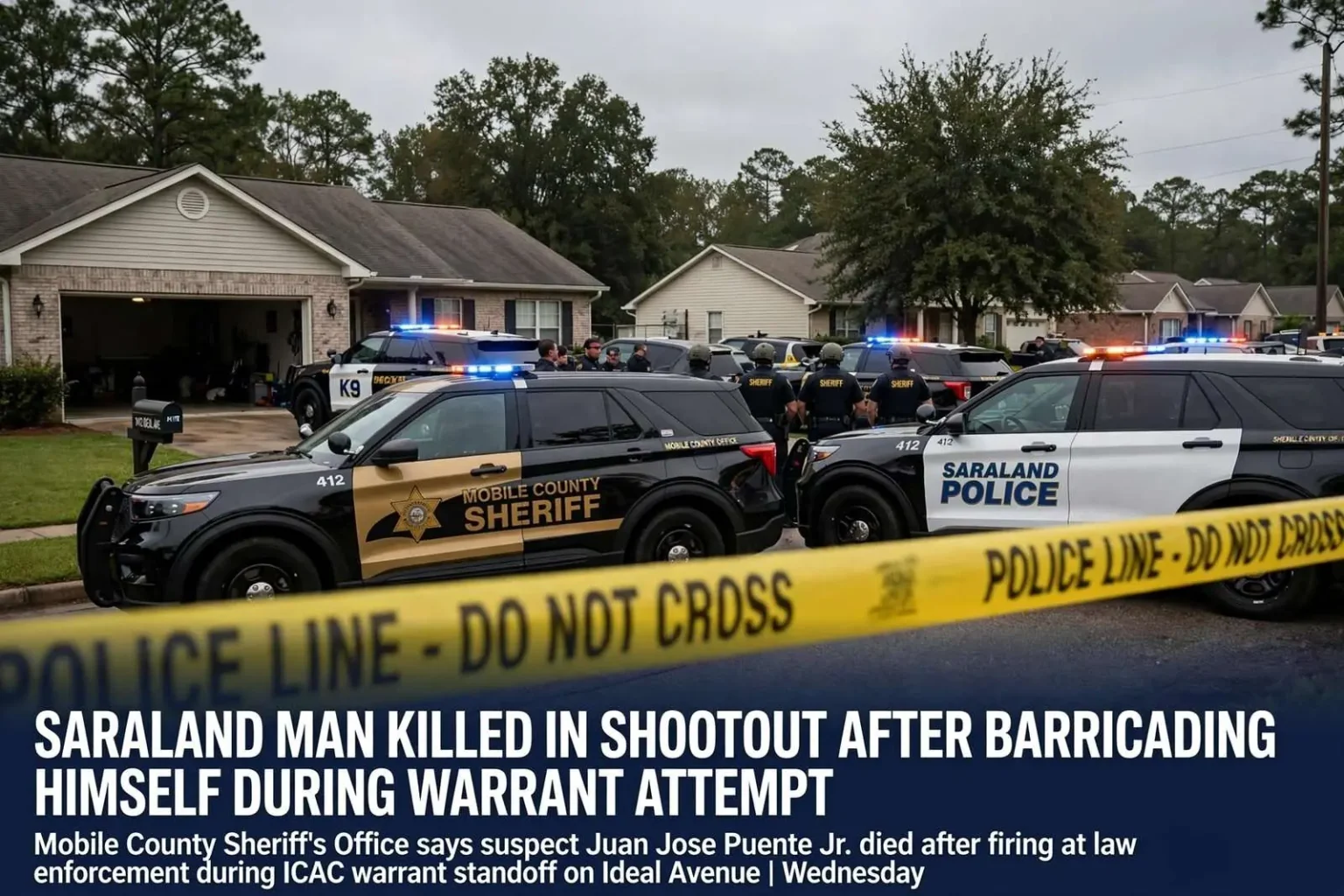
A Saraland man was shot and killed Wednesday after a standoff with multiple law enforcement agencies that began when deputies attempted to serve him with warrants tied to an internet crimes against children investigation. Juan Jose Puente Jr. died after firing on officers on two separate occasions during the encounter, according to Mobile County Sheriff’s Office spokesperson Lori Myles. Officers returned fire after Puente shot at them, ending the standoff.
The incident began when investigators with the Mobile County Sheriff’s Office Internet Crimes Against Children unit attempted to serve warrants on Puente at his home on Ideal Avenue in Saraland. The unit is part of the national ICAC task force program, a coordinated network of local, state and federal investigators who work child exploitation cases online — from enticement and grooming to the possession and distribution of illegal imagery. Warrants coming out of such investigations typically follow weeks or months of digital evidence work, and deputies serving them prepare for the possibility that the subject will not comply peacefully.
Deputies stopped Puente on Shelton Beach Road as he was leaving the residence, and he was tased after refusing to exit his vehicle when ordered to do so, according to the sheriff’s office. When the initial attempt to take him into custody failed, Puente then fled the traffic stop in his vehicle, turning a warrant service into a vehicle pursuit on Saraland’s roads. Pursuits of this kind set in motion the standard escalations — supervisors joining the chase, patrol units falling in behind, and coordinators beginning to plan for how the incident might end.
The standoff on Ideal Avenue
When a pit maneuver failed to disable the car, Puente returned to his home on Ideal Avenue and barricaded himself inside his vehicle within the garage, the sheriff’s office said. The turn boxed the encounter into a residential setting — neighbors’ homes close by, a single approach to the property, and no way to know whether anyone else was inside the house. Officers converged on the scene and established a perimeter, shifting the response from pursuit to standoff protocol.
From inside the garage, Puente opened fire on Mobile County Sheriff’s Office hostage negotiators, K9 units, personnel from the district attorney’s office and Saraland police officers who had assembled outside the home. Officers returned fire as negotiators spent roughly 30 minutes attempting, without success, to talk Puente into surrendering. The combination of negotiators, K9 teams and prosecutors’ staff at the scene reflected the layered response that major standoffs draw — each element positioned for a different ending, from peaceful surrender to arrest to the use of lethal force.
Puente continued firing at law enforcement during the standoff before he was fatally shot, according to the sheriff’s office. Authorities said the exchange of gunfire on two separate occasions during the encounter left officers with no alternative, though the agency has not released additional details about the sequence inside the garage or about which agency or agencies fired the shots that killed Puente.
The shooting is expected to undergo the standard review process for officer-involved shootings in Alabama, though the Mobile County Sheriff’s Office has not released additional details about which agency or agencies fired the shots that killed Puente. The investigation into the incident remains ongoing, and officials have said further information will come only as that process allows.
Officer-involved shooting reviews in Alabama follow a well-established path. Because multiple agencies fired or were present, the review typically falls to investigators from outside the involved departments, with findings eventually presented to prosecutors who determine whether any use of force was legally justified. The process examines everything from the initial warrant service plan to the ballistics evidence recovered at the scene, and it can take weeks or months before a public determination is made. Officers involved are ordinarily placed on administrative leave during the review, which is standard procedure rather than a finding of any kind.
How these standoffs unfold
Standoff responses are built around a deliberately slow escalation. Negotiators are dispatched first because the overwhelming majority of barricaded-subject incidents end in surrender, and every minute a subject spends talking to a negotiator is a minute no one is shooting. Perimeters protect neighbors and contain movement, K9 units provide options short of deadly force, and tactical teams stage out of sight as insurance. The presence of district attorney’s office personnel at scenes like Wednesday’s reflects the legal complexity of warrant cases — investigators and prosecutors coordinate closely when the underlying charges are as serious as those Puente faced.
The Internet Crimes Against Children investigations behind such warrant services have become one of the fastest-growing areas of law enforcement work, as the digital evidence trail in exploitation cases has expanded. Task force investigators in Mobile County work with counterparts across the region, and the caseload has grown steadily as online platforms have multiplied. Warrant services in these cases are planned carefully, with agents briefed on the subject’s background and the home’s layout, precisely because the subject pool — people facing charges that carry severe prison sentences — includes some who are judged likely to resist.
For Saraland, a city of quiet residential neighborhoods north of Mobile, the afternoon’s events brought an uncommon disruption. Residents along Ideal Avenue and Shelton Beach Road watched the street fill with patrol cars, K9 units and command vehicles as the pursuit and standoff played out, and nearby homes were effectively locked down while the scene was active. Incidents of this scale are rare in the city, and the multi-agency response — sheriff’s investigators, negotiators, K9 teams, prosecutors and Saraland officers — illustrated how jurisdictions share the load when a warrant service escalates beyond any single department’s resources.
What remains public is limited: the sequence from warrant service to traffic stop to pursuit to garage barricade, the two separate occasions on which Puente fired at officers, the roughly half-hour negotiation attempt, and the fatal outcome. The review process will determine the rest — which bullets struck Puente, whether the force used was justified, and whether any part of the response could have ended differently. Until that process concludes, the sheriff’s office has said its details will remain limited, and the case joins the small number of officer-involved shootings that Mobile County agencies and prosecutors must work through under the state’s standard review framework.
The PIT maneuver, which failed to end Puente’s flight, is a pursuit-tactics tool that patrol officers train on extensively. Short for precision immobilization technique, the maneuver involves a controlled tap to a fleeing vehicle’s rear quarter panel that spins it to a stop, and it is favored because it ends chases faster and at lower speeds than prolonged pursuits. When it fails — because of a vehicle’s stability, speed or the driver’s reaction — the pursuit continues until another option presents itself, which is how Wednesday’s chase moved from Saraland’s roads back to the Ideal Avenue address where it began.
Barricaded-subject incidents that begin with a vehicle pursuit pose particular challenges for negotiators. A subject who has already fled once and then opened fire has demonstrated both flight and fight responses, shrinking the middle ground between surrender and confrontation. The 30-minute negotiation window deputies worked on Ideal Avenue fell within the norm for such attempts, but the two separate volleys from the garage meant the scene was never stable enough for the incremental de-escalation that negotiators try to build — the kind that moves a subject step by step from armed resistance to empty hands.
The warrants behind the initial visit mark the other end of the case: an investigation that began online, likely weeks or months earlier, had matured into charges serious enough for arrest. Cases originating with ICAC task forces frequently involve evidence gathered from digital devices, online accounts and records served on internet providers, and the resulting prosecutions are handled with an eye toward the sentencing exposure the charges carry. It was that exposure, investigators say in cases like this, that shapes the calculus of a subject deciding whether to answer the door, flee, or fight — a calculus that turned a routine warrant service into the deadliest kind of encounter.
Sheriff’s office officials have not said whether Puente was wounded during the first exchange of gunfire on Shelton Beach Road or the second at the residence, nor have they identified the officers and deputies who discharged their weapons. Those details are typically held until the review process produces its findings, both to protect the integrity of the investigation and to shield the involved officers from premature judgment. The office has also not released the specific charges contained in the warrants Puente was sought on, which will presumably become public once the case file moves through the court system.