Satsuma Christmas Dinner Honors WWII, Korea, and Vietnam Combat Veterans
The Buffalo Soldiers Association joined Satsuma and Saraland for a sold-out Christmas dinner honoring combat veterans, with Medal of Honor recipient Bennie.
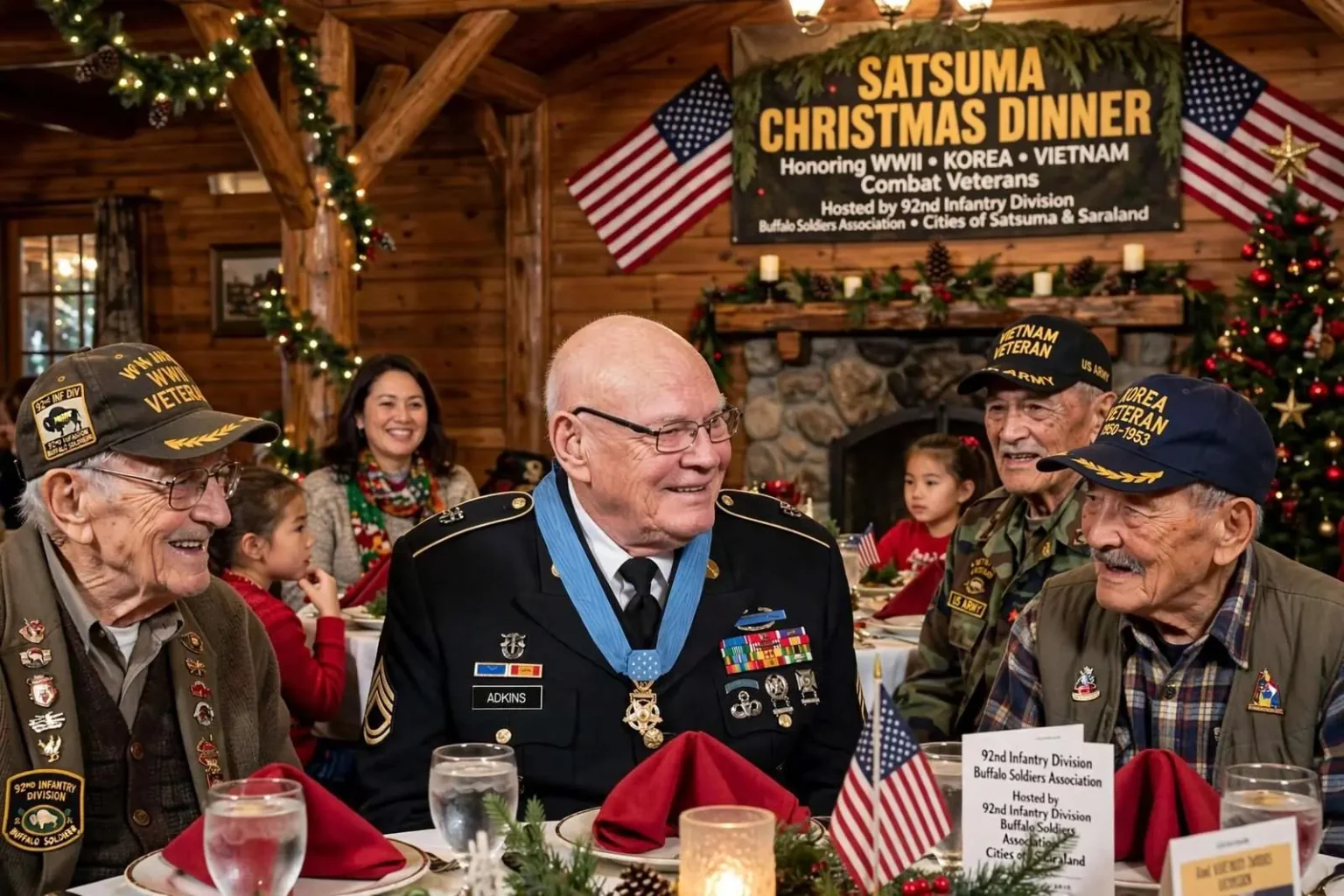
Combat veterans from three wars were the guests of honor Wednesday evening as the Mobile-area community gathered for a sold-out Christmas dinner at the Steel Creek Lodge in Satsuma. The 92nd Infantry Division Buffalo Soldiers Association teamed up with the cities of Satsuma and Saraland to host the tribute, which paid homage to service members who fought in World War II, Korea, and Vietnam. Among those attending was Command Sergeant Major Bennie Adkins, a Medal of Honor recipient recognized for his actions during the Vietnam War. The dinner gave community members a chance to personally thank some of the region’s most decorated veterans during the holiday season.
The event filled the lodge to capacity, with organizers reporting a sell-out well before the evening began. Families, local officials, and veterans of more recent eras joined the honorees for a holiday meal built around the men and women who had worn the uniform in combat decades earlier. For the guests of honor, most of them advanced in age, the dinner offered something that official ceremonies rarely do: a room full of neighbors, many of them strangers, taking the time to shake their hands and say thank you.
The partnership behind the evening reflected the way veterans’ commemorations are often organized in north Mobile County’s small cities, where municipal governments, civic groups, and heritage organizations work together rather than separately. Satsuma and Saraland, neighboring communities along U.S. 43 north of Mobile, both have active traditions of supporting veterans’ causes, and joining forces allowed the two cities to put on an event larger than either could host alone.
The Buffalo Soldiers legacy
The 92nd Infantry Division, whose heritage the host association carries forward, holds a distinguished place in American military history. The division was formed during World War II as a segregated unit of African American soldiers — the legacy of the original Buffalo Soldiers, the Black cavalry and infantry regiments founded on the western frontier after the Civil War. The 92nd deployed to Italy in 1944 and fought through some of the hardest campaigning of the Italian theater, serving with distinction in a military that, at the time, still kept Black soldiers in segregated units.
Associations like the one that hosted the Satsuma dinner preserve that history through education, scholarships, community service, and appearances at commemorations across the Gulf Coast region. Their members include descendants of the original division and veterans of later eras, and their mission, as they describe it at events like this one, is to make sure the story of the Buffalo Soldiers — a story of service to a country that had not yet granted its soldiers full equality — is passed to the next generation. A Christmas dinner that seats combat veterans beside school-age children is exactly the kind of handing-down those organizations exist to do.
The guests of honor
The veterans honored at the dinner represented three conflicts that shaped the middle of the twentieth century. World War II veterans in the room had served in the 1940s, in theaters from Europe to the Pacific; the Korea veterans had fought in the war of 1950 to 1953, often described as the Forgotten War because it sits between far more commemorated conflicts; and the Vietnam veterans had served during the long war in Southeast Asia, returning to a country divided over the conflict itself. Gathering all three generations at one table was a rarity even in a region with a deep military tradition.
Command Sergeant Major Bennie Adkins stood out even in that company. Adkins, an Alabama native, received the Medal of Honor — the nation’s highest award for valor — for his actions during a 1966 battle at the A Shau Valley in Vietnam, where, as a Green Beret sergeant major, he fought through multiple days of combat, was wounded repeatedly, and helped fellow soldiers escape. His award was presented decades after the battle, when a review of his record led to the medal being bestowed at a White House ceremony in 2014, bringing his story to public attention in his home state and across the country.
For attendees, meeting a Medal of Honor recipient in person is an experience few communities ever get. The medal itself is awarded for conspicuous gallantry above and beyond the call of duty, and fewer than 4,000 have been awarded since the Civil War — a figure that underlines how rare the company was inside the Steel Creek Lodge that night. Adkins, who made his home in Alabama after his Army career, was known in his later years for speaking to students, soldiers, and community groups about service and about the men he served with, an audience engagement that dinners like the one in Satsuma made possible.
The holiday timing of the tribute was deliberate. Christmas season events for veterans have a long tradition in American communities, and for older veterans in particular, the winter months can be isolating — a fact that veterans’ organizations work to counter with gatherings, phone trees, and ride programs. A sold-out dinner in their honor during that season sends a signal that goes beyond a single evening: that the community remembers, and that the invitation to be part of community life does not expire with a uniform.
Satsuma and Saraland’s veterans’ tradition
Satsuma, a small city in north Mobile County, and neighboring Saraland have both grown substantially in recent decades while keeping the civic traditions of small Alabama towns. Veterans’ observances — Memorial Day and Veterans Day programs, flag ceremonies at schools, and benefits for veterans’ charities — are regular features of the local calendar, and the area’s proximity to Mobile’s military installations and to the Gulf Coast’s large veteran population gives those observances a ready audience. The Steel Creek Lodge, the venue for the dinner, serves the community as a gathering place for events of exactly this kind.
North Mobile County as a whole has strong ties to the military. Families in Satsuma, Saraland, Creola, and the surrounding communities send sons and daughters into every branch of service, and the region’s veteran population spans from World War II-era service members — a shrinking group nationwide — to recent veterans of Iraq and Afghanistan. Events that bring those generations together serve a practical purpose as well as a ceremonial one: older veterans meet younger ones, organizations recruit volunteers, and stories that exist nowhere in written form get told aloud one more time.
Why tributes like this matter
Historians and veterans’ advocates make a consistent point about commemorations: the window for honoring combat veterans of World War II, Korea, and Vietnam in person is closing with each passing year. Members of the World War II generation are now in their nineties or older, and Korea veterans are not far behind. That arithmetic is part of why communities across Alabama have increased their efforts to honor the oldest veterans while they can still attend — and why a sold-out crowd in Satsuma mattered to the organizers who had worked to fill the room.
The dinner also highlighted the role of heritage associations in keeping military history local. Rather than waiting for national observances, groups like the 92nd Infantry Division Buffalo Soldiers Association bring history into hometown settings — lodges, schools, and city halls — where it becomes personal. The presence of two city governments as partners showed how municipalities can support that work with venues, staff time, and public recognition, multiplying what volunteer organizations can accomplish on their own.
By the end of the evening, the honorees had been fed, thanked, and photographed with families who will remember the meeting long after the veterans themselves are gone. Organizers described the event as a success, and the sell-out crowd suggested that the community would support similar gatherings in the future. For the combat veterans of three wars who sat as guests of honor, the message of the night was simple and, by every account, deeply felt: their service in World War II, Korea, and Vietnam is not forgotten in the communities of north Mobile County.
Across Alabama, similar tributes have become a fixture of the winter calendar, from school assemblies where students interview veterans to church suppers and American Legion dinners. The state has one of the larger veteran populations in the country relative to its size, a product of its military installations and of a culture in which service in the armed forces is a common family tradition. In north Mobile County, that tradition runs through generations — grandfathers who fought in the Pacific, fathers who served in Vietnam, and grandchildren now on active duty.
The Buffalo Soldiers Association’s presence gave the evening a historical dimension that ordinary holiday dinners lack. Members brought the story of the 92nd Infantry Division to a community audience, connecting the veterans at the tables to a lineage that stretches back to the frontier Army of the 1860s. For younger attendees, the evening worked as living history: the segregated units of the 1940s, the integrated military of later decades, and the Medal of Honor ceremony more than half a century after the battle it honored were all represented in one room by the people who lived them.
Organizers with the two cities and the association were expected to consider whether the dinner could become an annual tradition, based on the strong turnout the first evening produced. Community members who missed the sold-out event but want to support the effort behind it can reach veterans’ organizations in both cities, which accept volunteers and donations for programs serving older veterans throughout the year — transportation to medical appointments, assistance with benefits claims, and visits to homebound veterans during the holidays.