SBA Launches First-Ever $20 Million Critical Suppliers Prize Competition for Small Manufacturers
The SBA's first-ever Critical Suppliers Prize Competition offers up to $20 million to small manufacturers that can scale domestic production, with an Aug. 28 deadline.
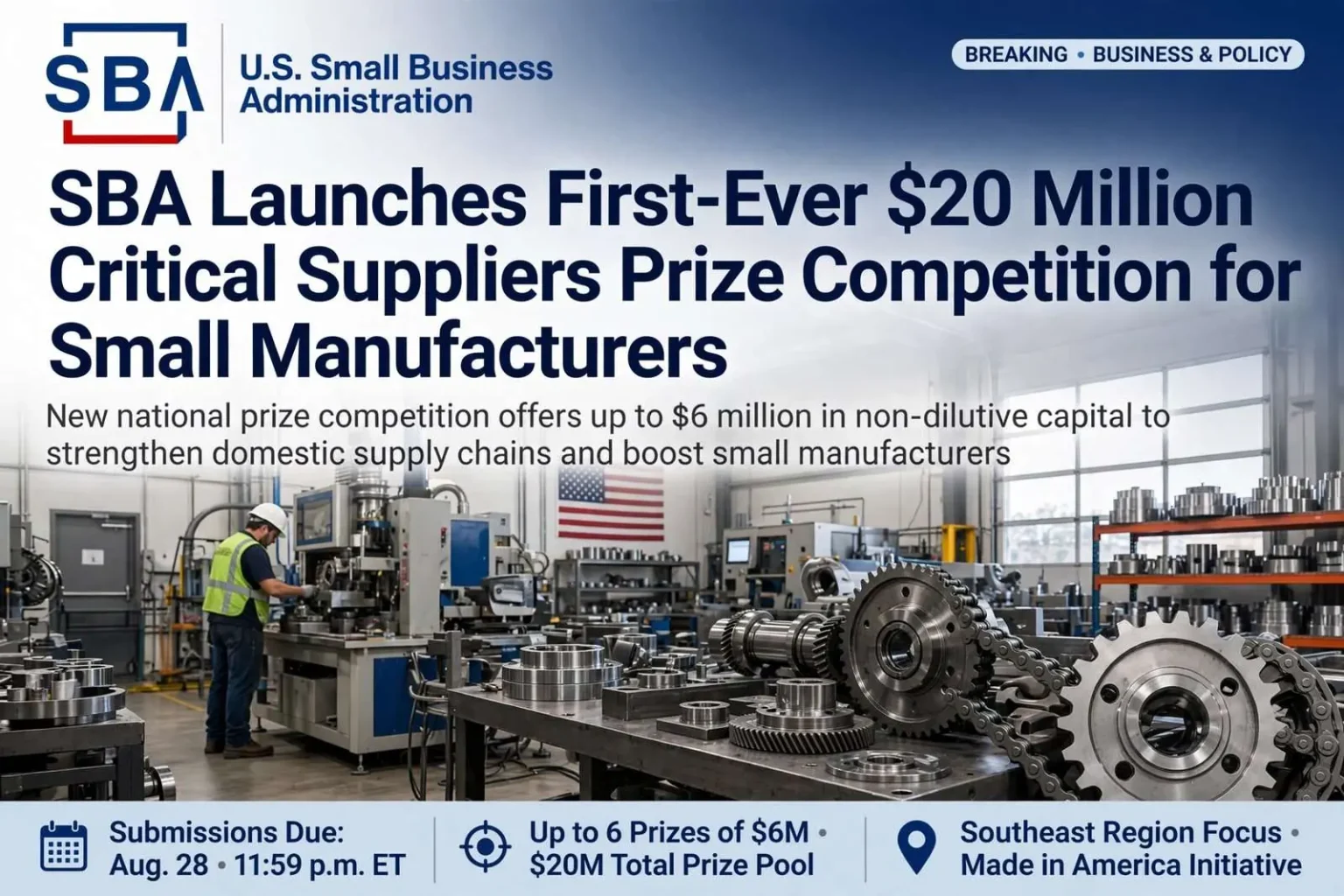
The U.S. Small Business Administration has launched its first-ever Critical Suppliers Prize Competition, a national contest aimed at strengthening domestic manufacturing and shoring up critical supply chains, with up to $20 million in prize money on the table for small businesses. The initiative represents one of the most significant federal prize programs ever aimed directly at the small manufacturers that supply the nation’s most essential industries.
The competition will award as many as six prizes of up to $6 million each in non-dilutive capital — funding that doesn’t require companies to give up equity — to small businesses that can demonstrate the ability to rapidly scale up domestic production through measurable, lasting supply chain solutions.
The distinction matters enormously to young manufacturers. Traditional venture funding buys ownership stakes, and federal contracts come with procurement bureaucracy; non-dilutive prize capital lets a company invest in capacity — equipment, facilities, workforce — without ceding control. For small suppliers in fields like advanced materials or energy systems, a $6 million infusion can mean the difference between a proven prototype and a production line.
The SBA’s framing of the competition reflects a broader national preoccupation. Supply chain disruptions in recent years — from semiconductors to pharmaceutical ingredients to critical minerals — have exposed how much of America’s industrial base migrated overseas, and policymakers across administrations have pushed to rebuild domestic capacity in the sectors the economy cannot function without.
A Southeast Call to Action
“I encourage manufacturers and critical suppliers across the Southeast Region to submit proposals for the Critical Suppliers Prize Competition,” said SBA Regional Administrator Tyler Teresa, who oversees SBA operations across Alabama, Florida, Georgia, Kentucky, Mississippi, North Carolina, South Carolina and Tennessee. “Our region is home to world class innovators in advanced materials, metals, and energy systems, and there is nothing more important than strengthening our supply chains by ensuring these products are Made in America.”
Teresa’s emphasis on the Southeast is well founded. The eight-state region has become one of the country’s fastest-growing manufacturing corridors, from the automotive and aerospace plants of Alabama and Georgia to the shipyards of the Gulf Coast and the advanced materials firms scattered through the Carolinas and Tennessee. Small suppliers form the connective tissue of that industrial landscape — the machine shops, fabricators, chemical processors and component makers that the region’s largest employers depend on.
For Alabama specifically, the competition arrives amid a manufacturing renaissance: automotive assembly, aerospace and defense work, and metals production have all expanded across the state in recent years, and each of those sectors relies on networks of small suppliers with the capacity to scale when demand surges.
How the competition works: Contestants must submit an aligned business strategy with tangible deliverables, which may take the form of a company pitch deck, electronically to [email protected]. The submission deadline is Aug. 28 at 11:59 p.m. ET.
The emphasis on “measurable, lasting supply chain solutions” sets a high bar. The SBA is looking for more than intentions — applicants must show a credible path from current capacity to scaled production of a critical input, with concrete deliverables that can be tracked and verified. Companies advancing in such competitions typically face multiple evaluation rounds, moving from written submissions to deeper due diligence on technology, finances and execution capability.
The prize structure — up to six winners splitting a pool that can reach $20 million — signals the agency’s intent to back a portfolio of solutions across sectors rather than a single bet. Suppliers of advanced materials, metals and energy systems, the categories the regional administrator highlighted, are explicitly in scope.
Why Non-Dilutive Capital Matters
For small manufacturers, the competition’s non-dilutive structure addresses a chronic gap in American industrial finance. Banks are often reluctant to lend against unproven production capacity, and equity investors concentrate on software and scalable consumer businesses more than on factories. The result is a financing valley between a working prototype and commercial-scale production — the exact stage where many domestic manufacturing ventures stall or sell out to overseas buyers.
Prize capital flips those incentives. A company that wins keeps its ownership intact, its technology at home and its balance sheet cleaner for the follow-on financing that growth requires. The model has gained favor across federal agencies in recent years precisely because it can crowd in private investment rather than replace it.
The SBA’s role in the initiative extends its traditional toolkit — loans, guarantees and counseling through Small Business Development Centers and SCORE — into direct industrial strategy. Agency officials have increasingly framed small manufacturers as national security assets, arguing that the suppliers who make critical components are as strategically important as the primes they feed.
The Deadline and the Audience
With submissions due Aug. 28 at 11:59 p.m. ET, the timeline is tight for interested companies — a deliberate urgency that reflects both the administration’s push and the prize competition format, which tends to concentrate effort rather than stretch it across a multi-year application cycle.
Small manufacturers considering a submission should focus on the fundamentals the SBA has named: a business strategy aligned with a critical supply chain need, tangible deliverables, and a demonstration of the ability to scale production rapidly and durably. The electronic submission to [email protected] — which may take the form of a company pitch deck — keeps the barrier to entry low enough for firms without grant-writing staffs.
For the Southeast’s small manufacturers — in Alabama and across the eight-state region — the competition offers a rare combination: federal capital without dilution, national visibility, and a mandate to prove that the products America needs can be made in America again.
The Critical Suppliers Prize Competition arrives at a moment when the economics of reshoring have shifted. Rising overseas labor costs, freight volatility, tariff uncertainty and the strategic lessons of recent supply chain crises have combined to make domestic production more competitive than it has been in decades — but capital-intensive gaps remain, and that is precisely where a $6 million prize can move a company from viable to vital.
Industry analysts note that the small suppliers at the heart of this competition occupy an outsized position in the industrial ecosystem. A single tier-two supplier of a specialty alloy, coating or electronic component can support production across entire sectors; when such a supplier fails or moves offshore, the disruption cascades. Rebuilding that layer of the economy with resilient, domestically rooted companies is the competition’s implicit goal.
The Southeast Region the SBA administrator oversees maps closely onto the industrial South’s new geography: Alabama’s automotive and aerospace complexes, Georgia’s logistics and manufacturing base, Florida’s space and defense industries, the shipbuilding and energy sectors of Mississippi and the Gulf, and the advanced manufacturing clusters of the Carolinas, Tennessee and Kentucky. In each state, small businesses supply the parts, materials and processes that the headline employers assume will simply be there.
What Winners Can Expect
Prize winners in federal competitions typically receive more than the check. The visibility that comes with a national award — and the implicit validation of the SBA’s due diligence — often attracts private investment, corporate contracts and talent that the money alone would not. For a small manufacturer on the threshold of scale, that combination of capital and credibility can compress years of commercial development into months.
The requirement for “lasting” solutions also points to how the SBA will judge success: not by a single production milestone but by durable capacity — facilities, workforces and supply relationships that persist after the prize money is spent. Companies that treat the award as a foundation rather than a windfall fit the profile the competition describes.
Small manufacturers with questions about eligibility or submission requirements are directed to the SBA through the [email protected] channel, the same address to which completed submissions must be sent by the Aug. 28 deadline.
For a region that has spent two decades building its manufacturing base — and for the small businesses that make that base work — the first-ever Critical Suppliers Prize Competition is both an opportunity and a signal: the country’s supply chains will be rebuilt somewhere, and the SBA wants the Southeast’s innovators to prove they should be rebuilt here.
The competition’s launch also carries implications for the region’s economic development agencies and small business support network. Alabama’s Small Business Development Centers, its manufacturers’ extension partnerships and local economic development offices are positioned to help small firms sharpen their submissions — and the short runway to Aug. 28 makes that assistance more valuable than in a slower grant cycle.
Manufacturing trade groups across the Southeast have encouraged members to examine the competition closely, noting that firms sometimes underestimate their own eligibility. A supplier that believes its product is niche may in fact sit inside a critical supply chain — defense, energy, medical, food, telecommunications — without ever having framed its work that way. The submission process itself can force a clarifying strategic exercise.
The agency’s use of a prize format rather than a grant program reflects lessons from recent federal innovation efforts. Prizes reward results rather than promises, attract applicants who might avoid bureaucracy, and allow the sponsor to evaluate a wide field quickly. For small manufacturers used to procurement paperwork, the pitch-deck-friendly submission is a notably lower lift.
The $20 million ceiling and the six-prize structure give the agency flexibility: it can award fewer, larger prizes to standout applicants or spread the capital across more winners, judging the field on the quality of the solutions submitted. Either outcome injects meaningful, debt-free capital into the domestic supplier base.
As the deadline approaches, the SBA’s challenge to the Southeast stands: eight states of manufacturers, from Gulf Coast shipyards to Appalachian materials labs, are invited to show how they would scale up the production America needs. The companies that answer before Aug. 28 will compete for the capital to make it real.