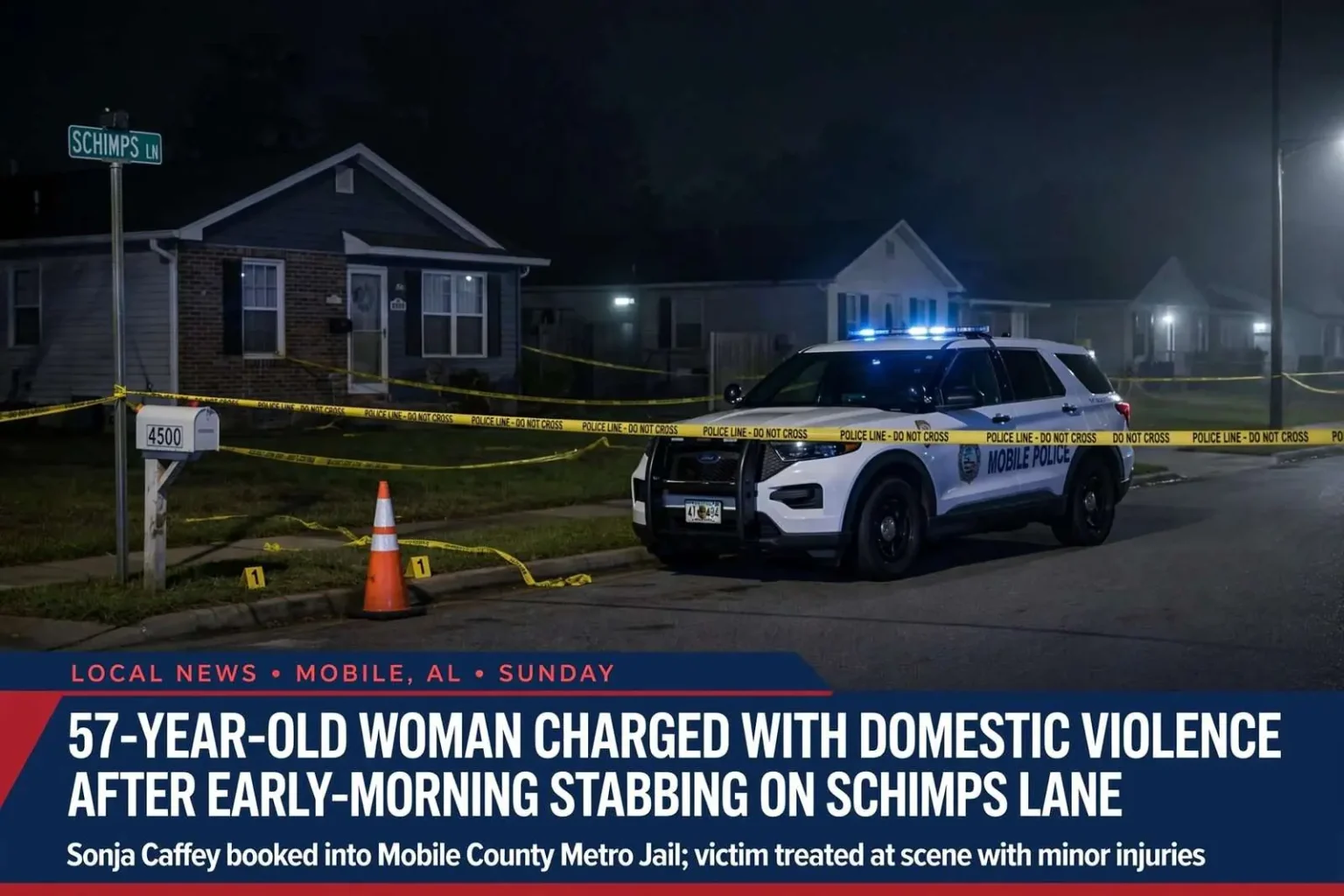
A 57-year-old Mobile woman has been charged with domestic violence and assault after police say she cut another woman with a blade during an argument inside a home in the 4500 block of Schimps Lane early Sunday morning.
Sonja Caffey was booked into Mobile County Metro Jail on charges of second-degree domestic violence and second-degree assault, according to the Mobile Police Department. The Call Officers were dispatched to a reported domestic stabbing at approximately 1:02 a.m. Sunday. When they arrived, they found a woman with minor injuries. Police say an investigation determined that Caffey cut the victim during an argument inside the residence, and that the two women were known to one another.
The victim was treated at the scene and refused transport to a hospital. Why the Domestic Violence Charge Matters Legally The distinction between an assault charge and a domestic violence charge in Alabama is not cosmetic. Under Alabama Code § 13A-6-131, domestic violence in the second degree applies when the underlying offense — here, second-degree assault — is committed against a current or former spouse, a parent, a child, a person with whom the defendant has a child, a present or former household member, or a person in a current or former dating relationship.
The charge is a Class B felony, more serious than the underlying assault charge alone, and it carries consequences that follow a defendant well past sentencing. A domestic violence conviction in Alabama triggers a federal firearms prohibition under 18 U.S.C. § 922(g)(9), commonly known as the Lautenberg Amendment, which prohibits anyone convicted of a misdemeanor crime of domestic violence from possessing firearms or ammunition. In Alabama, the state-level prohibition mirrors the federal one and extends to certain misdemeanor convictions as well. A domestic violence conviction can also affect child custody proceedings in family court and may be considered a disqualifying factor for public housing assistance.
Because domestic violence charges depend on the relationship between the parties, the fact that police established that Caffey and the victim were “known to each other” is the legal hinge on which the more serious charge turns. The Mobile Police Department’s report will document the specific relationship category that applies, and that determination will shape the prosecution’s case. Minor Injuries, Serious Charges Readers sometimes find it counterintuitive that a victim with minor injuries who declines an ambulance can nonetheless be at the center of a felony case. The reason is that Alabama’s assault statutes look at the instrument used, not only the outcome. Causing physical injury with a “deadly weapon or dangerous instrument” — which a knife or cutting instrument plainly is — elevates the offense regardless of how the wound ultimately healed.
Second-degree assault under Alabama Code § 13A-6-21 is a Class C felony, but when the assault is charged as domestic violence in the second degree under § 13A-6-131, it becomes a Class B felony carrying a sentencing range of two to twenty years in a state correctional facility. The weapons enhancement is what makes the injury severity secondary to the means by which it was inflicted. Mobile County’s Domestic Violence Response Infrastructure Mobile County has developed a coordinated response to domestic violence that involves law enforcement, the courts, and community-based victim services. The Mobile Police Department and Mobile County Sheriff’s Office both participate in the Domestic Violence Intervention Project, which trains officers in lethality assessment protocols designed to identify victims at highest risk of escalating violence. When officers respond to a domestic violence call, they are required to provide the victim with a written notice of rights and referrals, including contact information for the Penelope House, Mobile County’s primary domestic violence shelter and advocacy organization.
The Penelope House, located in Mobile, operates a 24-hour crisis line and provides emergency shelter, counseling, legal advocacy, and safety planning for victims of domestic violence and their children. The shelter serves residents across Mobile County and coordinates with the Mobile County District Attorney’s Office’s Victim Services Unit to ensure that victims are informed about the criminal case, protective order options, and available resources.
Mobile County’s district court judges routinely issue protection from abuse (PFA) orders in domestic violence cases, which can require the defendant to stay away from the victim’s home, workplace, and school, and can address temporary custody and support issues. Violations of a PFA order are criminal offenses that can result in additional charges and immediate arrest. The Legal Process Ahead Caffey is charged, not convicted, and is presumed innocent unless the state proves the allegations in court. The case will proceed through Mobile County District Court for a preliminary hearing, where prosecutors must establish probable cause. If the case is bound over, a Mobile County grand jury will consider whether to return an indictment for domestic violence in the second degree and assault in the second degree.
If indicted, the case moves to Mobile County Circuit Court for arraignment and, ultimately, trial or plea resolution. The Mobile County District Attorney’s Office will handle the prosecution, and Caffey will be represented either by retained counsel or by the Mobile County Public Defender’s Office if she qualifies for appointed counsel. The Alabama Rules of Criminal Procedure govern the proceedings, and both the U.S. and Alabama Constitutions guarantee the right to a jury trial, the right to confront witnesses, and the privilege against self-incrimination. Community Resources for Domestic Violence Victims Anyone in Mobile County experiencing domestic violence can reach confidential support and shelter services through the Penelope House at its 24-hour crisis line. The National Domestic Violence Hotline is also available around the clock at 1-800-799-7233 (SAFE). For victims in neighboring Baldwin County, the Lighthouse provides similar services, and in the Mississippi Gulf Coast region, the Gulf Coast Center for Nonviolence offers shelter and advocacy.
Mobile County’s Family Court, which handles protection from abuse petitions, is located at the Mobile County Courthouse. The court’s self-help center can assist victims with filing PFA petitions without an attorney, though legal representation is always recommended. Presumption of Innocence As with every criminal case in the United States, the constitutional presumption of innocence applies. Caffey will have the opportunity to present a defense, challenge the state’s evidence, and, if the case proceeds to trial, require the prosecution to meet its burden of proof beyond a reasonable doubt before a jury of her peers. The Mobile County Circuit Court will ensure that the proceedings adhere to the Alabama Rules of Criminal Procedure and the protections guaranteed by both the U.S. and Alabama Constitutions.
Court records for this case will be accessible through the Mobile County Circuit Clerk’s Office once formal charges are filed, and the docket will reflect each procedural step from arraignment through disposition.
Domestic violence cases in Mobile County are handled through a combination of municipal court, district court and circuit court, depending on the severity of the allegations. Cases involving serious injury or the use of a weapon are typically prosecuted as felonies in the circuit court.
Stabbings that result in serious injury are treated as significant felony cases in Alabama. The criminal charges filed depend on the circumstances of the alleged offense, including the relationship between the parties, the weapon used and the extent of the injuries.
The Mobile County Sheriff’s Office and the Mobile Police Department respond to domestic violence calls throughout the county. Calls that come in during overnight hours are handled by on-duty patrol officers, with investigators taking over the case during the next business day.
Local governments and community partners are working through the implications of the situation, and several follow-up meetings have been scheduled for the coming weeks. Members of the public who want to weigh in on the matter can find the meeting dates on city and county websites, and written comments can be submitted through the standard channels used by the relevant agencies. Local news outlets will continue to cover the story as it develops.
Across south Alabama, similar issues are being addressed in other communities, and the lessons learned here are likely to inform how those communities approach their own challenges. Local officials have indicated they are in regular contact with counterparts in neighboring cities and counties, and they expect to share best practices as the situation continues to evolve.
The agencies involved in the matter have committed to keeping the public informed as the work progresses, and residents who want to receive updates directly can sign up for email or text alerts through the relevant city or county websites. Local community organizations have also agreed to share information as it becomes available, and several have scheduled public forums in the coming weeks to give residents a chance to ask questions of the officials involved.
For background, readers can consult the official websites of the relevant agencies, the local newspapers that have covered the story, and the public-meeting archives that document the prior deliberations on related topics. The combination of those resources should give residents a thorough understanding of how the current situation developed and how the agencies and elected officials are approaching the decisions that remain.