Mobile Ad Executive and Navy Reservist Was Bound for Baghdad’s Green Zone
Scott Rye, a political consultant and advertising executive, was called up as a Navy Reserve commander to run media operations for Multi-National Force-Iraq, expecting to spend a year in Baghdad.
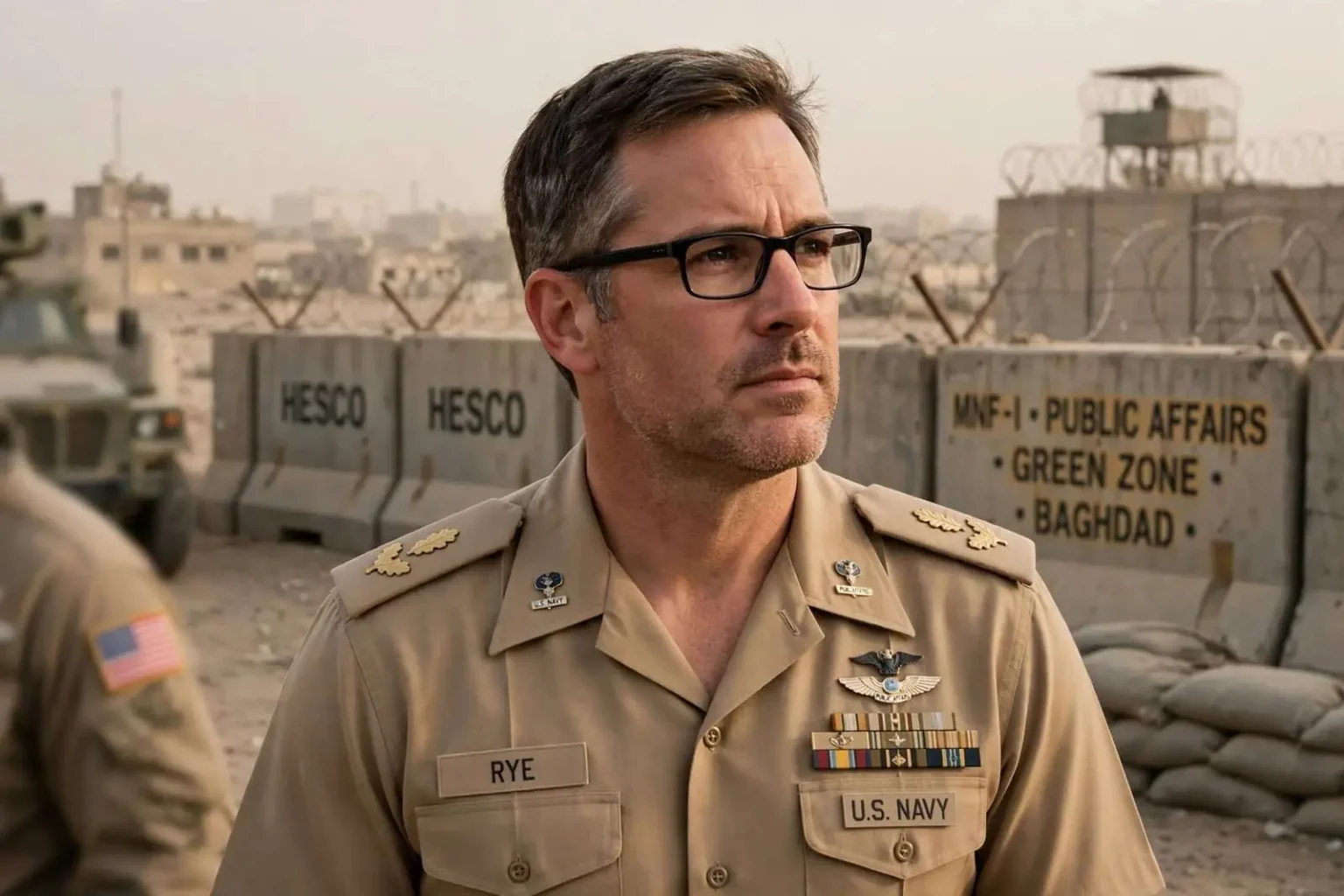
A familiar figure in Mobile political and advertising circles was headed for the Green Zone.
Scott Rye, a political consultant and advertising executive with Sullivan-St. Clair, was called up for a year in Baghdad. A commander in the U.S. Navy Reserve, Rye was the commanding officer of the public affairs unit that supports Navy Central Command and the Fifth Fleet, forward deployed to Bahrain.
“I’ll be headed to Baghdad to work in public affairs with Multi-National Force-Iraq in the Green Zone,” Rye reported.
The job on paper was a significant one. “In theory, I will be relieving the chief of media operations for MNF-I,” he said, “but as he is a Navy captain and I’m a commander, one rank lower, they may put me in a different billet.”
Multi-National Force-Iraq was the coalition command running the war, and its media operation was the point of contact between that command and the international press. Whoever held that desk stood between a war and the world’s reporting of it, at a moment when the surge of additional American troops ordered earlier that year was still unfolding and the casualty rate remained brutal.
Rye expected to depart Mobile in early August and to arrive in Baghdad a month later.
The Assignment and What It Meant
Public affairs at the MNF-I level meant shaping and answering the daily questions of a worldwide press corps: coordinating embeds, distributing command information, responding to reporting on operations and casualties, and making senior leadership available to explain the coalition’s strategy. The Green Zone itself — the heavily fortified enclave in central Baghdad that housed the coalition headquarters, the U.S. Embassy and the Iraqi government — was simultaneously the safest ground in the country and one of its most frequent rocket and mortar targets. Working there meant long days behind blast walls, moves between buildings in armored vehicles, and the particular stress of a posting where incoming fire was routine enough to be logged rather than news.
Rye’s military credentials ran deep in a region that understands them. A Mobilian whose professional life was built on campaigns — political ones for clients, and the communication campaigns that go with them — he brought to the assignment precisely the skills the Baghdad media operation consumed daily: message discipline, press handling, and the ability to explain complicated institutional positions to reporters on deadline.
He Saw It Coming
The call-up did not catch him by surprise.
“I think everyone in the reserve will wind up being called up before this thing is over,” Rye said. “I was on a short list to go to Anbar Province with the Joint Special Operations Task Force back in December and then was short-listed for this job about a month ago.”
That remark captured something about the war’s fourth year that statistics did not. The reserves, conceived as a strategic force to be drawn on in a crisis, had become an operational necessity, and reservists across the country were cycling through deployments that reshaped careers and families. Anbar Province, where Rye had nearly gone the previous December, was by then among the deadliest postings in Iraq — the heart of the Sunni insurgency west of Baghdad — and the Joint Special Operations Task Force operating there drew support personnel from every service, the reserves included.
By 2007, more than four years after the invasion, the Pentagon’s reliance on reserve components had become a defining feature of the war. National Guard and Reserve units that had once trained for rare, large-scale emergencies found themselves mobilized for repeated year-long tours, and individual sailors, soldiers and airmen were pulled from their units to fill billets in headquarters like MNF-I. The expectation Rye voiced — that everyone in the reserve would eventually go — was less a prediction than a description of how the force was actually working.
The Fleet Behind the Desk
For a Navy officer, the assignment also carried an unusual shape. The Navy’s war in Iraq was largely ashore — headquarters staffs, liaison teams and individual augmentees woven into Army and Marine commands — while the fleet Rye’s unit nominally supported, the Fifth Fleet, ran the maritime side of the war from Bahrain: carrier operations in the Arabian Sea, the security of Iraq’s oil terminals in the Persian Gulf, and the interdiction work that kept weapons and fighters from moving by sea. A public affairs commander moving from that unit into an MNF-I desk was exactly the kind of cross-service borrowing the war demanded of the reserve component.
What a Call-Up Costs a Civilian
Rye’s civilian life was the kind that does not pause easily. Political consulting is seasonal, campaign-driven and relationship-dependent. An advertising executive who disappears for a year returns to clients who have made other arrangements. Reservists have legal protection for their jobs, but no law can preserve a book of business or the momentum of a consulting practice.
The gap between legal protection and professional reality was one of the quiet stories of the war. Federal law guaranteed reservists their positions on return, but Alabama’s economy — like the nation’s — runs on small firms and independent practices where one person’s absence is the firm’s absence. Campaign consultants, real estate agents, insurance men, bankers: the reserve roster drew from exactly the professions least able to hand off a year’s work. Many mobilized reservists took substantial financial hits even while their jobs waited, and some came home to industries that had moved on without them.
He was going anyway, which is the entire point of a reserve commission and is easy to say and hard to do.
Mobile’s Military Ties
The Alabama coast has always sent more than its share into uniform. Mobile is a Coast Guard city, a shipbuilding city and a city with deep Navy connections, and the region’s National Guard and reserve units had been deploying to Iraq and Afghanistan for years by 2007. Alabama Army National Guard units had served extended tours; families in Mobile, Baldwin and the rural counties north had absorbed the deployments, the extensions and, in too many cases, the funerals.
The Navy’s presence threads through the city’s modern identity. Mobile is home to a major shipyard and a long Coast Guard presence on the riverfront, and generations of Mobilians have served aboard ships homeported elsewhere while keeping their families on the Gulf Coast. Naval Reserve units drilling in Mobile draw members from across the central Gulf Coast, from Pensacola’s aviation country to the shipbuilding corridors of Pascagoula, and their mobilizations ripple through employers up and down the coast.
A local advertising man packing for Baghdad was, by that point in the war, an ordinary event. That was precisely what made it worth reporting.
Rye’s departure leaves a familiar hole in Mobile’s political and advertising scene for the year he is gone. The work he leaves behind — campaigns planned, clients served, advertising placed — will be carried by colleagues, as it is at every firm that has sent a principal into uniform. In Baghdad, his days will be given over to the media operation of a coalition at war, answering the questions of a press corps that spans the world.
At a glance:
Name: Scott Rye, political consultant and advertising executive, Sullivan-St. Clair
Rank: Commander, U.S. Navy Reserve
Current command: Public affairs unit supporting Navy Central Command and Fifth Fleet
Assignment: Public affairs, Multi-National Force-Iraq, Green Zone, Baghdad
Duration: Approximately one year
Departure: Early August, arriving in Baghdad about a month later
He would trade an office in Mobile for one behind blast walls, and a client list for a press corps covering a war.
The War’s Fourth Year
The timing of the assignment placed Rye in Baghdad for one of the pivotal stretches of the war. The surge of additional American brigades ordered earlier in the year was still arriving, operations were underway in the belt of neighborhoods and towns around Baghdad, and the coalition’s public explanations of its strategy faced daily examination from capitals and newsrooms around the world. A media operations chief stood at the center of that exchange, translating military activity into public account and returning the press corps’ questions to the command for answer.
The Green Zone posting drew from the same pool of experienced reserve officers that filled similar desks across the theater. Public affairs billets at the command level demanded officers who understood both the military and the media, and the reserves — disproportionately staffed with civilians who worked in communications, law, business and government — supplied them. Rye’s advertising and political background made him typical of that population rather than exceptional within it, which is itself a measure of how thoroughly the reserve components had been woven into the conduct of the war.
Deployment also meant a different Mobile on return. The year he would spend in Baghdad would carry him through an entire election cycle in Alabama without him, a full rotation of municipal and county politics conducted by phone from behind blast walls if at all. Consulting practices survive such absences, but changed; colleagues and competitors alike note that the year abroad becomes part of the professional identity, one that some clients value and others quietly pass over.
The Navy has long drawn on Mobile for exactly this kind of officer. The city’s reserve tradition runs back through the Second World War, when the port’s shipyards and Merchant Marine activity tied the city’s civilian workforce directly to the fleet, and the pattern of Mobilians serving in uniform while running civilian businesses is older than any current deployment. Rye’s call-up fit a lineage the city knows well: the shop closes its owner’s door, the unit pins on the orders, and Mobile waits a year for one of its own to come home.