Mobile Planning Commission Rejects Sea Pines Mobile Home Park Rezoning Request
The Mobile Planning Commission voted 9-0 to deny a rezoning request that could have let Sea Pines Mobile Home Park add hundreds of new homes off Dauphin Island Parkway.
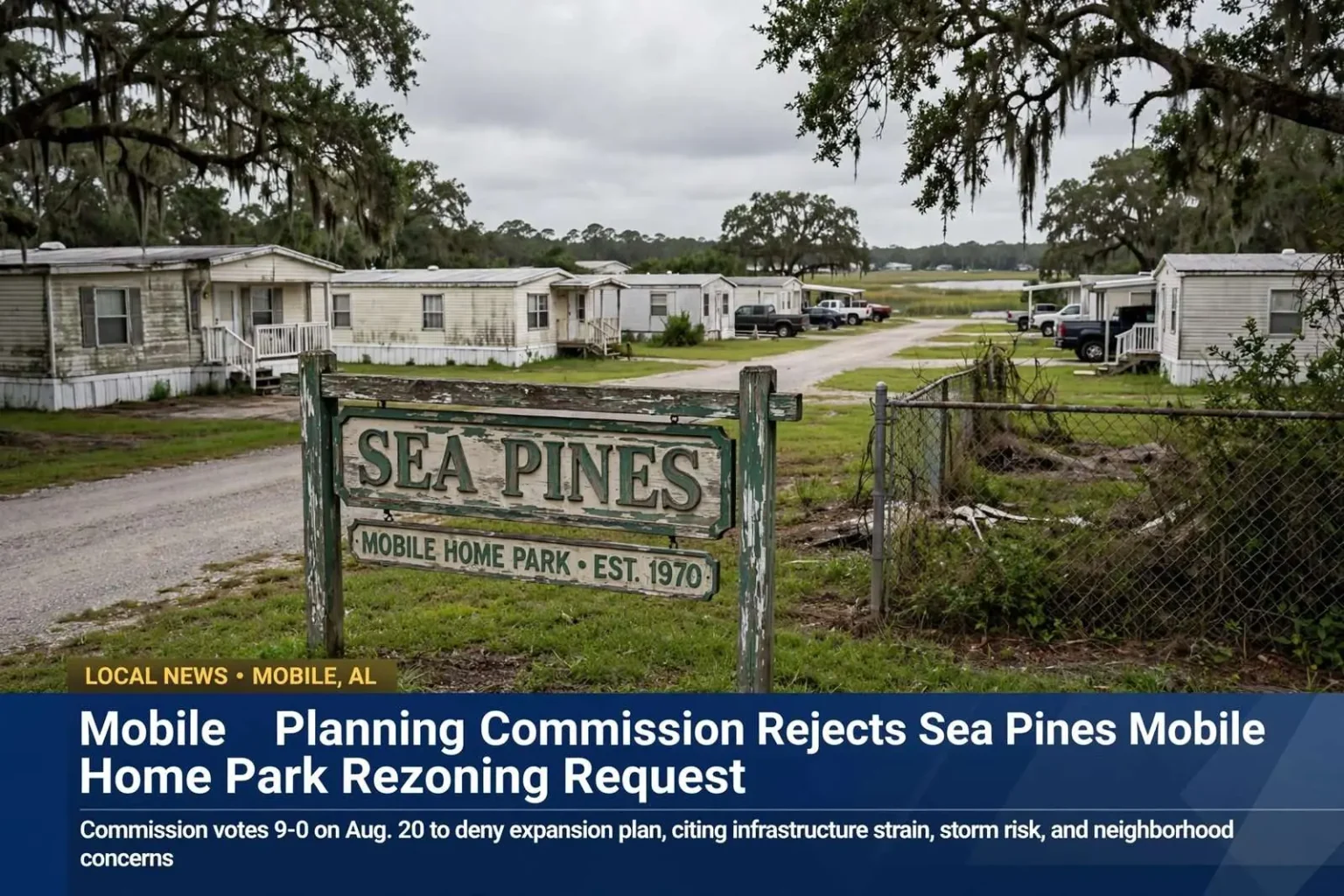
The Mobile Planning Commission voted unanimously Thursday, Aug. 20, to reject a rezoning request that would have cleared the way for a major expansion of Sea Pines Mobile Home Park off Dauphin Island Parkway, siding with neighbors who packed the meeting to voice concerns about overcrowding, safety and strained infrastructure.
The rezoning request was the first item on the commission’s agenda. On paper, the change sounded technical: it would have lifted a requirement that Sea Pines maintain a fence and vegetation buffer separating the park from neighboring single-family homes. But approval would have opened the door for the property’s owner to seek removal of a 133-unit cap the city placed on the park in 2022 – a cap neighbors said has kept the aging community in check. The City Council imposed the cap after years of code enforcement concerns.
A Push to Add Hundreds of New Homes
The property is owned by John Ray, who has held Sea Pines for 11 years, according to Planning Commissioner Kenny Nichols. Paperwork for the request was filed under the entity Tenacious 4 LLC. Land surveyor Jerry Byrd, representing Ray, and property manager Cristy Carranza spoke on the ownership’s behalf.
The original request sought to increase the park to 447 total units – the number of lots already wired for utilities – an addition of 314 homes above the existing cap. Facing pushback, the ownership offered a 20 percent reduction, down to 357 total units, an addition of 224 homes. Byrd told commissioners the build-out, if approved, would not be complete until 2031, with roughly 25 new mobile homes added every six months.
What the Planning Documents Showed
The park, located off Cedar Crescent Drive behind B.C. Rain High School, was originally approved in 1970 with approximately 447 mobile home spaces. In planning commission documents, the applicant argued that its internal street network and utilities were built to serve that capacity and that approval would provide additional affordable housing.
The same documents described a property that has been the subject of numerous code enforcement actions over the years because a city-required storm fence and a 10-foot-wide greenery buffer were never fully installed; a privacy fence was only partially put up. City staff concluded that adding homes would be a substantial increase in development intensity, inconsistent with the park’s low-density residential designation, and recommended that any future expansion be contingent on an approved site plan showing compliance with the city’s Unified Development Code unless the Board of Zoning Adjustment granted relief.
Neighbors Cite Safety, Infrastructure and Storm Risk
The Peninsula of Mobile, a nonprofit focused on revitalizing the Dauphin Island Parkway corridor, formally objected in writing, warning that the original, larger proposal could add between 942 and 1,256 people and as many as 628 cars to the neighborhood, straining local infrastructure and city services.
“The issue is not whether 447 units can physically fit on the property,” the group wrote. “It is whether the surrounding neighborhoods, roads, drainage, emergency services and limited transportation network of the Peninsula can reasonably absorb this level of additional population and traffic.” The letter described the area as a geographically constrained residential community on Mobile Bay where evacuation, stormwater, coastal resilience and emergency access deserve particular consideration.
Three residents spoke against the request at the meeting. Kenley Cutts, executive director of The Peninsula of Mobile, told commissioners the group is not opposed to affordable housing but supports development that is considerate of southern Mobile’s sensitive environment.
“This is an overcrowding of the residents living in this mobile home park,” Cutts said. “Piling more and more of these mobile homes is only going to decrease the safety and security of those residents. The residents in this park deserve a safe and properly maintained development without experiencing the depletion of their security, utilities and infrastructure.”
Cutts also pointed to history: Hurricane Katrina ravaged Sea Pines in 2005, and she warned that adding more mobile homes to the site would only worsen the damage from a future storm.
Area resident Bryant Knight told the commission the math didn’t work for the neighborhood. “It’s a substantial increase in the intensity of use,” he said. “At three to four people per home, that’s roughly a thousand additional residents. At two cars per home, that’s more than 600 additional vehicles funneling into an established residential neighborhood. This is the wrong place for that kind of density.” Knight added that the expansion would reverse a recent trend of positive development along Dauphin Island Parkway, noting the city denied a similar project on nearby Brill Road in 2022 and should do the same here.
Neighbor Betina Bailey described many of the park’s existing homes as “very dilapidated,” saying they have sat in a state of disrepair for decades. She also told commissioners she had heard about half a dozen gunshots ring out from the area earlier in the week.
Ownership Defends the Plan
Byrd countered that Sea Pines might never actually build out to the full 357 units, and argued commissioners should allow the expansion in the name of affordable housing. “Certainly it’s better than going to an apartment project, I think, living on the second or third floor next to a noisy neighbor,” he said. “At least you have some yard space.”
Carranza, who has lived at Sea Pines since 2010 and raised her children there, said the ownership understands neighbors’ concerns and is working to improve the community, including building a proper boundary fence. “Maybe now that I actually have a little bit of understanding of what they’re expecting from us, from our part as a community, maybe we could do that, as well,” she said. She added that to her knowledge there has been no criminal activity in the park during her tenure, and disputed that the gunshots Bailey described had come from inside Sea Pines. Carranza said the ownership’s goal is to restore the park to the larger, more vibrant community it once was. “It feels empty,” she said. “It feels like it’s like a ghost town, kind of. And we do want it to be more to where, you know, people have a nice community.”
Commission Votes 9-0 to Deny
Commissioner Kenny Nichols noted that Ray has owned Sea Pines for 11 years and “it seems that only recently has Mr. Ray decided to give this property the attention it deserves,” observing that crews have only recently begun repairing a boundary fence that has been out of compliance with city code for years. District 6 Councilman Josh Woods, who also sits on the planning commission, said that timing made him reluctant to support the request. “I have a hard time with this one,” Woods said.
Commissioner Matt Anderson made the motion to deny the rezoning request, finding that it “could adversely impact neighboring properties” and did not have “any manifest benefit to the community’s best interests.” The commission approved the motion 9-0.
Cutts welcomed the outcome. “A unanimous denial of their request is exactly what we were hoping for,” she said. “We cannot possibly overstate potential ramifications of adding that many residents, adding that many mobile homes into a site. The current ingress and egress of the property is just a gravel road that’s deteriorating in and of itself.”
What Comes Next
The vote kills Sea Pines’ expansion plans for now. A commission staffer said applicants typically must wait about a year before re-filing a similar request, though it was unclear when the ownership might attempt to bring the proposal back. Carranza said after the meeting that management plans to keep making improvements and may apply for the expansion again in the future.
Why the Dauphin Island Parkway Corridor Matters
The Dauphin Island Parkway corridor, running south from the city of Mobile toward the island of the same name, is one of south Mobile County’s most closely watched residential corridors. The Peninsula of Mobile, the nonprofit that organized opposition to the Sea Pines expansion, has made the corridor’s revitalization a primary focus, and the city’s planning commission has been a key venue for debates about density, infrastructure and the legacy of storms like Hurricane Katrina, which devastated mobile home communities across the region in 2005.
The decision to deny the rezoning request, by a 9-0 vote, reflects the commission’s reading of where the corridor’s residents stand on additional density. Neighbors pointed to the existing 133-unit cap, imposed in 2022, as evidence that the city has already struck a balance between the park’s housing role and the surrounding neighborhood’s character, and the commission’s motion, finding that the rezoning “could adversely impact neighboring properties” and lacked “manifest benefit to the community’s best interests,” signals that further attempts to expand the park will face an uphill fight.
What the Affordable Housing Argument Looked Like at the Hearing
Byrd’s argument for the expansion leaned heavily on the language of affordable housing, a framing that has been used in zoning cases across the country as developers push for higher density. The comparison he drew — that a mobile home with yard space is preferable to a third-floor apartment with a noisy neighbor — is a familiar one in Mobile zoning hearings, where manufactured housing is often held up as a more humane form of low-cost shelter than dense urban development. Neighbors did not dispute that affordable housing matters; they disputed whether Sea Pines, given its current condition and its infrastructure limitations, was the right site for hundreds of additional homes.
Carranza, the property manager who has lived at Sea Pines since 2010, made a related argument from a different angle. Her goal, she said, was to restore the park to “the larger, more vibrant community it once was,” which she described as a place that no longer feels empty or like “a ghost town.” That description of a once-thriving community now in decline resonated with the commission’s broader interest in revitalizing south Mobile, but it did not overcome the specific concerns raised about density, infrastructure and the unresolved boundary-fence issues that had been out of compliance with city code for years.
The Cap and What Comes After the Vote
The 133-unit cap that the city imposed in 2022 remains in place, and the denial of the rezoning request means the cap is the operative ceiling on Sea Pines’ size. Commission staff told attendees that applicants typically must wait about a year before re-filing a similar request, which suggests that any future attempt to expand the park will likely come with revised plans rather than a quick re-submission of the same proposal. The ownership may also pursue other regulatory pathways that do not require a rezoning, though any path that allows for substantial new construction at the site is likely to draw the same opposition from neighbors who packed the August 20 hearing.
For the broader debate about manufactured housing in south Mobile County, the Sea Pines case is now part of the record. The city’s decision to deny the rezoning request on grounds that it “could adversely impact neighboring properties” gives future applicants and neighbors a clear signal about how the planning commission weighs competing claims about density, infrastructure and the character of established residential corridors.