
Sears to Close Its Longstanding Bel Air Mall Store This Fall
Sears' Bel Air Mall store in Mobile closes by end of September, with liquidation sales starting July 17. More than 100 employees affected.
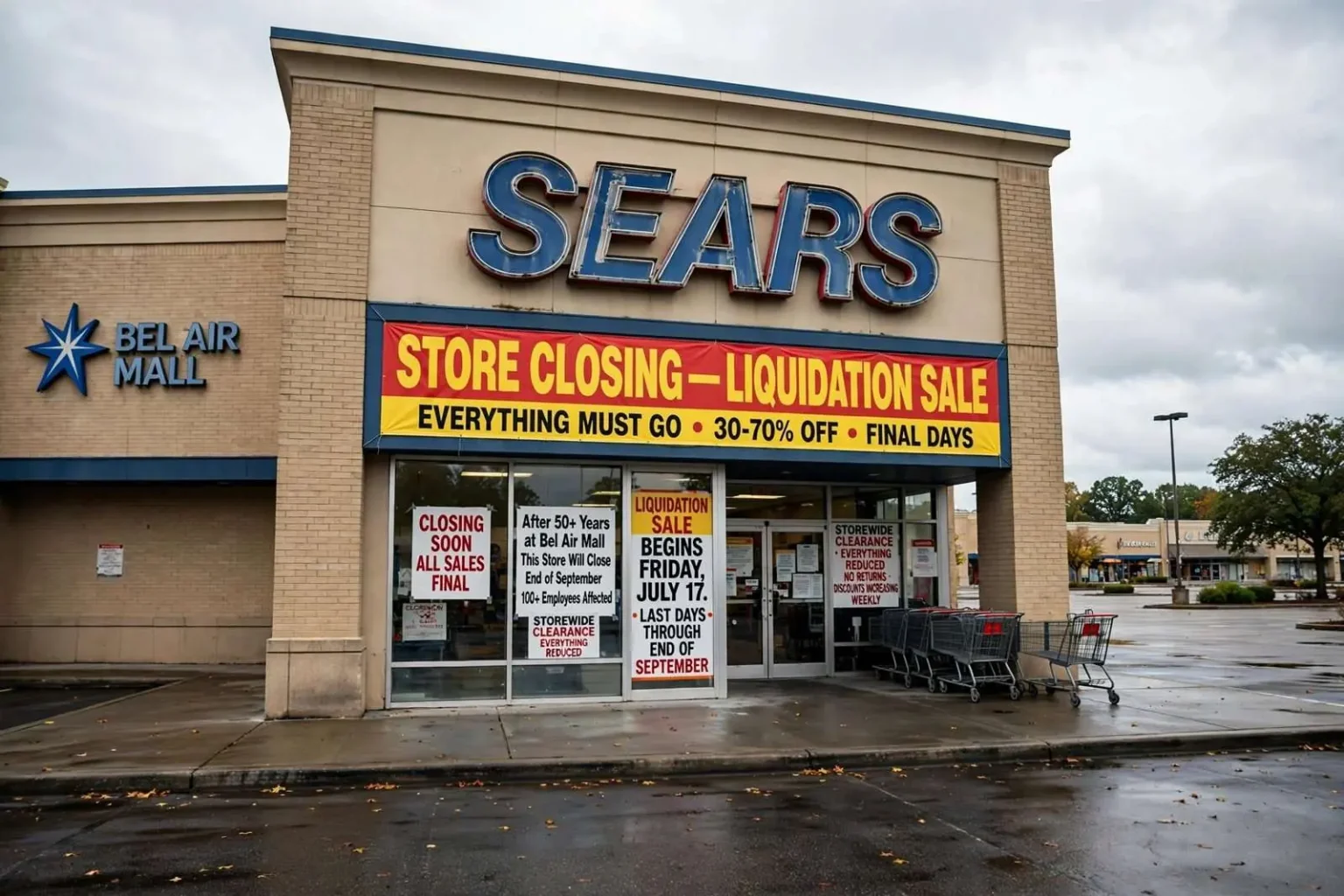
Another longtime anchor of Mobile’s retail landscape is on its way out. The Sears store at Bel Air Mall will close by the end of September, ending the iconic brand’s decades-long run at what has been one of the city’s busiest shopping centers. Liquidation sales at the store begin Friday, July 17, giving shoppers a final stretch to browse the racks before the doors close for good. The announcement removes one of the mall’s largest tenants and leaves west Mobile’s premier shopping center facing a question it has not had to answer in generations: what fills a Sears-sized hole.
A landmark closing
The store occupies nearly an entire city block within the mall and counts more than 100 employees, whose positions are affected by the closure. The footprint makes it one of the largest single tenants in the center, a two-level department store whose scale has defined the mall’s eastern presence for as long as most shoppers can remember. Employees learned the store’s fate as the liquidation timeline was set, and the sale that begins Friday, July 17, will run through the final day of operations, with merchandise discounts deepening as the inventory winds down.
Sears has been a fixture at Bel Air Mall for generations. The store opened with the mall itself and has anchored the center through decades of change in Mobile’s retail map, from the rise of suburban shopping centers to the arrival of big-box competitors along Airport Boulevard and the growth of specialty retail across the region. Many Mobile families have parallel histories with the location — school clothes bought there each August, appliances and tools financed through the store’s credit operation, portraits taken in its studio, and holiday trips built around the annual catalog era that Sears pioneered nationally.
For longtime shoppers, the announced departure will leave a noticeable gap, particularly heading into the busy holiday season. Department store anchors do more than sell merchandise; they generate the foot traffic that sustains surrounding tenants, and they serve as meeting points and landmarks that orient a mall’s customers. A closing anchor reshapes patterns throughout the center: shoppers who came specifically for one store now weigh whether the trip is worth it, while the stores that relied on Sears spillover traffic watch their own numbers in the months that follow.
What eventually fills the space remains an open question for mall ownership. Anchors of that size are difficult to replace one-for-one in the current retail climate, and owners of aging mall properties across the country have had to get creative — subdividing former department store boxes among several smaller retailers, converting them to non-retail uses such as medical offices, gyms and government services, or courting emerging national chains looking for regional entries. Bel Air Mall’s ownership now faces that exercise with one of the region’s most desirable retail locations at stake.
A shifting retail landscape
The closure fits a broader pattern that has seen department stores across the country consolidate or exit malls altogether as shopping habits shift online and toward specialty retailers. The department store model that built the American mall — a handful of national anchors whose names alone drew shoppers — has been under sustained pressure for years. Department store chains have closed hundreds of locations nationwide, concentrating their surviving stores in the strongest markets while liquidating weaker ones. Sears Holdings, the brand’s parent through its long decline, had already closed stores across Alabama and the region as part of cost-cutting moves that preceded this announcement.
The pressures on the model are structural. Online commerce has taken the largest share of categories that department stores once owned, from electronics to apparel, while off-price retailers, standalone brand stores and strip-center formats have captured shoppers who once saw the mall as the default destination. Anchor leases occupy enormous floor space at costs that are increasingly hard to justify per square foot, and mall owners now evaluate those spaces with an eye toward mixed uses their 1970s-era designs never anticipated.
Bel Air Mall has remained one of the more resilient centers in the region — an enclosed mall in an established part of west Mobile with steady traffic, popular national tenants and no direct competitor of comparable scale inside the city limits. That resilience is precisely why the Sears question matters locally: the mall’s ability to backfill the store will test whether the center can continue to command anchor-caliber tenants, and at what terms. A strong re-tenanting would confirm the mall’s standing in the regional market; a long vacancy would put pressure on the center’s economics and its image at the same time.
What it means for west Mobile
For west Mobile, the question now is whether Bel Air Mall can backfill the massive footprint — and whether another national tenant sees the same value in the location that Sears did for so many years. The store’s site has genuine advantages: visibility and access from one of the city’s principal retail corridors, a captive base of shoppers in surrounding neighborhoods, and the daily traffic a busy enclosed mall generates. Real estate observers have noted for years that former anchor boxes in healthy mid-sized markets often find second lives with retailers that did not exist when the original anchors were built — international fast-fashion chains, fitness clubs, entertainment concepts and hybrid store formats among them.
The human dimension is more immediate. More than 100 employees face the loss of positions that, for many, have been long-term jobs with predictable schedules in a familiar workplace. In liquidation closings, store staff typically work through the final sale, and some may find positions with other retailers in the area, but the loss of an institution that employed generations of Mobilians — many of them first jobs for young workers, others careers that lasted decades — is felt well beyond the mall’s parking lot.
For shoppers, the liquidation sale that begins Friday, July 17, offers a last chance to use the store as it has been used for decades, and the coming weeks will bring the familiar rituals of a closing: thinning racks, bare walls and, eventually, a darkened box on a corner where generations of Mobile shoppers began their trips to the mall. What rises in its place will say much about the next chapter of retail in west Mobile — whether the anchor model that built Bel Air Mall can be reinvented, or whether the era of the department store, already ending across the country, has now formally closed in Mobile as well.
The Sears name has been part of American retail life for well over a century, and in Alabama its stores have served as anchors for shopping centers from Huntsville to Mobile. For much of the twentieth century, the brand’s catalog was a lifeline for rural families across the Southeast, and its mall stores became institutions where communities did their serious shopping — appliances, tires, tools, winter coats. The company’s long decline has unfolded in stages that retail watchers know by heart: years of store closures, the merger that created Sears Holdings, repeated rounds of cost-cutting and asset sales, and a shrinking store base that has erased the brand from many markets entirely.
Mobile’s experience with the closing mirrors what communities across the country have gone through as their own anchor stores shut down. When a department store leaves a mall, the effects ripple in stages — first the sale and the empty box, then the questions about reuse, and finally whatever redevelopment follows. Cities that have managed the transition well have typically done so by treating former anchor space as an opportunity for reinvention rather than a loss to be mourned indefinitely: splitting the box among several tenants, drawing in uses that generate daily traffic rather than seasonal spikes, and rethinking the mall’s role as something more than a collection of clothing stores.
Word of the closing has already prompted the kind of reminiscence that follows the end of any long-standing local institution. Shoppers describe first jobs, layaway counters, back-to-school runs and holiday traditions — the small personal histories that accumulate around a store over decades. That accumulated familiarity is part of what an anchor location sells, and whoever takes the space will inherit it along with the square footage, hoping a new tenant can earn the same place in local routine that Sears held for so long.
Bel Air Mall’s ownership now faces that work with one of the region’s most valuable shopping centers at stake. The mall has outlasted multiple generations of retail fashions, and its location in the heart of west Mobile’s commercial district gives it advantages few properties in the market can match. Whether the post-Sears chapter begins with a new national tenant, a subdivision of the space, or a slower creative reuse, the closing marks the end of an era for Mobile shoppers — and the beginning of the test of what the city’s busiest mall looks like without the name that helped define it.


