
Second Arrest Made in Home Invasion That Left 81-Year-Old Mobile Woman Stabbed and Beaten
Mobile police charged a second suspect in the home invasion that left an 81-year-old woman stabbed, beaten and robbed on Pineda Court.
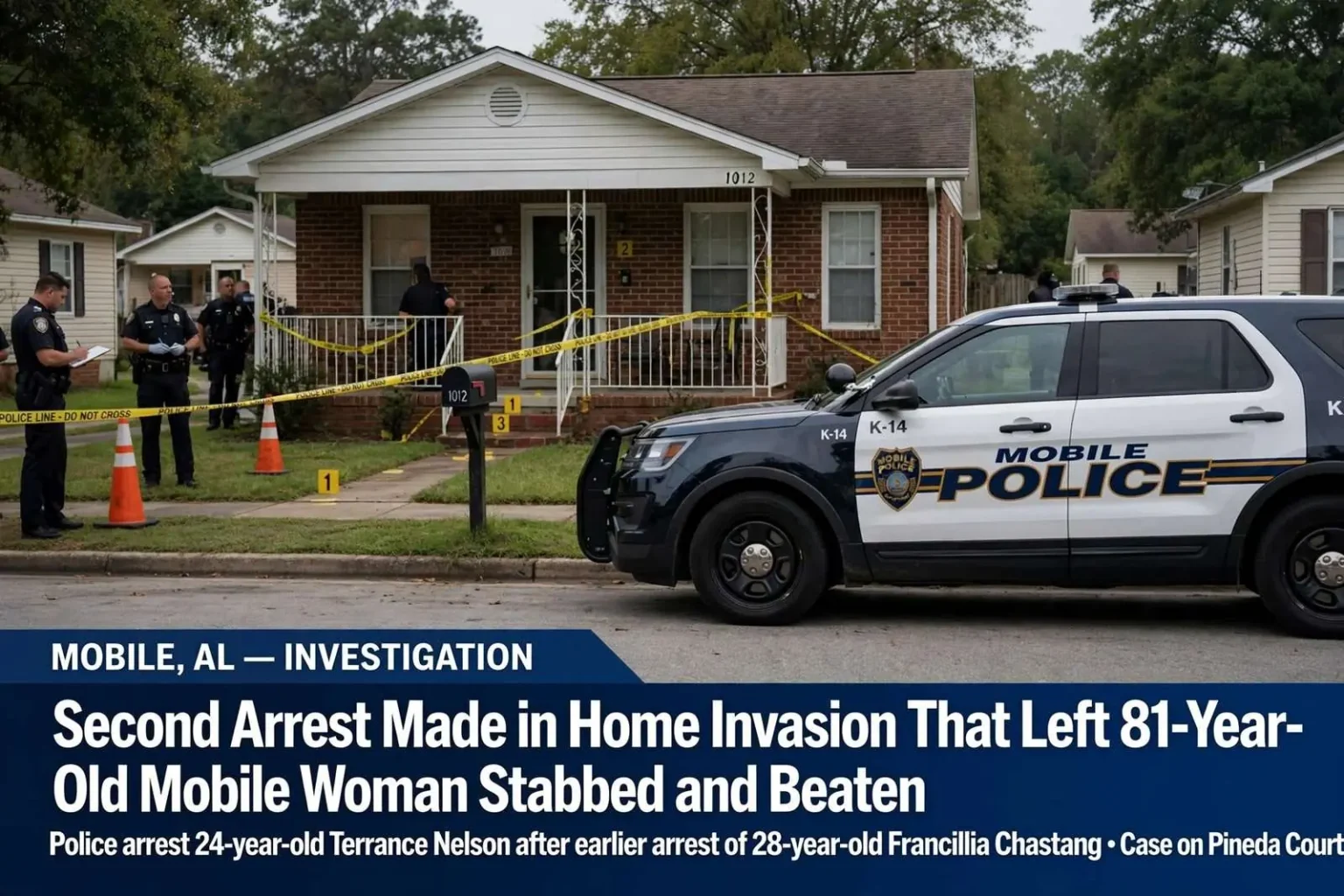
Mobile police have now arrested two people in connection with a home invasion that left an 81-year-old woman stabbed, beaten and robbed inside her Pineda Court home. The latest arrest came when officers took Terrance Nelson, 24, into custody and charged him with first-degree robbery in the case, according to the department. One day earlier, police announced the arrest of Francillia Chastang, 28, whom investigators identified as the person who attacked the victim, Margaret Campbell. Chastang faces counts including first-degree elder abuse, first-degree assault and first-degree theft of property, along with other felony charges.
The back-to-back arrests mark significant progress in a case that has unsettled the neighborhood where it happened and drawn attention across Mobile. Elderly victims of home invasion occupy a particular place in public concern: the crime combines the violation of a home’s sanctity with the vulnerability of a victim least able to resist or recover. Mobile police, by moving quickly to a second arrest, signaled that investigators believe more than one person took part in the attack on Pineda Court.
The charges the two suspects face differ, which reflects the roles investigators believe each played. Chastang, identified as the person who attacked Campbell, faces the most serious counts — elder abuse and assault — alongside theft charges. Nelson’s first-degree robbery charge indicates his alleged participation centered on the taking of property during the incident. Prosecutors will now weigh the evidence against each defendant as the cases move through the Mobile County court system.
What Happened on Pineda Court
The invasion unfolded around 3:30 p.m. on a Tuesday afternoon at Campbell’s home. Family members said the attacker stabbed her in the head and back during the assault. She was treated in the ICU at University Hospital, where relatives reported she was recovering and in stable condition.
The afternoon timing adds a troubling dimension to the case. Home invasions frequently occur under cover of darkness, but this attack happened in broad daylight, in a residential neighborhood where the movements of strangers are more visible. An 81-year-old woman answering her door in mid-afternoon had every reason to feel safe; the violence that followed has prompted residents of the area to reconsider the assumptions they bring to their own front doors.
University Hospital, where Campbell was treated, serves as the region’s major trauma center, handling the most severe injuries in southwest Alabama. Treatment in the intensive care unit reflects the seriousness of the stab wounds and beating she suffered. Her recovery to stable condition, as reported by relatives, came as a relief to a family and a neighborhood that had spent days awaiting news of her condition.
The intruders also took the woman’s purse, her television and her SUV. Police recovered the vehicle and returned it to the family’s home the following morning. The stolen items — everyday possessions plus a vehicle — suggest the perpetrators treated the attack as an opportunity for quick gain as much as an act of violence, and the SUV’s recovery gave investigators a potential source of forensic evidence linking suspects to the scene.
The Investigation Continues
Campbell’s family said they believe others were waiting outside during the attack to help carry out the getaway, and that she may have known her attacker because she let them into the home willingly. Police have not said whether additional arrests are expected as the investigation continues.
The family’s account, if accurate, describes a coordinated operation: one person at the door to gain entry, others positioned outside to assist with the escape and the stolen property. That structure is consistent with the multiple arrests police have now made, and it helps explain why investigators moved on a second suspect within a day of announcing the first. Home invasion cases often unfold this way, with roles divided among participants whose collective liability prosecutors sort out charge by charge.
The possibility that Campbell knew her attacker adds another layer to the investigation. Crimes in which victims admit offenders voluntarily are among the most difficult to prevent, because they defeat the usual defenses — locked doors, caution with strangers — that elderly residents are routinely advised to maintain. Investigators will work to establish the relationship, if any, between the victim and those now charged, since that connection shapes both the theory of the crime and the evidence needed at trial.
For the Pineda Court neighborhood, the arrests bring partial answers but not closure. Residents of the area have lived for days with the knowledge that an elderly neighbor was attacked in her own home in daylight, and the speed of the arrests offers reassurance that the department treats the case with urgency. Still, the open question of additional suspects keeps the neighborhood’s vigilance alive until police declare the investigation complete.
How Mobile Police Handle Major Cases
The pace of the arrests reflects how major crimes are worked in Mobile. Patrol officers secure the scene and begin the canvas immediately, but cases of this severity move quickly to the department’s investigative units, where detectives run down witnesses, execute search warrants, and coordinate with prosecutors on charging decisions. The announcements of Chastang’s and Nelson’s arrests on consecutive days suggest investigators developed their theory of the case rapidly, moving from the initial response to identified suspects in a matter of days.
Charging decisions in cases involving elderly victims carry enhanced significance under Alabama law. The state’s elder abuse statutes exist precisely because victims of advanced age face heightened vulnerability, and prosecutors treat offenses against them with corresponding seriousness. The combination of charges lodged against Chastang — elder abuse, assault, and theft — gives prosecutors a range of counts covering both the violence and the property taken.
Both defendants will now proceed through initial appearances and, likely, preliminary hearings as the state builds its cases. Convictions on first-degree charges in Alabama can carry lengthy prison terms, and the violent nature of the attack on Campbell — a stabbing and beating that left her in intensive care — will weigh heavily at every stage.
What Neighbors Can Do
Cases like the Pineda Court invasion typically prompt reminders from police about everyday precautions, and the circumstances of this attack give those reminders particular weight. Mobile police have long urged residents — especially older residents — to verify identities before opening doors, to report suspicious vehicles or persons in their neighborhoods immediately, and to look out for elderly neighbors who live alone. Community vigilance is consistently described by investigators as one of the most effective tools against residential crime.
Neighborhood watch-style vigilance has a real foundation in Mobile’s policing. The department encourages community engagement programs across its precincts, and tips from residents routinely break cases that begin with no witnesses. In the Pineda Court case, the investigation is ongoing, and police have not ruled out further arrests; anyone with information is typically urged to contact Mobile police or the department’s tip lines.
For Margaret Campbell’s family, the arrest of two suspects is progress in a case that began with a phone call no family wants to receive. Their reports of her recovery — from an ICU bed to stable condition — have accompanied the investigation from the start, and the family’s account of the attack has shaped the public understanding of what happened on Pineda Court. As the two suspects face the courts, the family’s focus remains where it has been since that Tuesday afternoon: an 81-year-old woman recovering from an attack inside the home where she should have been safest, in a neighborhood waiting to learn whether everyone responsible has been caught.
The Stolen SUV and the Getaway
The stolen SUV deserves particular attention in the case’s reconstruction. A vehicle taken from the scene of a violent crime is among the most valuable leads available to investigators: it moves the perpetrators away from the area quickly, but it also carries fingerprints, DNA, and trace evidence, and its movements can be tracked through witness sightings and surveillance cameras along its route. The fact that police recovered the SUV and returned it to the family the very next morning suggests the vehicle was found and processed promptly, and the speed of the subsequent arrests indicates that evidence from the recovery likely contributed to identifying both suspects.
The family’s belief that lookouts waited outside during the attack also matches what investigators often find in home invasion cases involving multiple offenders. Divided roles — one person to force entry, others to watch for police, drive, or help carry stolen goods — spread the risk and speed the escape. They also expand the circle of criminal liability: under Alabama law, participants in a crime need not personally commit every act to answer for the offense as a whole.
The Broader Problem of Crimes Against the Elderly
The attack on Campbell fits a pattern that victim advocates and law enforcement across Alabama have worked to combat. Elderly residents are disproportionately targeted for certain crimes — burglary, fraud, and home invasion among them — because offenders perceive them as less able to resist, less likely to pursue aggressive prosecution, and more likely to have valuables accumulated over a lifetime. The state’s elder abuse laws, which prosecutors have invoked in Chastang’s case, were strengthened over the years precisely to confront that targeting.
For Mobile’s growing population of older residents, the case is a reminder that safety planning matters at every age. Simple steps — doorbell cameras, verified appointments for utility and repair visits, regular check-ins from family and neighbors, and immediate reporting of anything suspicious — form the practical defense. Community organizations and senior centers across the city periodically host safety programs tailored to older residents, and police departments consistently report that engaged, watchful neighborhoods experience less residential crime than isolated ones.
The Pineda Court case will now move from the streets to the courts, where its ultimate resolution will take many months. But the two arrests in two days stand as the first chapter’s conclusion — and a message, delivered by the Mobile Police Department through its actions, that an attack on one of the city’s most vulnerable residents would be answered quickly and with the full weight of the law.


