Second Murder Trial Begins in 1980 Mobile Cold Case
A Mobile man is on trial again for the 1980 rape and murder of 19-year-old Sandra Williams, a Toulminville cold case reopened by DNA evidence decades later.
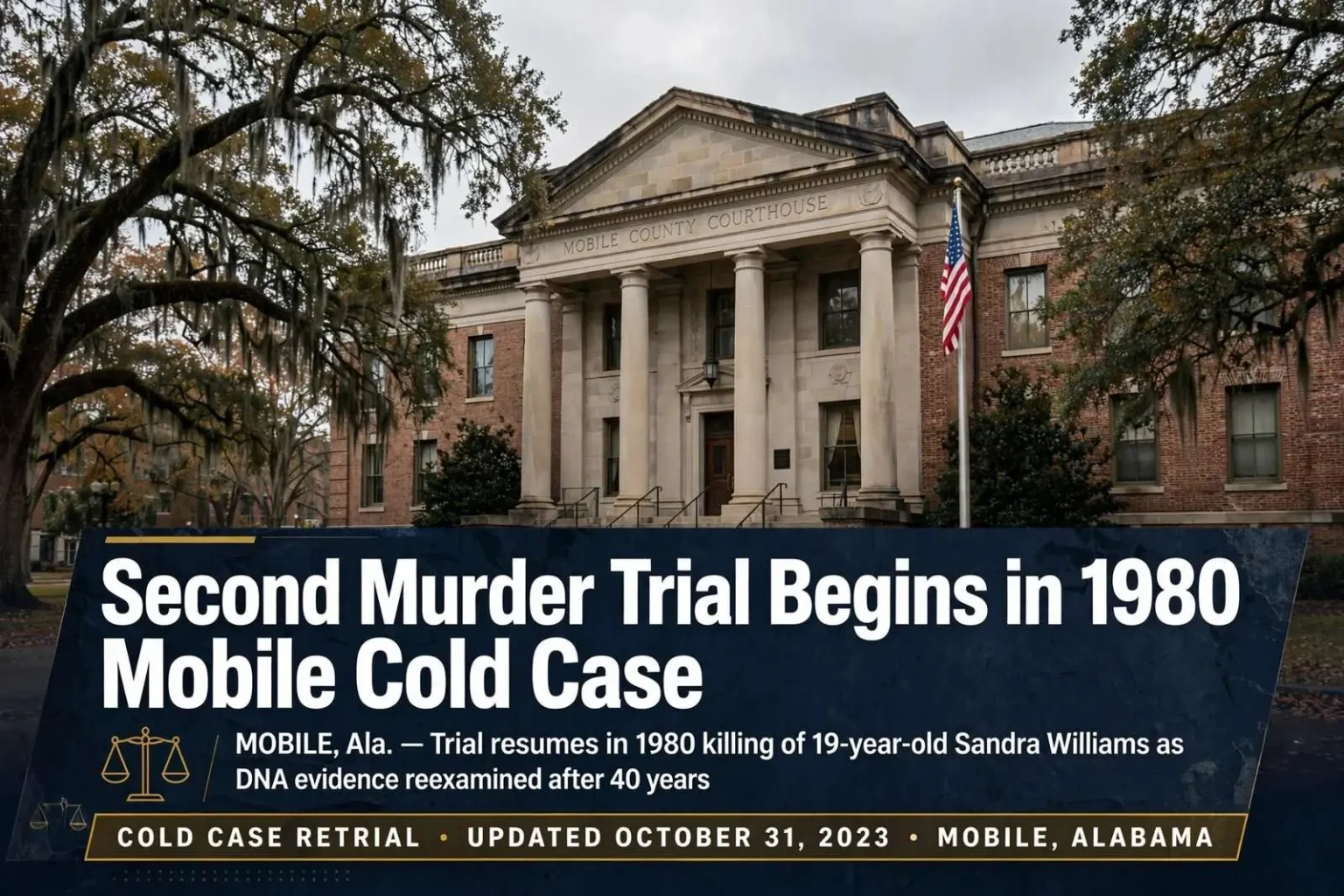
MOBILE, Ala. — A Mobile man is standing trial a second time for the 1980 rape and murder of a 19-year-old woman, more than four decades after her body was found in the Toulminville community.
Sandra Williams, 19, was discovered dead on Sept. 11, 1980, at the end of Clementine Court in Toulminville, roughly eight miles from her apartment on Azalea Road. Investigators said she had been raped and stabbed to death. The case went cold for nearly 40 years.
According to investigators, DNA recovered from the jeans Williams was wearing was eventually linked to Alvin Ray Allen and not to other men previously suspected. Advances in DNA analysis eventually allowed testing of evidence collected in 1980, and the profile developed from the clothing pointed investigators toward Allen after decades in which the case had sat unsolved in Mobile’s cold-case files.
Allen was arrested and charged in September 2019 and was released on a $100,000 bond hours after he was booked into jail. A first trial in March 2020 ended in a mistrial after a jury deliberated for three days without reaching a verdict. Circuit Judge Brooks ordered Allen fitted with an ankle monitor and barred him from contacting the victim’s family, limiting his movements to church and three rental properties he owned.
The retrial begins
Opening statements in the retrial began Tuesday. Prosecutors told the new jury that Allen had a history of harassing Williams, making her uncomfortable during family visits and damaging her property after she rejected him.
That history of harassment is central to the state’s theory of motive. Prosecutors laid out a pattern in which Allen’s attention to Williams continued after she made clear she wanted nothing to do with him, escalating from unwanted presence during family visits to damage to her property — conduct that, in the state’s telling, culminated in the 1980 attack. The prosecution’s narrative asked jurors to connect decades-old events into a coherent story of obsession and rejection.
Defense attorneys challenged the DNA evidence, arguing the two had a casual relationship and suggesting the genetic material could have come from an earlier encounter. The defense’s strategy rests on the sheer passage of time: with no living eyewitness to the attack and physical evidence limited to what was collected in 1980, the defense asked jurors whether a DNA match alone, absent context of when and how it was deposited, proves a killing four decades later.
Four witnesses testified Tuesday, including a friend of Williams and the construction worker who found her body. Their testimony recreated the Mobile of 1980 for jurors who were not yet born when Williams was killed — the neighborhood where she was found, the circumstances of the discovery, and the people around her in the weeks before her death.
Two additional accounts were read from transcripts of the first trial: both Richard Michael Barton and James Gill, officers who responded to the 1980 scene, have since died. Reading their testimony from the first trial’s transcript preserved their accounts for the second jury, a common practice when witnesses die between trials in long-delayed prosecutions.
The trial is set to resume Wednesday morning.
The case goes to the jury
Update (Oct. 31, 2023): The second trial has now gone to the jury. In closing arguments, prosecutors said the state had proven motive, intent, opportunity, consciousness of guilt and DNA evidence linking Allen to Williams’ killing.
Defense attorneys countered that the evidence was insufficient, noting that Allen’s DNA was found on the crotch of Williams’s pants and arguing the two had been in a casual relationship, so the genetic material could have dated from an earlier encounter. The framing sharpened the case’s central question: whether jurors believe the DNA is proof of the crime itself or merely proof of contact at some earlier time.
The defense also highlighted a rape kit collected in 1980 that was lost by the Alabama Department of Forensic Sciences — a loss prosecutors acknowledged, saying they too wished they had access to it. The missing kit has shadowed the case from its revival, representing evidence that might have confirmed or contradicted either side’s theory had it survived the decades. Its loss is part of a broader, well-documented pattern of evidence storage failures from that era, when case materials were kept under far less rigorous tracking than modern protocols require.
During closings, defense attorneys invoked “To Kill a Mockingbird,” arguing the case echoed the novel’s themes because a Black man stood accused of raping and murdering a white woman. Prosecutors rejected the comparison as unrelated to the facts of this case.
The exchange underscored how charged this trial has been in a city where Harper Lee’s novel — set in fictional Maycomb, rooted in Alabama’s history of racially fraught criminal justice — remains a cultural touchstone. The defense’s argument asked jurors to weigh the state’s evidence against that history; prosecutors told the jury the only relevant history was what happened on Clementine Court in 1980, and that DNA evidence does not carry a race.
Four decades of delay
Trials arising from four-decade-old cases present juries with problems no modern prosecution faces. Memories have faded or been lost entirely to death, as the 1980 responding officers’ absence demonstrated. Evidence has degraded or gone missing, as with the lost rape kit. And the science that broke the case open — DNA analysis — did not exist when the crime was committed, meaning evidence was collected by investigators who could not have imagined how it would someday be used.
Mobile County courts have handled several such revived cases in recent years, and judges in these prosecutions must carefully manage evidence and testimony that predate modern rules of procedure and evidence handling. In this trial, that challenge has been visible at every stage — from the admitted transcripts of dead officers to the acknowledged loss of forensic material — as the court works to give both sides a fair hearing across a gap of more than forty years.
Yet cold-case prosecutions have become an increasingly common feature of the American justice system as DNA technology has improved. Genetic methods can now develop profiles from samples too small or too degraded for earlier testing, and genealogy-based techniques have extended that reach further. What was untouchable in 1980 became the centerpiece of a 2019 arrest, and the interval between the crime and the charge is now a defining feature of the trial itself.
The stakes for both sides
For Williams’ family, the retrial represents another attempt at a verdict that eluded prosecutors in 2020, when the first jury deadlocked. The family has endured both the original loss — Williams was 19 when she was killed — and the four-decade wait for an arrest, followed by the uncertainty of a mistrial and the conditions of Allen’s release, which allowed him to remain in the community under an ankle monitor pending the new trial.
For Allen, the stakes are the most serious Alabama law allows. A conviction for the 1980 rape and murder would carry a sentence measured in decades or life imprisonment, and at his age even the minimum exposure would effectively amount to dying in prison. His defense has consistently argued that the case against him is built on a single piece of physical evidence interpreted two ways, and that the burden of proof — beyond a reasonable doubt — applies with full force even in a case this old.
The first jury’s deadlock looms over the retrial. A hung jury is not an acquittal, and prosecutors were entitled to try the case again, but it demonstrated that twelve Mobile County jurors weighing this same evidence could not agree. The second jury has heard much of the same testimony, supplemented by the transcript accounts of two officers who did not live to testify again, and its deliberations will test whether the state’s case has grown more persuasive or the defense’s framing has taken hold.
What comes next
Once the jury begins deliberating, the question before it is narrow: whether the state has proven beyond a reasonable doubt that Alvin Ray Allen raped and killed Sandra Williams in September 1980. A guilty verdict would close one of Mobile’s oldest active cases with a conviction; an acquittal would leave the 1980 killing formally unsolved once more.
Either outcome will mark the end of a legal journey that has spanned more than forty years, two trials, and the deaths of witnesses and investigators alike. For the Toulminville community where Williams was found, and for a city that has watched the case move from cold file to courtroom, the verdict will bring a resolution of sorts — though, as both sides acknowledged in closing arguments, no jury’s answer can return what was lost on Clementine Court in 1980.