Second suspect arrested in December murder on Buckingham Road
A second suspect, Freddie Jefferson, has been arrested in the December shooting death of Javonte Shoemo on Buckingham Road in Escambia County.
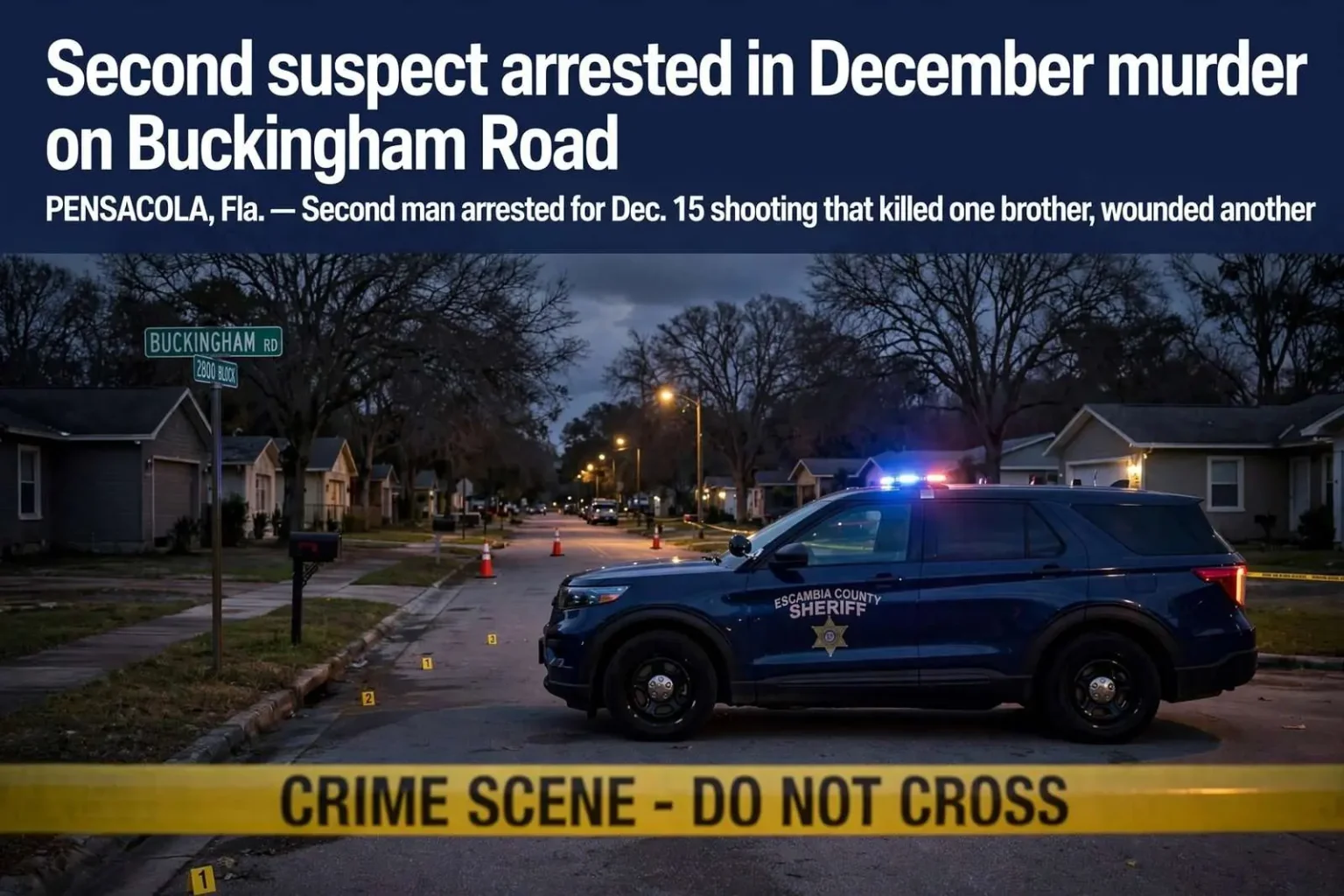
PENSACOLA, Fla. — A second man wanted in connection with a deadly December shooting on Buckingham Road has been arrested, closing out the pair of suspects authorities had been pursuing since the gunfire that killed one brother and wounded another.
Freddie Jefferson is charged in the shooting of brothers Javonte and James Shoemo. Javonte Shoemo died from a gunshot wound, and James Shoemo was taken to a hospital with multiple gunshot wounds. The shooting happened Dec. 15 on Buckingham Road, a residential street where deputies spent the following days gathering evidence and interviewing people who knew the men involved.
The arrests
Omar Collier Sr. was the other suspect in the case, and he had already been taken into custody on Dec. 17, two days after the shooting. Jefferson’s arrest followed as investigators worked the remaining leads in the case. With both suspects in custody, detectives could move forward with the process of presenting the case for prosecution, assembling witness statements, forensic evidence and the timeline of events that connected all four men to the same neighborhood that night.
Escambia County detectives had spent the interval between the two arrests running down information from the community. In cases where victims and suspects knew one another, investigators typically lean on phone records, social media activity and interviews with people close to everyone involved, building a picture of the evening before deciding what charges each suspect will face. The pace of the second arrest suggested that work was already well underway when Collier was taken into custody.
A case with a known connection
During the investigation, authorities determined that all four men — the two victims and the two suspects — had been together earlier that evening, and an argument may have led to the shooting. That finding reshaped the case from a random act of violence into something investigators see far more often: an escalation between people who already knew each other, ending in gunfire on a residential street.
The pattern matters both for the investigation and for the community’s understanding of the risk. Shootings arising from personal disputes are generally not considered random threats to the neighborhood, and deputies typically say so when the evidence supports it, both to calm residents and to narrow the field of possible witnesses. In this case, the earlier gathering meant investigators immediately had a universe of possible witnesses — anyone who saw the men together that evening, anyone who knew about the argument, anyone who heard what was said afterward.
The Escambia County investigation
Escambia County Sheriff’s Office deputies and investigators handle homicide cases across the county outside Pensacola’s city limits, and Buckingham Road falls in their jurisdiction. The unit’s work in a case like this one runs a familiar course: secure the scene, canvass for cameras and witnesses, process the vehicles and shell casings, track the movements of everyone involved through phone data, and bring the findings to the State Attorney’s Office for formal charges. The arrest of a second suspect weeks into the case is consistent with that timeline, as investigators confirm enough of the narrative to charge each participant according to his role.
The charges Jefferson faces will be tested in the court process ahead, where prosecutors must establish what happened in the moments before the shooting and who did what. Cases arising from mutual gatherings and arguments often turn on that reconstruction, and the defense will have its own account. With both suspects arrested, the case now moves from the streets to the courtroom, where the evidence gathered in December will be laid out for a judge or jury.
The human cost
For the Shoemo family, the arrests come with the loss of Javonte and the recovery of James. Two brothers shot on the same night, one fatally, is a blow that extends through households of relatives and friends across the Pensacola area. Community members who knew the men described the kind of grief that follows when violence takes someone young, and the knowledge that everyone involved had been together earlier that evening only deepens the sense of a night that should have ended differently.
Pensacola-area residents who followed the case watched the standard sequence play out: the initial report of a shooting, the confirmation of a death, the first arrest within days, and the second arrest as the investigation tightened. Each step brought the case closer to resolution, though no arrest restores what the family lost.
The case stands as a reminder of how quickly disputes among acquaintances can turn lethal. Deputies continue to encourage anyone with information about any violent case to come forward, and in this one, the information gathered from the community helped investigators place four men together on a December evening, trace the argument that followed, and bring both suspects before a judge.
The Buckingham Road case also unfolded within the broader context of how Escambia County approaches gun violence. Deputies operate across a large, varied jurisdiction that stretches from suburban neighborhoods near the Pensacola city line out to the rural northern reaches of the county, and violent-crime response in the unincorporated areas depends heavily on rapid patrol work followed by patient detective follow-up. In the hours after a fatal shooting, the first priorities are medical aid, scene security and the immediate canvass; the longer work of building a prosecutable case takes days and often weeks.
Escambia County has for years run violent-crime and fugitive units whose work often determines whether suspects like Jefferson and Collier are found quickly. Those teams combine warrant service, surveillance and tips from the public, and their effectiveness in a case often shows up in the interval between the crime and the second arrest. Two arrests within days and weeks of a December shooting reflect the kind of concentrated effort that follows a homicide in the county, where sheriff’s officials regularly appeal for the public’s help and stress that tips can be left anonymously.
When an argument turns lethal
Investigators’ determination that the four men had been together earlier that evening points to a reality that criminologists and police alike emphasize: a large share of homicides arise not from predatory violence but from disputes between people who know each other. Arguments over money, respect, relationships or old grievances can escalate when weapons are present, and the presence of guns converts a fight that once ended in bruises into one that ends in a morgue and a hospital room.
That dynamic shapes how such cases are investigated and prosecuted. When the people involved were together beforehand, investigators look for the sequence: where the gathering happened, what was said, who left first, whether threats were made in person or by text, and what each man did after the split. Witnesses to the earlier portion of the evening often prove more forthcoming than witnesses to the shooting itself, and their accounts help establish motive and sequence even when nobody saw the trigger pulled.
Supporting a wounded survivor
James Shoemo’s survival added another dimension to the case. Multiple gunshot wounds typically mean surgeries, extended hospitalization and a long rehabilitation, and survivors of serious shootings carry both physical and psychological wounds. Survivors are also, often, the prosecution’s most important witness, though investigators must weigh what a victim who was present for the dispute can reliably remember and say. His account of the evening and the argument would have been central to the case detectives assembled against both suspects.
Prosecutors in the First Judicial Circuit, which covers Escambia County, handle cases of this kind through the grand jury system, where the evidence is presented to determine formal indictments. Cases with two charged defendants can proceed together or be separated as the legal process develops, and outcomes depend heavily on the strength of the physical evidence — shell casings, ballistic matches, phone records — that is gathered in the first weeks and preserved for trial.
The neighborhood’s experience
For the residents of Buckingham Road and the surrounding blocks, a fatal shooting is a destabilizing event. Deputies block the street, investigators move door to door, and the neighborhood watches the case unfold through local news reports over the following weeks. Residents in such situations typically describe a mix of grief, fear and frustration, and sheriff’s officials respond with increased patrols and public appeals for information. When arrests come quickly, the sense of relief in the neighborhood is real, even as the underlying loss remains.
The case also reflects the cost to everyone connected to it. Two young men dead or wounded, two suspects facing murder charges, families on both sides of the courtroom, and a neighborhood left to process what happened on its own street. Investigators who work these cases routinely note that no arrest undoes the event, and that the best outcome is the one where the argument never reaches for a gun.
With Jefferson and Collier Sr. both in custody, the Buckingham Road shooting case moves into its judicial phase. The record assembled in December — the scene, the shell casings, the statements, the timeline of four men together on a winter evening — will now be tested in open court, where the full account of what happened will finally be laid out publicly.