Secret Repayment Deal Hid $82,000 Contractor Overbilling From Mobile County Commission
Testimony in the corruption trial of Mobile County License Commissioner Kim Hastie revealed a secret 21-month repayment plan that let a longtime county computer contractor quietly pay back more than $82,000 in overbilled charges without commissioners ever finding out.
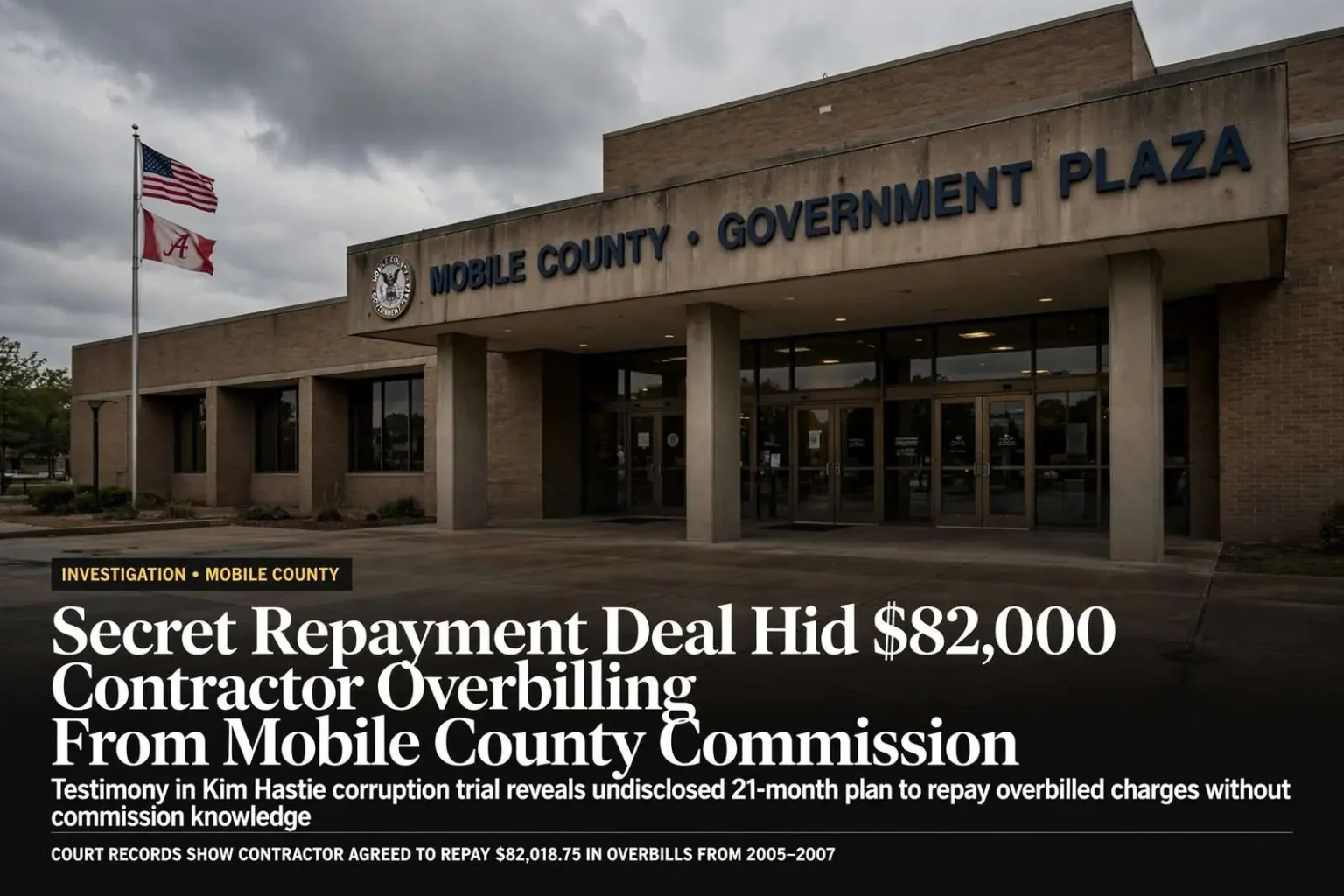
Testimony from the recently concluded corruption trial of Mobile County License Commissioner Kim Hastie has exposed a previously unknown arrangement that allowed a longtime county computer contractor to quietly repay more than $82,000 in overbilled charges without the Mobile County Commission ever being told. The revelation surfaced over the course of a seven-day trial in which defense attorneys closely examined years of work performed for Mobile County by computer contractor Victor Crawford and his company, APL Software Engineering.
Crawford’s firm has held some form of government contract with the county dating back to 1988, working at various points with the Mobile County Probate Court, the public works department, the license commission and the county commission itself. Much of that longevity, according to testimony, traces back to Crawford’s relationship with County Engineer Joe Ruffer, described during the trial as Crawford’s “friend and mentor.” That relationship became a focal point for defense attorneys seeking to undercut Crawford’s credibility as a witness against Hastie.
Attorneys highlighted a pattern in APL Software’s contracts in which the company billed the county a higher hourly rate for employees than Crawford ultimately paid them in salary. Testimony showed that APL Software employee Katie Williamson was billed to the license commission at $75 an hour for work performed between 2012 and 2014, even though Crawford acknowledged on the stand that he paid her closer to $25 an hour, keeping the remaining difference for the company.
Defense attorneys characterized the arrangement as “overbilling,” a label Crawford disputed. But the trial testimony marked the second time in less than a decade that his firm’s invoices to the county had come under serious scrutiny.
County documents show that in 2007, Crawford billed Mobile County’s public works department $65 an hour for several employees listed in his contract as “senior programmer analysts.” A subsequent review determined that rate was inflated by roughly $25 an hour given the employees’ actual qualifications and the work they performed. In written correspondence with Ruffer, Crawford conceded that the duties being performed were “more befitting the job description of a ‘computer operator,’” and agreed to reduce his rate to $45 an hour going forward.
An administrative service manager who reviewed the contract at the time worked with the public works department to calculate the scope of the problem, ultimately determining that the county had been overbilled approximately $82,018.75 between June 2005 and May 2007. Rather than requiring immediate repayment, correspondence from August 2007 — which involved only Ruffer and Crawford — laid out a 21-month plan to recoup the money by reducing Crawford’s regular monthly invoices going forward.
“The method of reimbursement was determined and approved by Mr. Ruffer,” the agreement stated.
No county commissioner or administrator appears to have been informed of either the overbilling or the repayment arrangement Ruffer put in place. Stephen Nodine, who represented District 2 on the county commission at the time, said he was never told about the deal.
“There was never any inclusion or the hint of a clue that some type of payment plan was set up,” Nodine said in a recent interview. “First of all, it’s illegal. That would have had to have come back before the commission. Not only was I not informed, but neither was the county attorney or our public relations person at the time.”
Nodine, whose own legal troubles since 2010 have included a federal gun conviction, a perjury conviction and an unsuccessful murder prosecution, has in recent years been willing to speak publicly about disputes that arose during his tenure on the commission.
A former county employee, speaking on condition of anonymity, separately confirmed that the overbilling issue was never brought before the commission. Mike Dean, who also served on the commission at the time, could not be reached for comment.
Notably, the overbilling review took place while Nodine was already pressing colleagues over Crawford’s contracts and billing practices. In 2007, Nodine secured the second vote needed to terminate APL Software’s consulting contract with the county commission, only to see the company rehired a month later on a month-to-month basis before its contract was terminated again in 2008.
Published reports from that period noted Nodine’s repeated public complaints about APL Software’s rates and what he described as information being withheld from the county. Nodine said he later compiled a package documenting Crawford’s billing practices and turned it over to then-Mobile County District Attorney John Tyson, though no formal investigation appears to have followed.
Nodine also recalled that Ruffer pushed for years to keep Crawford’s contracts intact across both the commission and the public works department. “I respect Joe Ruffer, but he had no authority or legal standing to set up any payment plan with Victor Crawford at the time,” Nodine said.
Ruffer declined to discuss the matter, as did current County Administrator John Pafenbach, who held the same position in 2007. Asked about Pafenbach’s knowledge of the arrangement, a county spokesperson said he “doesn’t know anything about it and so is not in a position to comment on it.” Nodine maintained that it should have fallen to the county administrator at the time to alert commissioners to the billing dispute.
Crawford’s only remaining county contract is with the Mobile County License Commission, and his future there is uncertain given his role as a key witness in the case against Hastie. With Hastie having been acquitted of the most serious charges against her, Crawford’s position carries no federal protection tied to his testimony.
Crawford declined to be interviewed for this story, as he has for previous reporting on his county work. Hastie did not return calls seeking comment.
Her attorneys said they had advised her not to discuss the overbilling matter while she awaits a retrial on a separate, unrelated tax evasion charge, which is scheduled to begin in late August.
About the offices involved
The Mobile County License Commission, the elected office Hastie leads, handles motor vehicle registrations, tag renewals and titles and collects local sales and use taxes. The Mobile County Commission, a three-member elected body, approves county contracts and the county budget, which is why Nodine argued that a repayment arrangement of this kind should have come before commissioners.