
Severe Weather Prompts School Delays and Cancellations Across Gulf Coast
School districts across the Gulf Coast announce delays and cancellations following overnight severe weather.
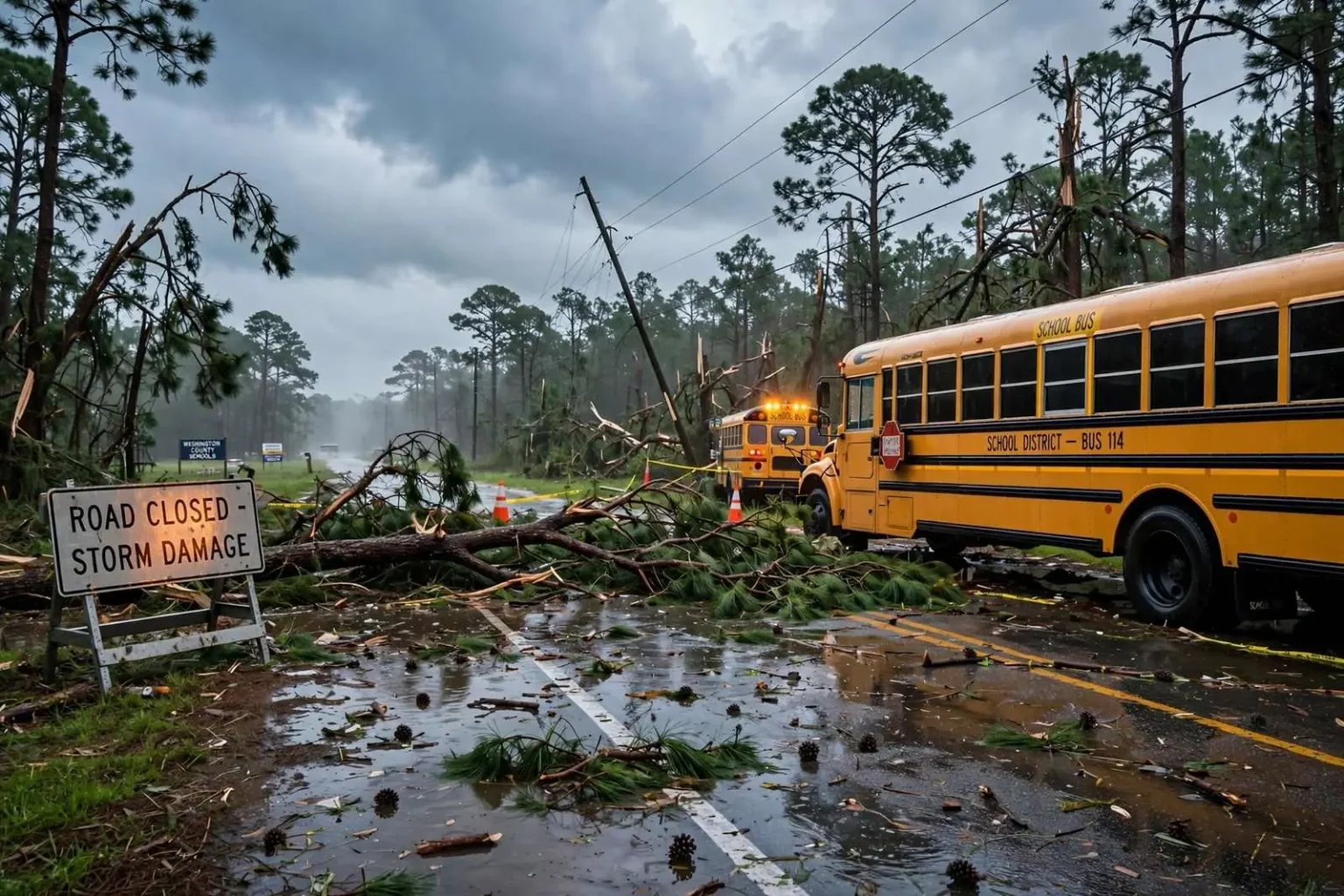
As severe weather moves out of the Gulf Coast following overnight storms, school districts across the region are announcing delays and cancellations while transportation officials inspect roads and campus buildings for damage. The overnight storms brought heavy rain, gusty winds and the threat of severe weather to southwest Alabama, and superintendents spent the early-morning hours weighing road conditions, power outages and bus route safety before deciding how to open their schools, if at all. The result is a patchwork of closures, delayed starts and adjusted bus schedules across the Gulf Coast, with each district making its own call based on local conditions.
In Washington County, Superintendent Lisa Connell announced that all schools in the county are closed today. Employees need to remain at home and will get an update at 9:00 a.m. The announcement means students throughout the rural county, which sits west of Mobile along the Mississippi state line, will stay home while officials assess whether conditions are safe enough to resume classes tomorrow. Washington County’s school system serves communities scattered across a wide rural area, where bus routes cover long stretches of two-lane roads that are more vulnerable to storm damage, downed trees and localized flooding than the arterials in more urbanized parts of the region.
In Chickasaw, the Chickasaw City School District announced a delay until 10:00 a.m. today. Bus schedules will be on a 3-hour delay, giving drivers and transportation staff additional daylight and time to evaluate routes after the storms. There will be no change in dismissal time, which means students will still be released at the normal hour in the afternoon and the school day will simply run on a shortened schedule. Parents who drop children off at school are asked not to arrive before the delayed start time, when staff will be on hand to receive students.
Mobile County Public Schools, the largest district in Alabama, announced that it is not on a delay. However, bus routes will be delayed by an hour while transportation crews confirm that roadways are passable and that bus stops are safe. Student tardies and absences will be excused today, a step designed to reassure families who may face flooded streets, blocked roads or damaged neighborhoods on the way to school. Employees are expected to report to school at their regular time, so that campuses are fully staffed to receive students arriving on the adjusted transportation schedule.
Why districts make different calls
The differing responses among neighboring districts reflect the way severe weather behaves across southwest Alabama. A line of storms moving through the region overnight can dump damaging winds and torrential rain in one community while leaving another largely untouched. Washington County’s closure reflects conditions on the ground in its attendance zone, while Chickasaw’s shortened day and Mobile County’s adjusted bus schedule represent a middle path — keeping schools open, where conditions allow, while protecting the youngest students and those who ride buses through potentially affected areas.
School transportation is usually the deciding factor in these decisions. Bus drivers begin routes before dawn, when darkness makes it difficult to see standing water, washed-out road edges or downed power lines. A delayed start moves routes into daylight hours, when road crews have had time to clear debris and utility companies have begun restoring power. Districts also consult with county emergency management agencies and local law enforcement before making a final call, and many superintendents personally drive portions of bus routes in the pre-dawn hours to see conditions firsthand.
The Mobile County Public School System serves tens of thousands of students across Mobile, Prichard, Saraland’s neighboring communities, Tillman’s Corner, Grand Bay and communities across the county’s roughly 1,200 square miles, making any transportation adjustment a massive logistical undertaking. A one-hour bus delay touches hundreds of routes and thousands of stops, and the district’s decision to excuse tardies and absences is intended to prevent families from making unsafe choices — such as driving through standing water — just to avoid an unexcused absence. District officials emphasize that student and staff safety takes precedence over attendance figures on storm-affected days.
Chickasaw City Schools, one of the smaller independent systems in the area, operates on a compact footprint within the city limits north of Mobile. Even there, the 3-hour bus delay gives the district’s small transportation staff room to maneuver. The city, which incorporated in 2008 after splitting from the Mobile County system, has built its own city school district from the ground up in just over a decade, and officials there have consistently emphasized close communication with parents during weather events through the district’s notification systems and social media channels.
Washington County’s full closure underscores a different calculation. The county’s schools sit in small communities such as Chatom, McIntosh, Millry and Leroy, and its bus routes thread through heavily wooded rural terrain where storm damage can leave roads impassable well after the rain ends. With no large population centers to consolidate around, a delayed start still leaves many students waiting at rural bus stops in damaged areas. Closing for the day, with a 9:00 a.m. update for employees, gives the district maximum flexibility to restore normal operations once conditions are confirmed safe.
What parents need to know
Families in all three systems should pay close attention to how today’s adjustments affect pickup and drop-off. In Chickasaw, buses will run on a 3-hour delay and the delayed start is 10:00 a.m., but afternoon dismissal remains unchanged, so parents should plan for an earlier-than-usual day at the bus stop in the afternoon relative to the morning schedule. In Mobile County, buses run one hour late, students who arrive late or stay home will be excused, and school employees report at the normal time. In Washington County, all schools are closed and employees should await the 9:00 a.m. update before making any plans to report.
District leaders also remind parents to have a plan for future weather events. Southwest Alabama sits in one of the most tornado- and storm-prone corridors in the country, and overnight severe weather during the spring and the fall severe weather seasons routinely forces these decisions. Parents should make sure their contact information is current in their district’s notification system, follow official district social media accounts rather than unofficial pages, and have a backup arrangement for childcare on days when schedules change abruptly. Officials caution against relying on word of mouth, which can spread outdated or incorrect information while districts are still finalizing decisions.
The storms behind the schedule changes
The overnight storms that prompted the schedule changes swept across the Gulf Coast with heavy rain and strong winds, knocking down tree limbs, dumping water on low-lying roads and knocking out power in scattered neighborhoods. Afternoon and evening storms are a fixture of Gulf Coast summers, and the region’s dense pine forests and sandy soils mean that even moderate winds can topple shallow-rooted trees across roadways. Local emergency management offices spent the morning collecting damage reports and coordinating with utility crews, and school officials used those same reports to finalize their transportation decisions.
Forecasters had warned of the possibility of strong storms overnight, and the region’s broadcast meteorologists tracked the line as it moved in from the west. By daybreak, the worst of the weather was pushing out of the area, but the aftermath — standing water, debris, and dark traffic signals in some neighborhoods — was enough to justify the cautious approach most districts took. Emergency managers stress that the hours after a storm passes can be as dangerous as the storm itself, with drivers encountering flooded roads that appear shallower than they are and downed lines that may still be energized.
Looking ahead
Districts are expected to return to normal schedules tomorrow unless additional weather develops, and officials in all three systems said they would communicate any further changes through their standard channels. Parents with questions about today’s schedule are encouraged to check their district’s official website and social media pages, or to contact their child’s school directly once phone lines are staffed. Athletic events, after-school programs and other activities typically resume automatically when the regular schedule does, though individual schools may announce exceptions.
For now, the coordinated response across Washington, Chickasaw and Mobile County reflects the routine that Gulf Coast school systems have refined over years of severe weather. Each district makes an independent decision, but the pattern is familiar: close or delay where roads are unsafe, adjust bus schedules where students can attend safely, and excuse absences so that no family is forced to choose between an education record and a risky drive. As the region dries out, classes will return to normal — with the storm season’s next round already a matter of when, not whether, along the northern Gulf Coast.


