Shannon McNally and Chelsea Crowell Bring Americana to Callaghan’s on Sunday
Shannon McNally and Chelsea Crowell, two acclaimed singer-songwriters, share the stage Sunday at Callaghan's Irish Social Club in Mobile.
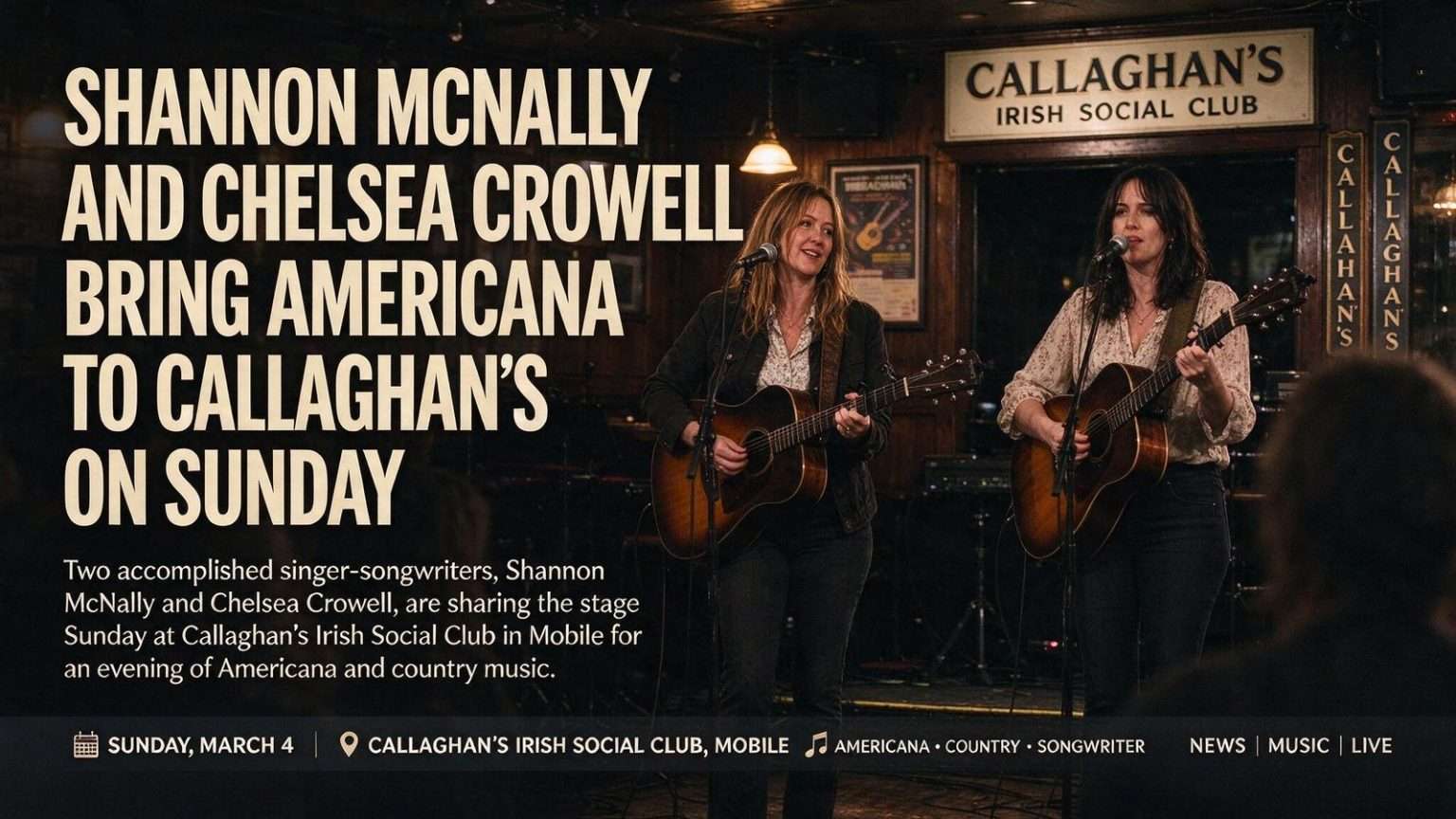
Two accomplished singer-songwriters, Shannon McNally and Chelsea Crowell, are sharing the stage Sunday at Callaghan’s Irish Social Club in Mobile for an evening of Americana and country music. The pairing brings two distinct songwriting voices — one forged in the New Orleans and Mississippi hill country scenes, the other carrying one of the most storied surnames in country music — into one of Mobile’s most intimate listening rooms for a single Sunday night.
McNally, a New York native who moved to New Orleans and later Oxford, Mississippi, has performed with and opened for artists including John Hiatt, Neal Casal and Ryan Adams. Her most recent album, “Western Ballad,” arrived in 2011, and she has since been reported to be at work on a new project tied to guitarist Luther Dickinson. That trajectory — from the Northeast to the Deep South, from bars in New Orleans to studios in northern Mississippi — has made her a familiar figure in the Gulf South’s Americana circles, and her Mobile appearances have consistently drawn listeners who follow the regional circuit.
Crowell, a Nashville resident who studied history, English and photography at Belmont University and the Memphis College of Art, recently finished her second solo record. Her latest release, Crystal City, came out in 2011. She is the daughter of songwriters Rodney Crowell and Rosanne Cash, making her the granddaughter of the legendary Johnny Cash — a lineage that inevitably frames every conversation about her music, even as her own records have pursued a quieter, more literary path than the family name might suggest.
The Artists and Their Catalogs
McNally’s catalog blends folk, country, blues and rock with a delivery that sits somewhere between singer-songwriter intimacy and roadhouse swagger. “Western Ballad” continued the evolution, drawing on the musical vocabulary of her adopted South. The reported project with Luther Dickinson — the North Mississippi Allstars guitarist and producer whose family studio has anchored much of that region’s roots music — points toward the rawer, closer-to-the-source sound that has defined her recent work.
The company she has kept tells its own story. Opening for John Hiatt and Ryan Adams, and performing alongside Neal Casal, placed McNally in the company of songwriters’ songwriters, the artists whose craft other musicians study. Building that resume required not just a voice but a songbook, and her sets typically range across the full arc of her recordings rather than resting on any single album.
Crowell’s path has run through both academia and art — history and English at Belmont, photography at the Memphis College of Art — before returning to the family trade of songwriting. That background shows in her writing, which leans toward narrative and image rather than formula. Crystal City, her 2011 release, followed a debut and preceded the second solo record she had just finished as this show approached, making the Mobile date a chance to hear new material from an artist in a productive stretch.
Callaghan’s and the Mobile Listening Room Tradition
The Sunday, March 4, show at Callaghan’s pairs the two on original material in an intimate club setting. Callaghan’s Irish Social Club, in Mobile’s Oakleigh Garden District, has built a national reputation disproportionate to its size — a neighborhood pub whose back room has hosted touring songwriters of national standing while remaining, at its heart, a local bar where the kitchen’s burgers draw almost as much loyalty as the music.
Rooms like Callaghan’s occupy a crucial place in the Americana economy. The genre’s artists rarely ride radio play; they tour constantly, room by room, and the venues that matter are the ones where the audience actually listens. A Sunday night show — off the peak weekend calendar — is exactly the kind of date that circuit depends on, and Mobile’s willingness to turn out on a Sunday evening for two touring songwriters says something about the depth of the local audience.
A Family Name, a Separate Career
For Chelsea Crowell, the lineage is both an asset and a shadow. Being the daughter of Rodney Crowell and Rosanne Cash — and the granddaughter of Johnny Cash — opens doors and draws curiosity, but it also sets a bar of comparison that no debut artist meets. Her response has been to build her own catalog on her own terms: records built on her writing, touring that stands on her own billing, and a body of work that rewards attention without reference to the family tree. Audiences who come to the show expecting only the famous surname tend to leave talking about her songs.
That generational story is itself a piece of American music history. The Crowell-Cash household sits at the center of the country and Americana traditions — Rodney Crowell’s songwriting helped define the genre’s literary wing, Rosanne Cash’s catalog is among the most celebrated of her generation, and Johnny Cash remains one of the towering figures of American music. Chelsea Crowell’s emergence as a songwriter in her own right extends that lineage into a third generation, this time through a distinctly independent route.
McNally and Crowell make a natural double bill despite their different paths. Both write within the roots tradition, both prioritize the song over the production, and both are at home in rooms where the quiet passages can actually be heard. Their shared stage at Callaghan’s — whether trading songs, backing each other, or playing separate sets — offers the kind of evening that the club’s regulars have come to expect and that keeps touring artists returning to Mobile.
What the Show Offers Local Listeners
For Mobile audiences, the Sunday date is a rare pairing on the Gulf Coast circuit. Touring songwriters of this caliber more often appear in New Orleans, Oxford or Nashville; a Mobile stop at a room the size of Callaghan’s puts the audience within a few feet of the performers, close enough to hear the nuances that larger venues flatten. The club’s format — food and drink through the early sets, music at the center of the room — suits the material both artists bring.
The timing also catches both artists at telling moments: McNally with a new album behind her and a reported collaboration with Luther Dickinson ahead, Crowell with Crystal City in circulation and a second record just completed. Shows like this one are where the next albums get tested — new songs played for a listening audience before they are committed to tape.
Callaghan’s has long served as the place where Mobile’s Americana audience and the national touring circuit meet, and the March 4 date continues that role. Two songwriters, one small room, and a Sunday night’s worth of original music — the kind of show that defines the club and, month after month, keeps Mobile on the map for artists passing through the Gulf South.
Shannon McNally’s Road to the South
McNally’s story is worth unpacking for readers new to her work. A New York native, she came up through the singer-songwriter world of the late 1990s and early 2000s, releasing records that drew attention for a voice that could move between smoke and clarity within a single verse. Her relocation south — first to New Orleans, then to Oxford, Mississippi — was more than a change of address. It placed her in two of the most fertile roots-music environments in America, and her songwriting absorbed both: the Crescent City’s groove-forward lineage and the hill-country blues tradition that runs through northern Mississippi.
That move also connected her to the circuit of players and producers who define the region. Oxford sits at the center of a musical triangle that includes Memphis to the north and the Delta to the south, and the city’s recording culture has drawn artists for decades. McNally’s reported project with Luther Dickinson fits squarely into that world — Dickinson and his family’s studios have been central to the area’s sound, and a collaboration bearing his influence suggests a record rooted in the raw materials of North Mississippi music.
Her touring history completes the picture. Sharing bills with John Hiatt placed her in front of audiences devoted to songcraft; opening for Ryan Adams connected her to the alt-country generation; working with Neal Casal tied her to the guitarist’s wide-ranging roots rock world. Each of those associations reflects peers’ respect, which in the songwriter economy is the currency that matters most.
The Americana Circuit and Sunday Nights
The economics of a show like this one explain why it matters to the artists as much as the audience. Americana tours are built on nights like Sunday, March 4 — dates between the weekend’s bigger markets, in rooms where a split bill splits the travel cost and doubles the draw. Two songwriters sharing a stage broaden the audience for each, and the informal, everyone-on-stage-at-the-end character of such nights often produces the moments fans remember most.
For the artists, the value is the room itself. Writing songs is solitary; playing them in a listening room is the feedback loop that shapes an album. McNally and Crowell both arrived at this show with active projects — the reported Dickinson collaboration and Crowell’s newly finished second record — and sets like these are where new material proves itself or gets reworked.
For Mobile, the night is part of a longer story. Callaghan’s has spent years building its reputation one songwriter at a time, and the club’s consistent booking has made the city a regular stop on routes that once bypassed it entirely. Audiences who fill the back room on a Sunday night are, in a very practical sense, the reason the next touring act adds Mobile to the itinerary. The March 4 pairing of Shannon McNally and Chelsea Crowell — two writers with deep catalogs, famous connections and new records in motion — is exactly the kind of date that reputation was built on, and exactly the kind of evening Mobile’s Americana listeners have learned not to miss.