‘She Deserved Better’: Boyfriend Mourns Kimberly Robles, 21, Killed in Chickasaw Shooting
Anthony Ford speaks out after girlfriend Kimberly Robles, 21, was fatally shot in her Chickasaw home; police say no sign of forced entry.
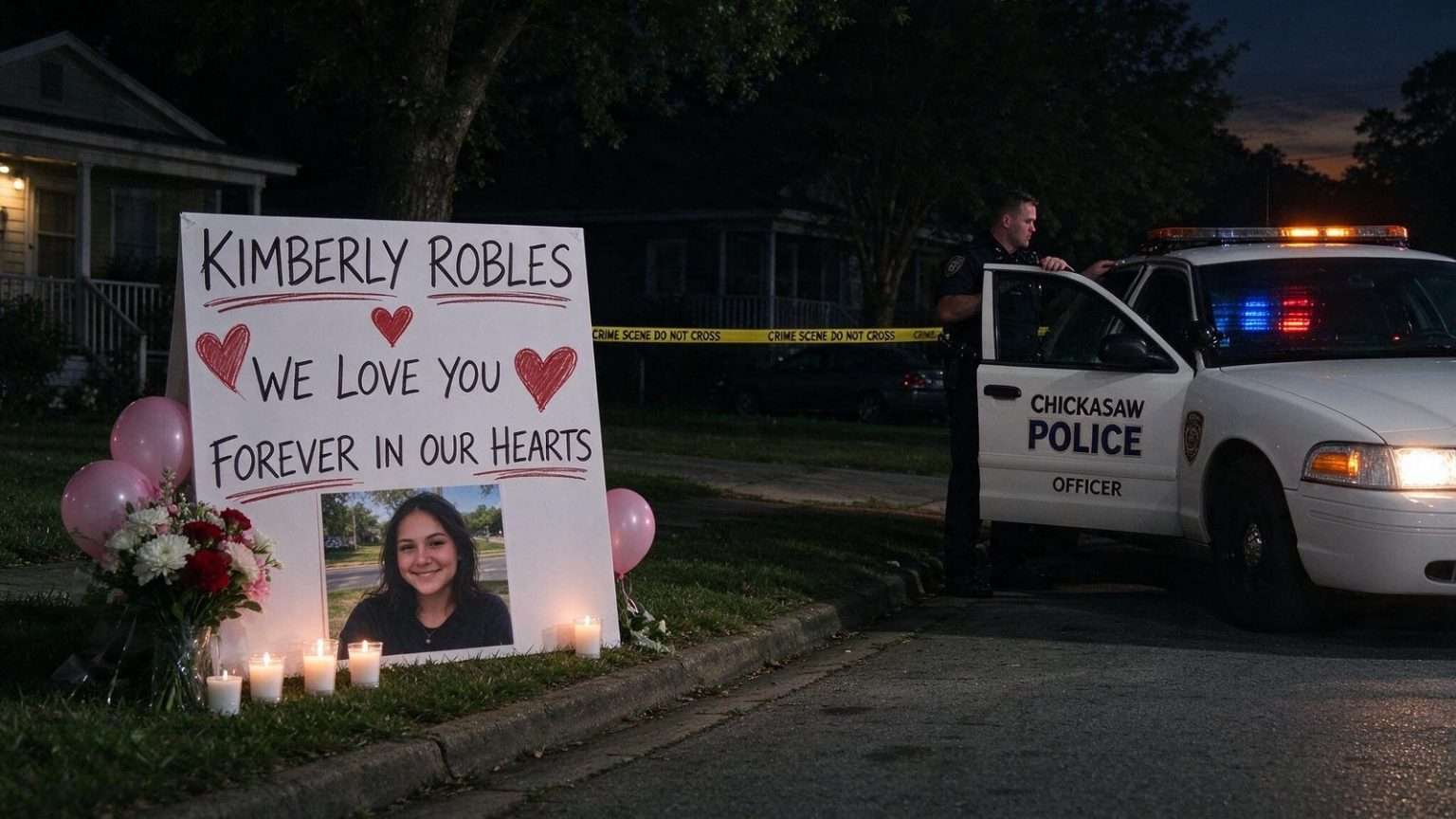
CHICKASAW, Ala. — The boyfriend of a 21-year-old woman shot to death inside her Chickasaw home is speaking out — both to remember her and to demand that whoever is responsible be held accountable. Police identified the victim as Kimberly Robles, though her boyfriend, Anthony Ford, says family and friends knew her as Kimberly Cabrera. She was shot multiple times Thursday night at a home off 3rd Avenue and later died at USA Trauma Center.
In the days since the shooting, Ford has spoken publicly about the woman he described as the center of his life, turning his grief into a public appeal for information in a case that has left a small Mobile County city searching for answers.
No sign of forced entry
According to police, suspect or suspects arrived at the home and opened fire. There was no sign of forced entry, and three people were inside at the time — including Ford, who witnessed the attack. The absence of forced entry has been one of the few details authorities have disclosed, and it is a detail investigators weigh heavily in shootings at private residences, since it can shape how detectives think about who came to the door and why.
A neighbor told reporters she heard roughly six to eight gunshots followed by a scream before taking cover. The account, coming from a quiet residential street, captured how quickly the violence unfolded — a burst of gunfire on an ordinary evening in a neighborhood where residents say they are unaccustomed to such scenes.
Robles’ four-year-old daughter was at a relative’s house when the shooting happened, sparing the young child from witnessing the attack that took her mother’s life.
A wonderful mother, remembered
Ford described his girlfriend as a wonderful mother and said she had helped him rebuild his life during their two years together. It is that picture — a young mother raising a daughter, a partner credited with steadying another person’s life — that family and friends say should define how Kimberly Robles is remembered, rather than the circumstances of her death.
For a family, the sudden loss of a 21-year-old carries a particular weight: the milestones that will never happen, the daughter who will grow up without her mother, the questions that have no answer until an arrest is made. Ford’s public remarks have carried all of that at once — mourning and memory in one breath, and in the next, a demand for accountability.
A plea for answers
Ford is urging anyone with information to come forward. “Rogue shooters are bad for everybody,” he said. “If you know something, say something.”
“She deserves to be recognized for all the greatness she was,” Ford added. “What could have been.”
His appeal reflects the reality that investigators face in shootings like this one: cases are so often broken open not by forensic evidence alone but by a neighbor, an acquaintance or a stranger who comes forward with a single useful detail. In Mobile County, law enforcement agencies routinely ask residents to share what they saw or heard, and anonymous tip lines exist precisely so that people who are afraid to be identified can still pass information to detectives. Every day that passes without an arrest, witnesses’ memories fade and the trail grows colder, which is why advocates for victims’ families stress the urgency of early tips.
The shooting’s impact on Chickasaw
The killing has resonated in Chickasaw, a city of modest neighborhoods in northeastern Mobile County that sits along U.S. Highway 43 between Prichard and Saraland. Incorporated as a city in 2008 after decades as an unincorporated community built around the historic Chickasaw shipyard, the city has worked to build its own police force and civic institutions, and its size means violent crime is rare enough to register as a shock rather than a pattern. Residents of the 3rd Avenue area described the aftermath in personal terms — a street of families, children and longtime neighbors suddenly marked by yellow tape and unanswered questions.
The shooting also highlighted the role USA Trauma Center plays across the Gulf Coast region. As the area’s primary center for the most severe injuries, it receives patients transported from across Mobile County and beyond, and when a shooting victim dies there, the loss ripples back to the community where the violence began. For Chickasaw, the journey from a residential street to the trauma center and back — as a death notification — was the cruel arithmetic of a single night.
What witnesses and neighbors can do
Police have not publicly named a suspect, and investigators typically keep early details — a description of a vehicle, possible motives, whether the shooter was known to the victims — out of public view to protect the integrity of the case. What detectives generally need most in the first days are the fragments only residents can supply: a car seen idling near the home, a face on the street that did not belong, sounds heard before and after the gunfire. The neighbor’s account of six to eight shots and a scream is exactly the kind of detail detectives will try to match against other statements, and anyone else who heard or saw something that night has been urged to contact investigators.
Community leaders in the Mobile County area have long argued that silence is the ally of violent crime. When shooters face no consequences, the behavior spreads; when neighbors speak up, arrests follow and confidence in the safety of a neighborhood grows. Ford’s plea — “if you know something, say something” — is the same argument in plainer language, delivered by a man who watched violence take someone he loved from inside his own home.
A young life measured in what was ahead
At 21, Kimberly Robles was raising a 4-year-old daughter, and friends describe a future that was finally coming together. The phrase Ford reached for — “what could have been” — carries the particular grief of a death that arrives before a life has had the chance to unfold: birthdays and first days of school for her daughter, the years of partnership he counted on, the ordinary future that ended in a burst of gunfire off 3rd Avenue.
Family and friends have focused on the name they knew her by — Kimberly Cabrera — and the person behind it, insisting that she be remembered as a mother, a daughter, a partner and a friend rather than as a crime statistic. In the end, that is the memorial her loved ones are asking for: not the details of how she died, but the recognition of “all the greatness she was.”
The investigation continues
Chickasaw police continue to work the case, and as with any shooting inside a residence with multiple people present, detectives have a substantial pool of firsthand accounts to draw from — including Ford’s own. Authorities have not said whether they believe the shooters targeted the home or its occupants specifically, and no arrests had been announced at the time of this report. For now, the city waits, and a young mother’s family waits with it, sustained by the hope Ford has repeated publicly: that someone who knows something will finally say something, and that Kimberly Robles’ killer will be held accountable for what was taken from a 4-year-old girl, a grieving family and a quiet Chickasaw street.
Small cities and the cost of unsolved violence
For a young city like Chickasaw, an unsolved homicide carries costs that go beyond the family’s grief. Public confidence in neighborhood safety is a fragile asset in communities of this size, and police departments depend on residents’ willingness to report what they see. When a case stalls, fear can settle into a neighborhood — people stay behind locked doors, children are kept indoors, and the informal watchfulness that keeps streets safe erodes. That dynamic is part of why investigators and community advocates alike treat early tips as a civic duty rather than a personal favor.
The case also underscores the wider regional challenge Mobile County faces with gun violence, an issue that spills across city lines between Mobile, Prichard, Chickasaw and the surrounding communities. Each unsolved shooting sends the same corrosive message, and each solved one — almost always through a witness who spoke up — sends the opposite message. Victims’ families across the county have formed a familiar chorus in recent years, appearing at press conferences and vigils with the same request Ford made this week: help us, so this does not happen to someone else’s family.
Remembering Kimberly
As the investigation moves forward, those who knew Kimberly Robles are doing what families in her situation inevitably do: telling stories. They describe a young woman whose two years with Ford coincided with his effort to rebuild his life — a partnership he credits her with making possible. They describe a mother whose daughter was, by luck and by the arrangement of that evening, spared from the scene. Those stories, shared publicly, serve a purpose beyond comfort. They keep a case alive in the public’s mind, remind potential witnesses that the victim was a person and not a headline, and hold the community’s attention on the promise that her death will not simply fade into the background of another quiet year.
Anyone with information about the shooting is urged to contact Chickasaw police or the tip line that serves Mobile County, where callers may remain anonymous. For Ford, the message is simple and it is unchanged since the night he survived the attack: the people responsible for Kimberly’s death are still out there, her daughter is still growing up without her, and every day that someone stays silent is a day longer before the family gets the answer it deserves. “She deserves to be recognized for all the greatness she was,” he said — and, he added, so does justice.