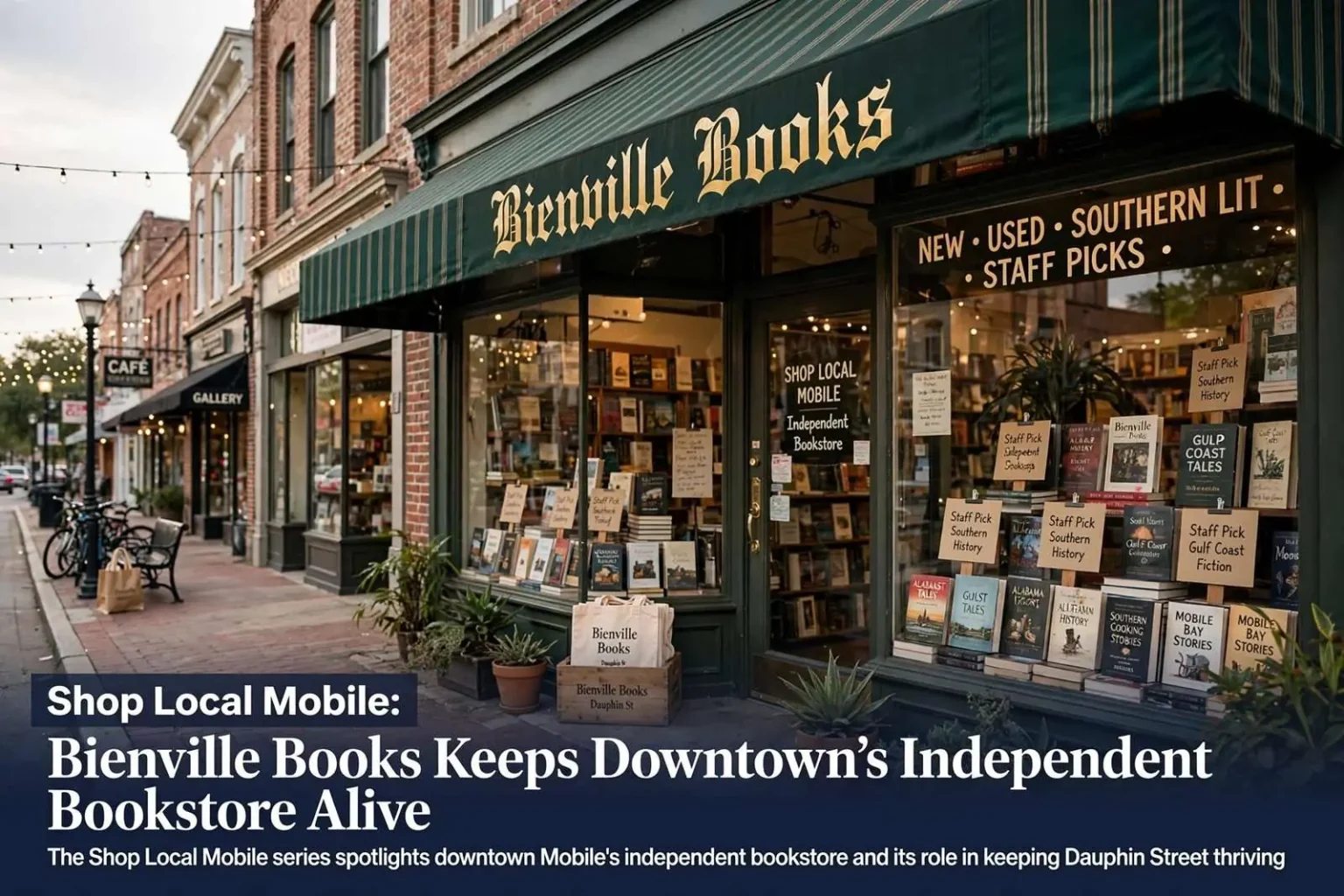
Shop Local Mobile: Bienville Books Keeps Downtown’s Independent Bookstore Alive
A look at Bienville Books, downtown Mobile's independent bookstore, and the shop-local movement behind Mobile's favorite small businesses.
Mobile likes to call itself one of the South’s best-kept secrets, and locals have long argued that the city’s small businesses belong in that conversation right alongside its events and scenery. The “Shop Local Mobile” series set out to prove the point, sitting down with the people behind some of the city’s favorite independent shops — starting with Russ Adams of downtown’s Bienville Books.
A bookstore on Dauphin
Bienville Books operated as Mobile’s independent bookstore in the heart of downtown, a place where browsers could find new releases, used titles and staff picks without setting foot in a big-box chain. The store’s shelves mixed bestsellers with Southern literature, history and the used volumes that give independent bookshops their treasure-hunt quality, drawing a clientele that ranged from downtown office workers on lunch breaks to devoted browsers who planned their weekends around a visit.
Adams, the store’s owner, walked host Courtney Matthews through what makes an indie bookstore work in a mid-sized Gulf Coast city: personal recommendations, community ties and a physical space that online retailers simply can’t replicate. His argument for the indie model starts with the handshake — booksellers who know their customers well enough to put the right paperback in the right hands — and extends to the store’s role as a gathering place for the city’s readers.
Independent bookstores survive, Adams explained, by being what no algorithm is: a curated room where a staff member’s enthusiasm, a display table and a conversation can sell a book no customer arrived planning to buy. The staff picks that mark Bienville Books’ shelves function as a running dialogue between the store and its readers, the bookish equivalent of a neighbor’s advice.
The store’s downtown location put it in the middle of Dauphin Street, the corridor that anchors Mobile’s entertainment and shopping district. That geography mattered to the store’s identity: a bookstore within walking distance of restaurants, bars and offices contributes to the street-level vitality that downtown advocates have spent decades trying to rebuild.
The shop-local case
The series made a simple economic argument for skipping the megastore. Money spent at locally owned shops recirculates through the local economy, supports downtown storefronts and keeps districts like Dauphin Street vibrant after five o’clock — a cause that grew only more urgent as holiday shopping shifted online.
Economists have long made the case that locally owned businesses return more of each dollar to the surrounding community than national chains do, through local hiring, local suppliers and the banking and service relationships that keep spending in town. Shop-local campaigns translate that research into a civic habit: the choice between a chain checkout and a hometown register, repeated across a holiday season, adds up to a measurable difference for a city’s commercial districts.
For downtown Mobile, the stakes were visible in the storefronts themselves. Vacant blocks and dead hours after five were the symptoms the city spent years working to cure, and locally owned shops — bookstores, galleries, confectioners, boutiques — were the prescription that made the district worth an evening visit rather than just a weekday commute.
The timing of the series reflected its own argument. As holiday spending migrated online, the businesses that depended on foot traffic — the ones that make a street feel alive — needed deliberate support from the customers who said they valued them. The series’ message was that valuing local shops is a behavior, not a sentiment.
The shops that give Mobile its personality
Other businesses featured in the Shop Local Mobile series included Lunatix & Co., Three Georges, Urban Emporium, Kangal Gallery and Inside Up — a cross-section of the vintage stores, confectioners and boutiques that gave Mobile its retail personality.
Each of those shops represents a category the big-box economy has trouble replacing. Vintage and resale stores like Lunatix & Co. and Urban Emporium trade in one-of-a-kind finds that no chain can stock; a gallery like Kangal Gallery connects local and regional artists to buyers; and a confectioner like Three Georges carries the kind of handcrafted sweets that turn a shopping trip into a tradition — the boxed chocolates and wrapped gifts that generations of Mobilians have carried to holidays and hostess gifts alike.
Together they form the retail ecology that shop-local advocates describe: distinct businesses that reward a stroll down the same few blocks, each drawing customers who then patronize the neighbors. That cross-pollination is the theoretical foundation of a shopping district and the practical reason downtown organizations work to keep storefronts occupied with independent operators rather than leaving them vacant.
Dauphin Street and downtown’s revival
Dauphin Street’s story mirrors downtown Mobile’s broader revival. The corridor that runs through the heart of the city weathered decades of suburban flight, when retail followed the population to shopping centers outside the city limits and downtown storefronts darkened. The turnaround came through the accumulation of the very businesses the series profiled — restaurants, bars, galleries, bookstores and boutiques that gave people a reason to come back after dark.
A bookstore plays a particular role in that mix. Retail analysts and downtown advocates treat anchors like independent bookstores as foot-traffic generators that support neighboring businesses: browsers who come for a book stay for coffee, dinner or a drink, and the street as a whole benefits from the dwell time. Bienville Books’ presence on Dauphin Street made it part of that engine.
The shop-local argument extends to how a downtown looks and feels. Locally owned shops occupy distinctive storefronts, sponsor local events and put owners on the sidewalk — the small, visible signs of a district that is loved and inhabited rather than merely leased. Chains can be recruited anywhere; a city’s retail personality is built by the independent operators who choose it.
Holiday shopping with a hometown multiplier
The series framed its appeal around the holiday season, when the distance between a click and a purchase is shortest and the temptation to shop online is strongest. The counterargument it offered was experiential as much as economic: shopping local means gifts with stories, conversations with owners and a downtown street busy enough to feel like an occasion.
For shoppers making a season of it, the message was straightforward: the alternative to crazy big-store parking lots and impersonal online carts had been downtown all along. A day on Dauphin Street could cover books at Bienville Books, sweets from Three Georges, a vintage find, a piece from a local gallery and a boutique’s gift — with lunch in between and none of the mall.
The businesses behind the series’ episodes made the case in person, each owner describing the relationship between their shop and the city’s identity. Russ Adams’ version was the bookish one: a store where recommendations come from people who read the books, where the used shelves hold out-of-print surprises and where a downtown street keeps a living room for its readers.
What independent stores ask of their cities
The owners profiled in the series share a common dependence on deliberate choices by their customers. Independent shops rarely compete on price with national retailers or online marketplaces; they compete on selection, knowledge, atmosphere and the relationships that make a customer return. Every purchase at a store like Bienville Books is, in effect, a vote for the model.
Adams’ explanation of the bookstore’s work doubled as a description of what customers receive for their loyalty: a bookseller who tracks what they read, orders what they ask for and hands them something new on instinct. That service layer is the indie bookstore’s product as much as any title on the shelf, and it disappears when the store does.
Shop-local campaigns across the country have leaned on the same seasonal rhythms — Small Business Saturday, downtown holiday open houses, gift guides built around hometown shops — to convert good intentions into December traffic. Mobile’s version joined a national movement while making a specifically local argument: this city’s character lives in its independent storefronts, and those storefronts answer to the season’s receipts.
The series’ larger point
“Shop Local Mobile” functioned as both profile and advocacy, introducing viewers to the people behind storefronts they may have walked past while making the economic case for changing their habits. The format — a host touring each business with its owner — gave viewers the kind of introduction that word of mouth once provided, and it gathered the city’s independents into a single roster of places worth a trip downtown.
The roster’s variety was the point. A bookstore, a candy kitchen, vintage clothing shops, a gallery and a boutique appeal to different customers, but together they make the argument that downtown Mobile offers a day of shopping no single store could. The series’ episodes stacked up into a walking itinerary of the city’s retail personality.
For a city that bills itself as the South’s best-kept secret, the series offered a quiet rebuttal to anyone who mistook the label for a lack of things to do. The secret, as the episodes presented it, was hiding in plain sight on Dauphin Street — in a bookstore’s staff picks, a confectioner’s boxes and the vintage racks and gallery walls of a downtown that locals have been trying to tell the rest of the region about for years.
The final message of the shop-local case was less a plea than an invitation: park downtown once, walk the block, meet the owners. The businesses profiled by the series — Bienville Books first among them — have staked themselves on the bet that Mobile’s shoppers, once introduced, will keep coming back.