Short-Term Vacation Rentals Cleared to Reopen in Three Northwest Florida Counties
Florida approved short-term vacation rental plans in Escambia, Santa Rosa and Okaloosa counties, letting Panhandle rentals take bookings immediately.
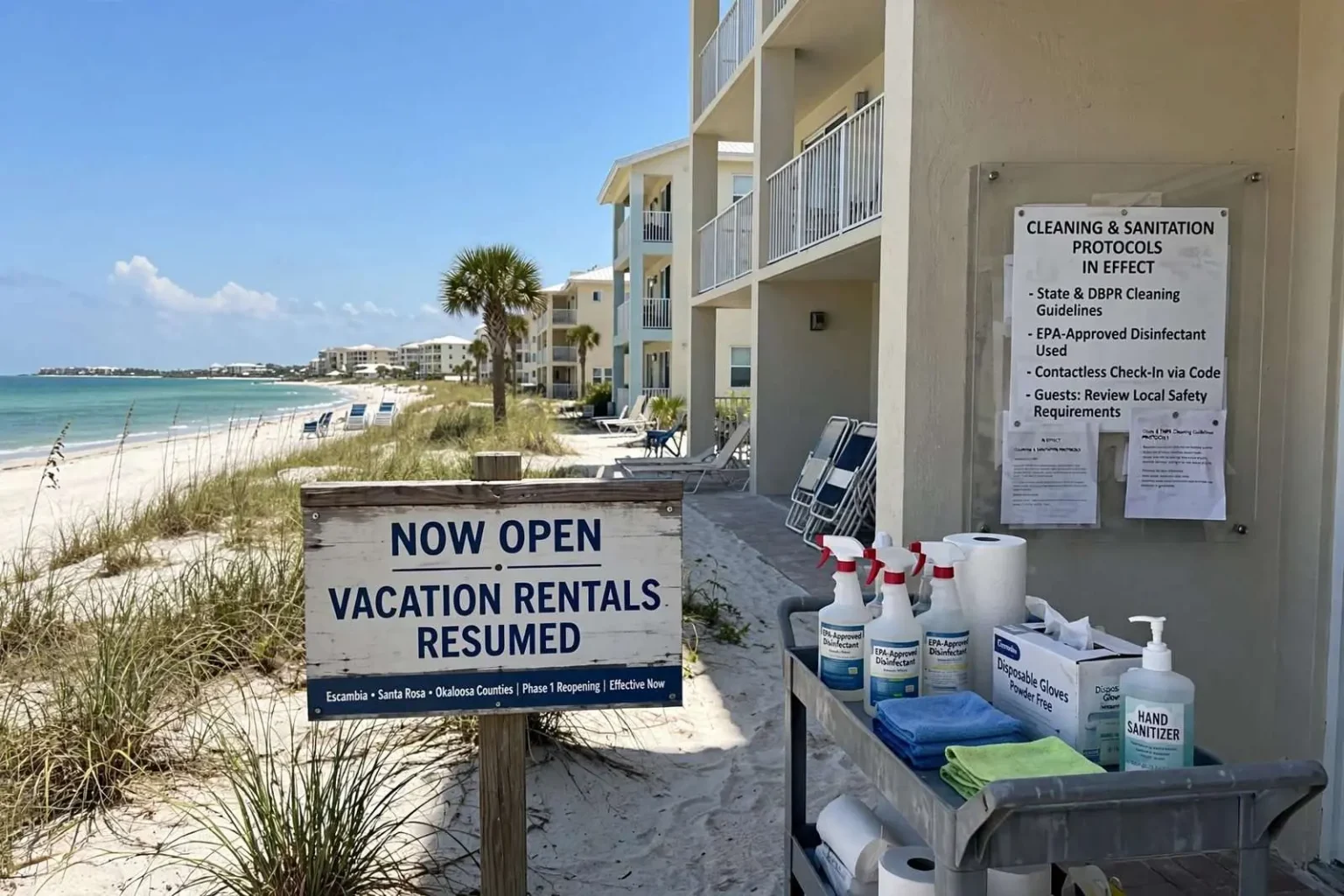
PENSACOLA BEACH — Short-term vacation rentals in Escambia, Santa Rosa and Okaloosa counties can begin taking reservations and checking in guests again after the state signed off on each county’s reopening plan, effective immediately. The approvals came as a supplement to Florida’s Phase 1 reopening and cleared the way for rental units along the Panhandle coast to restart a business that had been shut down during the early months of the coronavirus pandemic. For the beach towns that line the coast from Pensacola to the Destin area, the announcement reopened an industry that had been dark since spring — thousands of condos, cottages and beach houses that had sat empty through what should have been the first stretch of the booking season.
Restrictions Attached to the Approvals
Under the county plans, reservations from areas the governor designated as high-risk through executive order — at the time New York, New Jersey, Connecticut and Louisiana — must be booked for periods longer than the quarantine window set out in those orders. Guests staying in those units are expected to follow the quarantine restrictions or face established civil and criminal penalties. The requirement effectively screened out short getaways from the hardest-hit regions while still allowing longer stays, and it put the enforcement burden on property owners, who were suddenly being asked to ask their guests questions about where they were traveling from.
Okaloosa County’s plan also directs property owners and managers to brief guests on any local restrictions in place during their stay and to post that information where visitors can find it. The directive acknowledged a practical reality of the vacation rental business: unlike a hotel, where a front desk hands every guest a card at check-in, a rental house welcomes guests who may arrive after dark with a door code and no human contact at all. Posted notices, emailed briefing sheets and pre-arrival messages became the tools that made those local rules enforceable.
Cleaning and Sanitation Requirements
Owners and managers must follow the state Department of Business and Professional Regulation’s existing sanitation and safety rules for transient lodging, along with industry cleaning guidelines issued for COVID-19 by vacation rental housekeeping and management associations. Federal public-health guidance for public spaces, businesses and homes applies on top of those state requirements. The layered rules meant a rental property was now subject to standards that reached from Tallahassee regulation down to federal health guidance — a far heavier compliance load than the pre-pandemic cleaning checklist that most housekeeping crews had followed for years.
The plans call for flexible turnaround time between stays rather than a fixed interval, on the reasoning that units vary in size and take different amounts of time to clean properly. A one-bedroom condo can be turned over in an hour or two; a six-bedroom beach house with four bathrooms might take a full crew a good part of a day to disinfect to the new standard. Building the flexibility into the rules let property managers book realistically around their cleaning capacity instead of promising check-ins their crews could not safely meet.
Signage explaining the cleaning protocols between stays is to be posted at each property, and managers are directed to supply employees and contractors with safety guidance and to share health resources with guests, including guidance for travelers with pets or service animals. Housekeeping staff became some of the most exposed workers in the reopening, moving from unit to unit and touching the same surfaces guests had just left, and the requirement to provide them safety guidance recognized that risk. Pet policies, meanwhile, had their own pandemic wrinkles — traveling families increasingly brought animals along, and service-animal rules remained in force regardless of the emergency.
Counties said the plans would be reviewed at least every two weeks and updated as conditions changed. The rolling review committed local officials to watching infection data and adjusting the rules rather than setting them once and walking away — an approach that mirrored the way the state’s phased reopening itself was built to flex with the pandemic’s movement.
Vacation rentals are a central piece of the tourism economy along the Northwest Florida coast, and the reopening restored a revenue stream that beach communities rely on heading into the summer season. The shutdown had hit more than rental owners: housekeeping crews, maintenance contractors, pool services, linen suppliers, restaurants and retail shops all draw their business from the visitors the rentals bring. In beach towns from Pensacola Beach through Navarre and Destin, the difference between a booking calendar that is full and one that is empty is measured in jobs.
The three counties affected by the approvals stretch across the heart of the Panhandle’s beach country. Escambia County takes in Pensacola Beach and Perdido Key, Santa Rosa County covers Navarre Beach and the quiet stretches east of it, and Okaloosa County includes Fort Walton Beach and the Destin area, one of the most intensively visited resort regions in the state. Each county drafted its own plan under the state’s framework, and the state’s approval of all three meant the coast could reopen as a destination rather than a patchwork.
For property managers, the immediate task was triage. Cancellations from the shutdown had stacked up for weeks, deposit refunds had to be untangled, and every reservation on the books had to be reviewed against the new rules — including the travel-history restrictions on guests from the designated high-risk states. Managers who had spent the shutdown deep-cleaning units and upgrading contactless check-in systems suddenly found themselves in a race to re-market their inventories before the summer window narrowed.
Guests returning to the coast encountered a different experience than the one they remembered. Pool decks and elevators posted capacity limits, rental binders were supplemented by emailed guidance, and mid-stay housekeeping services were scaled back or suspended to reduce the number of people entering occupied units. The industry’s pitch to travelers was simple: the beach is open, the houses are cleaned to a documented standard, and the two-week review cycle means the rules on the books reflect current conditions rather than March’s worst-case assumptions.
The reopening marked a turning point for a coast that had spent two months watching its season slip away. Whether the summer could be salvaged depended on how well the new rules held — and on whether visitors, once again, were willing to book the trip.
What the Rules Mean for Owners and Guests
The Department of Business and Professional Regulation is the state agency that licenses transient lodging in Florida, and its involvement in the reopening gave the county plans a legal backbone they would otherwise have lacked. Vacation rental operators in the three counties hold state licenses under the same framework that governs hotels and motels, which meant the state could suspend or condition that licensing framework county by county — and, just as importantly, restore it the same way. Owners who ignored the reopening conditions were risking not just local penalties but the license that made their business legal in the first place.
The economics behind the shutdown were severe enough that few operators needed convincing to comply. Northwest Florida’s beach communities collect tourist development taxes on every short-term stay, and those pennies on the dollar fund beach renourishment, lifeguards, sports complexes and the marketing that brings the next wave of visitors. When bookings stopped, the tax stream stopped with them, and the counties lost revenue precisely when their summer budgets were being set. Approving the reopening plans was, for county commissions, both a public-health decision and a fiscal one.
Travelers from Louisiana and the Northeast — the markets named in the governor’s executive order — had historically been among the coast’s most reliable summer guests, which added a commercial sting to the travel restrictions. Property managers had to weigh the letter of the quarantine rules against long-standing relationships with repeat guests from New Orleans, New York and New Jersey, and many resolved the tension by steering those guests toward longer stays that satisfied the quarantine window anyway. The rules, in other words, reshaped booking patterns rather than simply shrinking them.
The two-week review cycle promised by the counties set up a summer of rolling announcements. Each update could tighten or loosen the restrictions depending on infection trends, and guests booking weeks in advance were advised to read the current rules before travel rather than relying on what was in effect when they reserved. For an industry built on forward bookings, the uncertainty was its own burden — but it beat an empty calendar, and most operators along the coast said they would take changing rules over no guests at all.
Local officials along the coast also urged visitors to plan around capacity limits at the beaches themselves. Parking lots at public beach accesses, charter fleets, waterfront restaurants and the causeways leading to the barrier islands were all operating under their own reopening conditions, and a rental reservation did not guarantee every amenity a returning guest remembered. The counties asked guests to check municipal websites before travel, the same way they were asked to review the rental rules — a small chore that officials said would spare everyone a spoiled vacation.