
Six dolphins found dead in Dauphin Island marsh in Alabama’s first mass stranding of its kind
Six Atlantic spotted dolphins were found dead in a Dauphin Island marsh, the first mass stranding of its kind recorded in Alabama.
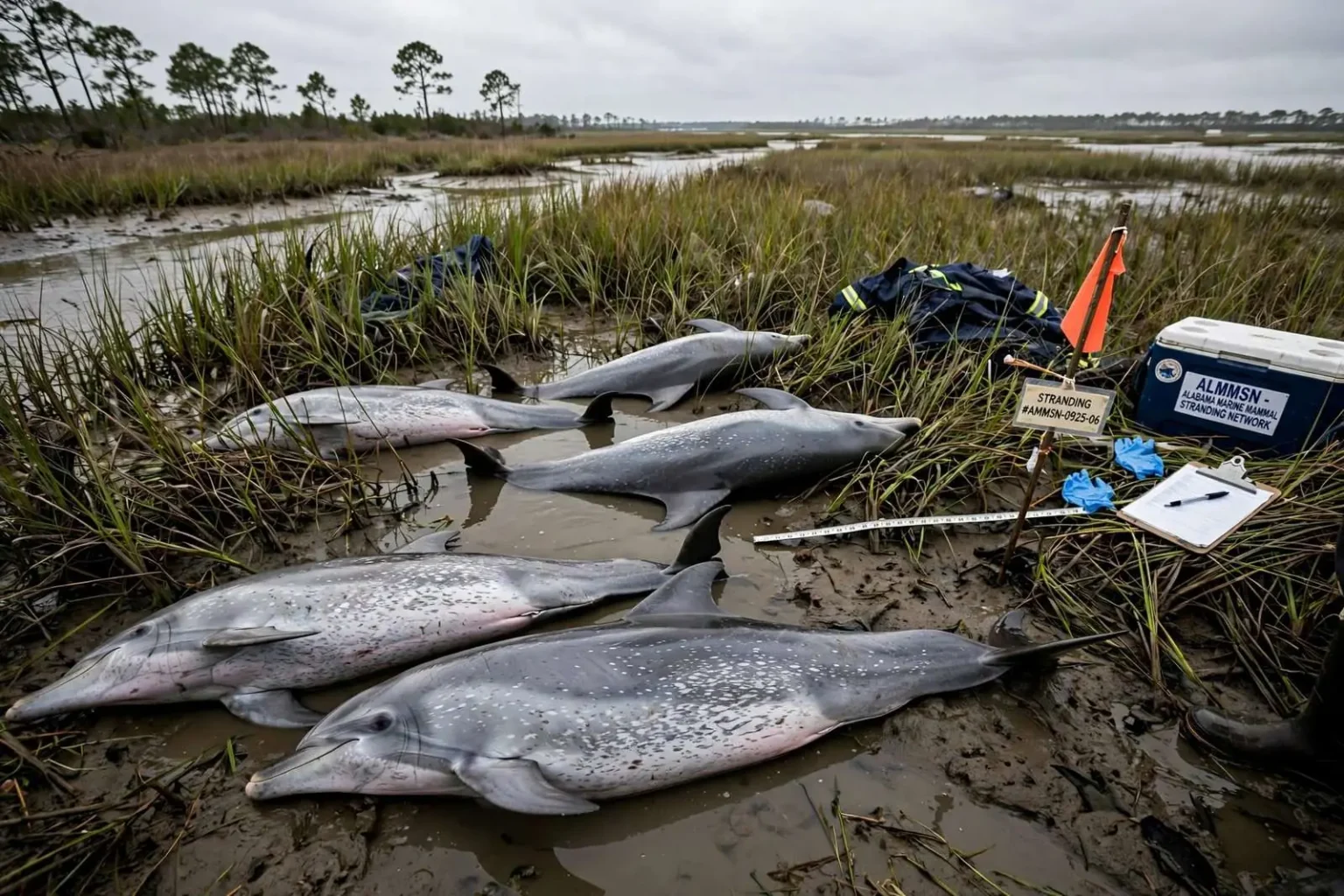
DAUPHIN ISLAND, Ala. — Six Atlantic spotted dolphins were found dead in a Dauphin Island marsh last week in what state officials are calling the first mass stranding of its kind in Alabama. The discovery, made in a sheltered marsh on the north side of the barrier island, has given marine mammal researchers a sobering case study in how hurricanes push offshore animals into places they were never meant to be.
The Alabama Marine Mammal Stranding Network said the dolphins, all females, were discovered Friday, Sept. 25, in the marsh on the north side of Dauphin Island. They appeared to have stranded alive several days earlier, meaning the animals likely spent their final days trapped in shallow, confined water where feeding was impossible.
“The animals likely came into the Mississippi Sound during Hurricane Sally, after becoming disoriented in the Gulf,” said ALMMSN stranding coordinator Mackenzie Russell. Hurricane Sally, which made landfall in September as a slow-moving Category 2 storm near Gulf Shores, drove powerful storm surge and wind-driven tides through the barrier islands and into the sound, reshaping channels and pushing marine life far from its normal ranges.
Atlantic spotted dolphins are offshore animals rarely seen stranding on the Alabama coast; the last such stranding was documented in January 2018. The species typically lives over the continental shelf and deep Gulf waters beyond the sight of land, so the presence of six of them inside an island marsh was itself an anomaly that pointed toward a catastrophic event like a hurricane.
How the Discovery Unfolded
The group was discovered by a paddle boarder in Graveline Bay, whose report set the stranding network’s response in motion. Volunteers and responders documented the animals, confirmed they were deceased, and arranged for recovery — a logistics-heavy task in a marsh environment where heavy equipment cannot easily go and where every carcass must be brought out by boat or by hand.
All six were examined at the Dauphin Island Sea Lab’s Marine Mammal Research Center. The Sea Lab, the state’s marine science education and research institution at the eastern end of the island, maintains facilities for necropsy and specimen work, making it the natural hub for the response and for the research that follows a stranding.
A veterinarian noted nearly empty stomachs, indicating the animals had not eaten in some time. That finding fit the timeline responders had reconstructed: dolphins that had stranded in the marsh days earlier would have been unable to catch prey in the shallow, muddy water, and a dolphin’s metabolism leaves little reserve for extended fasting.
The examinations also serve science beyond this single event. Tissue samples, measurements, and necropsy findings from stranded animals feed into long-term datasets on Gulf of Mexico dolphin health, baseline information that becomes critical whenever the region faces an environmental disaster, such as an oil spill or a bloom of harmful algae.
Hurricanes and Stranding Risk
Marine mammal responders have long observed that major storms produce a wave of strandings in the weeks that follow. Storm surge can carry dolphins over barriers and into sounds, bayous, and marshes; when the surge recedes, the animals can find themselves cut off in water too shallow to swim in or trapped behind newly closed-off channels. Disorientation in churned, sediment-heavy water compounds the problem.
The Mississippi Sound, the estuary that separates Dauphin Island from the mainland, is a complex environment under normal conditions, and a hurricane rewrites its geography in a single day. Sandbars shift, passes open and close, and the marshes behind the island fill and drain in ways that can strand anything that entered at the storm’s peak.
ALMMSN, which coordinates responses across Alabama’s Gulf and Mobile Bay waters, relies on trained volunteers and public reports to find stranded animals quickly. Rapid response matters because dolphins found alive in shallow water can sometimes be herded or relocated back to open water — but only if someone reports them in time.
What Residents and Visitors Should Do
Anyone who finds a sick, injured or deceased marine mammal in Alabama should call the 24/7 ALMMSN Stranding Hotline at 1-877-WHALE-HELP. Responders ask the public to keep a distance from the animal, keep pets away, and note the location as precisely as possible — landmarks, GPS coordinates, or photos that help responders find the site quickly.
Marine mammals are protected by federal law, and moving, pushing, or riding a stranded dolphin back into deeper water without trained guidance can injure the animal or the rescuer. Even a dolphin that appears healthy on a sandbar may be severely dehydrated or injured, and untrained handling frequently makes the outcome worse. The hotline exists so that the first call is the right call.
The mass stranding on Dauphin Island joins a history of dolphin mortality events along the northern Gulf Coast. The region’s dolphin populations have faced serious stress in recent decades, from the Deepwater Horizon oil spill — which researchers linked to lung disease and reproductive failure in Barataria Bay dolphins — to blooms of toxic algae and the recurring diseases that sweep through coastal bottlenose populations.
The Science of the Response
Every stranded animal that reaches a necropsy table contributes to that body of knowledge. Researchers record the species, sex, size, and condition, look for signs of disease, entanglement, or boat strike, and preserve samples that can be tested for contaminants and pathogens. Over time, the stranding record becomes a map of what the Gulf is doing to its marine mammals — and what they are telling researchers about the health of the ecosystem.
The fact that all six animals were females adds a dimension researchers will consider, since the loss of breeding-age females carries a heavier cost to a population than the loss of males. Whether the group represented a family band or a coincidental gathering is among the questions the examinations can help address, along with each animal’s age and overall health before the storm.
For Dauphin Island itself, the episode was a visible reminder of the island’s dual nature: a barrier beach that takes the Gulf’s first blows and the marsh, bay, and sound behind it that shelter an enormous range of wildlife. The island’s communities live alongside that ecosystem, and its residents have been among the stranding network’s most reliable sources of reports over the years.
Recovery work after a hurricane continues on many fronts at once — power, debris, roads — and wildlife response runs in parallel, often with volunteers doing much of the labor. The six dolphins of Graveline Bay will not be the last animals pushed ashore by Gulf storms, but the record of what happened to them, and why, will inform how the next storm’s toll is understood.
The stranding network’s work depends on a chain that starts with the public. A paddle boarder who took the time to report what he found set everything in motion; without that call, the animals might have remained undiscovered for days longer, decomposing past the point where useful examination was possible. Responders emphasize that early reports make the difference between usable data and a lost opportunity.
Alabama’s Marine Mammal Response System
ALMMSN operates as the state’s coordinator for marine mammal strandings, organizing trained volunteers, coordinating with the Sea Lab and federal authorities, and maintaining the hotline that connects a beachgoer’s phone call to a response team. Its coverage area includes the Gulf beaches of Baldwin County, the Mobile Bay system, and the Mississippi Sound shoreline — waters where dolphins are a common and beloved sight but where few residents know what to do when one appears in trouble.
Federal law places stranded marine mammals under the protection of the National Oceanic and Atmospheric Administration’s response framework, and local networks like ALMMSN operate under that umbrella. The structure ensures that evidence from strandings feeds into national databases while giving local responders the authority and guidance to act quickly.
The economic and ecological weight of the sound’s dolphin population is real. Dolphins draw wildlife watchers, factor into the region’s ecotourism, and sit near the top of the estuarine food web, making their health an indicator of the health of the waters that support the region’s fisheries. A mass stranding of offshore animals, while rare, is one more data point in the long record of how the northern Gulf absorbs punishment from storms.
Researchers will continue to work through the findings from the six examinations in the weeks ahead, and any conclusions about the animals’ condition, history, and cause of death will add to the understanding of how Hurricane Sally affected marine life far beyond the damaged homes and downed trees that dominated the immediate aftermath. For now, the marsh has gone quiet again, and the network returns to its standing vigil — waiting for the next call.
Resident reports remain the foundation of that vigil. Fishermen, kayakers, beach walkers, and boaters are on the water far more often than any responder, and a single accurate call — location, condition, and whether the animal is moving — lets the network prioritize and mobilize. Officials ask that anyone who finds a stranded animal stay nearby if it is safe to do so, since a responding team works fastest when someone can guide it to the exact spot.