
Slain Mobile Police Officer Justin Billa’s name added to National Law Enforcement Memorial
Slain Mobile Police Officer Justin Billa's name has been added to the National Law Enforcement Memorial in Washington D.C.
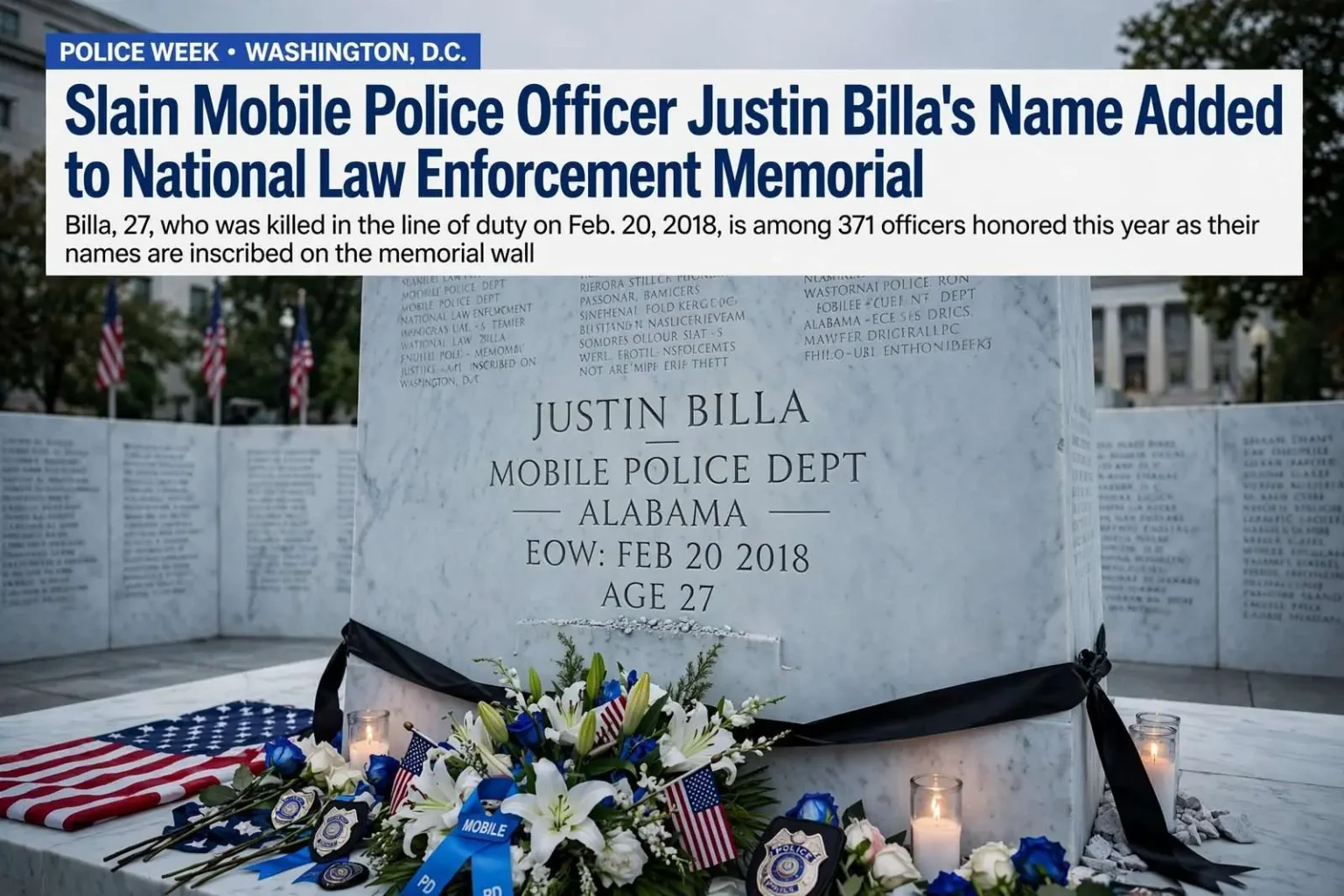
The name of slain Mobile Police Officer Justin Billa is among 371 names being added to the National Law Enforcement Memorial in Washington, D.C., this year. The additions include 158 officers killed in the line of duty in 2018 and 213 individuals who died in the line of duty historically. Billa was murdered in the line of duty on Feb. 20, 2018, while responding to a domestic violence call. The officers are being honored as part of Police Week, observed this week in the nation’s capital. Billa’s name joins those of law enforcement officers from across the country remembered for their service.
For Mobile’s law enforcement community, the inscription carries a weight that numbers cannot convey. Billa, 27, had served the Mobile Police Department since 2016, and his death while answering a domestic disturbance call in the city’s Fowl River area sent shockwaves through a department of roughly 500 sworn officers and across the entire Gulf Coast. On the night of Feb. 20, 2018, officers responded to reports of shots fired at a residence, and as Billa approached the scene he was shot and killed by the suspect inside. The alleged gunman, Robert Hollie, was later found dead of an apparent self-inflicted gunshot wound nearby, and the domestic violence call that drew officers to the home had already claimed another victim before Billa arrived.
The memorial inscription ceremony in Washington took place during National Police Week, the annual observance each May that brings tens of thousands of officers, survivors and citizens to the nation’s capital. Established by an act of Congress and dedicated in 1991, the National Law Enforcement Memorial in Judiciary Square bears the names of more than 20,000 officers killed in the line of duty dating back to the first recorded death in 1791. Each May, new names are formally dedicated, and survivors — spouses, children, parents and colleagues — travel to Washington to see them cut into the marble walls.
A Life Cut Short in Service to Mobile
Billa’s path to the Mobile Police Department reflected the kind of officer departments hope to recruit. A native of the region with deep family ties to south Alabama, he joined the force as a young man and quickly earned a reputation among colleagues for his dedication and steady demeanor. He was assigned to patrol duties, the foundation of police work, where officers handle the full range of calls — alarms, accidents, disputes and disturbances — that make up most of a department’s daily business. Domestic disturbance calls are among the most routine and among the most dangerous, because officers never know the emotional state of the people inside a home when they arrive.
His death underscored that danger with terrible clarity. National statistics consistently place response calls, traffic incidents and ambushes among the leading circumstances of officer fatalities, and domestic violence calls rank among the most volatile situations officers face. Mobile’s department had not lost an officer in the line of duty since 2013, when Officer Steven Green was shot and killed, and Billa’s death reopened wounds familiar to every veteran of the force. News of the shooting prompted an immediate outpouring across the city: flags lowered, badges draped in black bands, and a procession of emergency vehicles that stretched for miles during his funeral arrangements.
The tributes that followed came from every direction. Fellow officers recounted his willingness to take calls and back up colleagues. Residents left flowers and candles outside police precincts. School groups and churches sent cards to the department. For a city that had watched its police force absorb criticism and stress through difficult years, the response to Billa’s death revealed the depth of the community’s respect for the work officers do at three in the morning, in the rain, on the calls no one else wants.
Police Week and the Meaning of the Wall
National Police Week traces its origins to a 1962 joint resolution of Congress designating May 15 as Peace Officers Memorial Day, with the week surrounding it set aside to honor law enforcement service. The modern observance has grown into a series of events: candlelight vigils, a ceremonial lighting attended by thousands, a national peace officers’ memorial service, a 5K run, and conferences for surviving family members organized by concerned law enforcement organizations. The names added each year are vetted by a committee that reviews the circumstances of each death to confirm they occurred in the line of duty, a process that sometimes adds officers killed decades earlier when historical research brings their cases forward.
That is the story behind the 213 historical names added alongside the 158 officers who died in 2018. Some served in small town departments a century ago; others died of illnesses contracted in the line of duty, or in crashes and shootings only recently confirmed through archival research. Their addition to the wall closes long-unhealed accounts, allowing descendants who never knew them to touch a name that officially records their sacrifice. Together with the current-year honorees, the 371 names added this year represent both the immediate cost of police work and the long memory the profession maintains for its own.
For Mobile, Billa’s inclusion ensures that the city’s loss is permanently recorded among the nation’s. Visitors to the memorial will find his name among the panels for 2018, and each May the city’s delegation to Police Week — officers, command staff, and the family and friends who still grieve — will see it honored in the nation’s capital alongside officers from every state. Back home, his memory endures in the department’s annual observances and in the daily reminder, carried by every officer who pins on a badge in Mobile, of what the job can ask. Justin Billa served the city for less than two years, but his name now stands where the country keeps its promises: remembered, inscribed, and never forgotten.
Carrying the Memory Forward in Mobile
The bond between a department and a fallen officer’s family does not end with a ceremony in Washington. Mobile’s police community has a long tradition of supporting the families of its fallen through peer networks, survivor organizations and the department’s own remembrances, which include annual memorial observances held each May to coincide with national Police Week. Officers who served alongside Billa have carried his name into roll call traditions, memorial rides and charity events that benefit survivors of line-of-duty deaths across Alabama. Such traditions matter inside a profession where grief is often carried quietly, and they give new officers a tangible connection to the department’s history.
Billa’s name also now appears in the company of other Mobile officers lost across generations, a lineage that includes officers killed in vehicle collisions, shootings and rescues dating back more than a century. Each inscription in Washington echoes the local memorial markers that anchor remembrance at home, from the department’s memorial displays to the ceremonies where names are read aloud each year. For residents, the message of Police Week — and of the 371 names added this year — is straightforward: the uniform answers calls that carry real risk, and the community that benefits owes those answers its memory. In Mobile, that memory has a new name on a wall in the nation’s capital, and a place that will be visited, honored and kept for generations.
Domestic Violence Calls and the Risk Officers Carry
The circumstances of Billa’s death fit a pattern that law enforcement trainers across the country study in depth. Domestic disturbance calls are consistently ranked among the most dangerous assignments in patrol work, not because they occur rarely — they occur constantly, forming a large share of any urban department’s call volume — but because officers must enter a private space where emotions are already at a breaking point, weapons may be present, and the people involved may turn on responders regardless of who called for help. Training academies devote substantial classroom and scenario time to these calls precisely because the margin for error is so thin: approach patterns, cover positions, communication style and information gathering all influence whether a call ends safely.
In Alabama, as nationally, domestic violence response has evolved over the decades from an attitude of non-interference into a specialized field with dedicated statutes, protective order systems and victim advocacy programs. The Alabama Law Enforcement Agency and local departments coordinate with shelters and court systems, and Mobile’s own community includes advocacy organizations that work alongside police on protection orders and victim safety planning. Officers responding to a domestic call now document evidence, assess lethality factors and connect victims with resources — work that happens in minutes at the doorstep and can determine whether a family’s next night is safe.
The Fowl River area, where Billa answered the call that night, lies in the southern reaches of Mobile city limits, a stretch of communities along the bayous and waterways south of the city core where residential neighborhoods meet tidal marsh. Patrol districts there are wide, response distances long, and backup minutes matter in ways that officers feel acutely. When a shot-fired call comes in at night in an area like that, every arriving unit knows the calculus of distance and time. Billa approached the scene as those procedures directed, and the shots that ended his life arrived before the situation could be brought under control — the random, arbitrary cruelty that every officer’s family understands and every officer accepts when they take the oath.
Carrying the Memory Forward in Mobile
The bond between a department and a fallen officer’s family does not end with a ceremony in Washington. Mobile’s police community has a long tradition of supporting the families of its fallen through peer networks, survivor organizations and the department’s own remembrances, which include annual memorial observances held each May to coincide with national Police Week. Officers who served alongside Billa have carried his name into roll call traditions, memorial rides and charity events that benefit survivors of line-of-duty deaths across Alabama. Such traditions matter inside a profession where grief is often carried quietly, and they give new officers a tangible connection to the department’s history.
Billa’s name also now appears in the company of other Mobile officers lost across generations, a lineage that includes officers killed in vehicle collisions, shootings and rescues dating back more than a century. Each inscription in Washington echoes the local memorial markers that anchor remembrance at home, from the department’s memorial displays to the ceremonies where names are read aloud each year. For residents, the message of Police Week — and of the 371 names added this year — is straightforward: the uniform answers calls that carry real risk, and the community that benefits owes those answers its memory. In Mobile, that memory has a new name on a wall in the nation’s capital, and a place that will be visited, honored and kept for generations.


