Smoke From Wildfire Causes 12-Vehicle Crash, Closes Alabama 56 in Washington County
Smoke from a Washington County wildfire caused a 12-vehicle crash and closed Alabama 56 on Monday, according to ALEA. Two people suffered minor injuries.
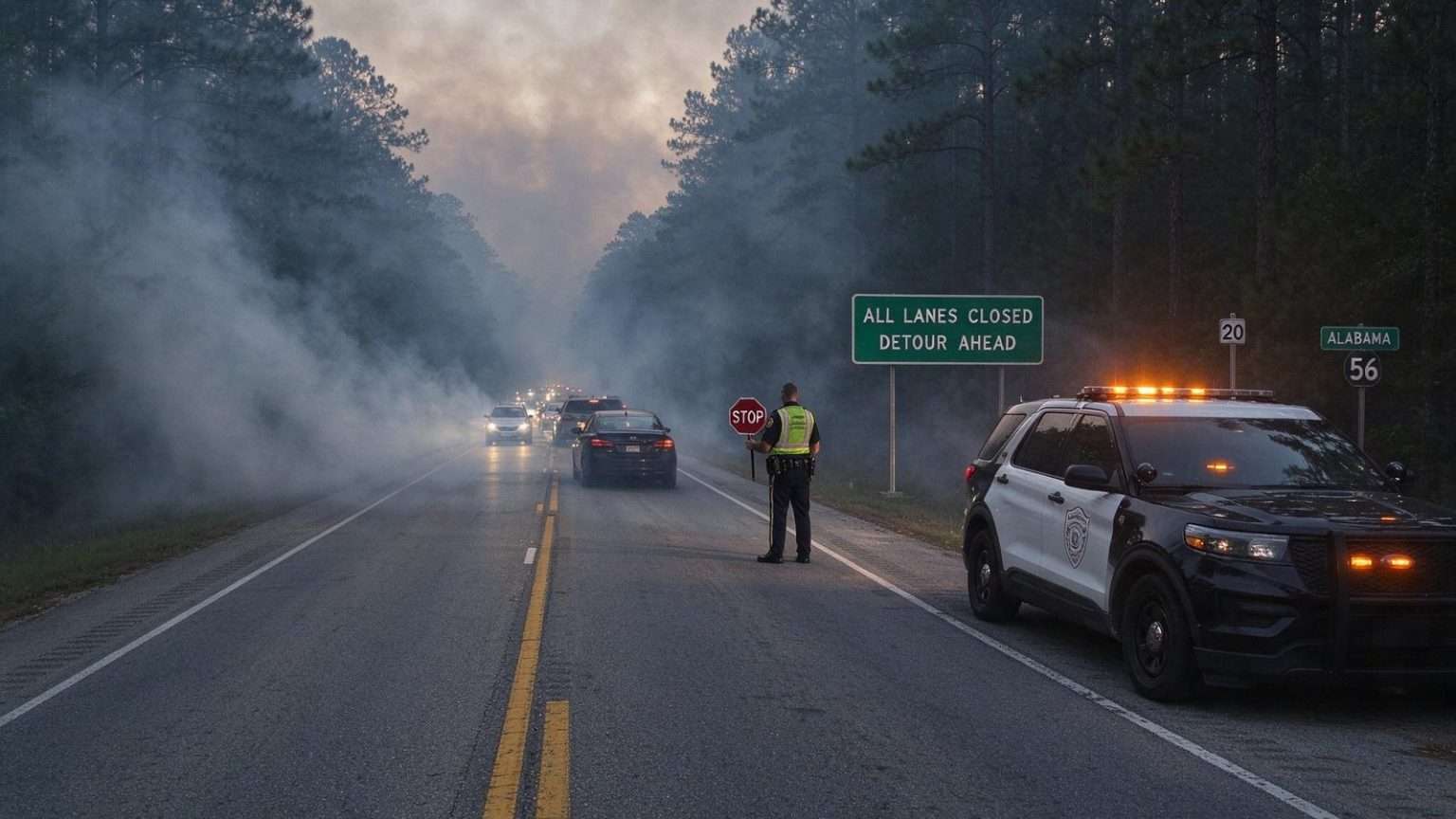
Smoke from a nearby wildfire caused a 12-vehicle crash that closed Alabama 56 in Washington County on Monday, according to the Alabama Law Enforcement Agency. The crash, involving at least four vehicles initially, happened around 5:30 a.m. near the 20-mile marker. All lanes were closed while ALEA Highway Patrol troopers investigated.
An update from ALEA said three separate wrecks were investigated in Washington County. One involved 12 vehicles, and the others were single-vehicle crashes. All were attributed to visibility problems caused by smoke from a wood fire. A later update said the smoke came from a wildfire off Alabama Road 56 on Batley Road. The Alabama Forestry Commission worked to contain the fire.
ALEA said two people suffered minor injuries. The Forestry Commission also said a fire alert was going back into place for Southwest Alabama, including Washington, Mobile and Baldwin counties.
The early-morning timing made the pileup more dangerous than the crash count alone suggests. At 5:30 a.m., drivers on a rural highway are traveling in darkness, and smoke hanging over the roadway is nearly invisible until a vehicle is inside it. Visibility can drop from miles to a few feet in seconds, leaving drivers no time to react to stopped or slowing traffic ahead.
What Happened on Alabama 56
The chain of events began when smoke from the Batley Road wildfire drifted across Alabama 56 in the pre-dawn hours. At least four vehicles were involved in the initial collision near the 20-mile marker around 5:30 a.m., and as traffic bunched up in the smoke, the incident grew — ultimately involving 12 vehicles in the main crash, with two additional single-vehicle wrecks investigated separately on the same morning.
Troopers closed all lanes of the highway while they investigated, a full closure that rerouted traffic onto rural county roads and stranded commuters heading toward jobs in Chatom and points east. Rural highway closures of this kind have outsize effects in a county like Washington, where two-lane state routes carry most of the traffic and there are few alternatives for through travel.
The injuries, mercifully, were minor — two people hurt among the dozen vehicles involved. Multi-vehicle crashes on high-speed rural highways often end far worse, and the minor toll in this pileup reflects the speeds and spacing of early-morning traffic as much as anything. Even so, the crash scenes tied up the highway for hours and required troopers to sort out a tangle of collisions in darkness and smoke.
Smoke: The Invisible Highway Hazard
Smoke over a highway behaves differently from fog, and drivers often fail to grasp the difference until it is too late. Fog tends to form in low-lying areas and lifts gradually with the morning sun; wildfire smoke moves with the wind, arrives suddenly and can hold visibility near zero for extended periods while a fire burns. Piles of burning wood — brush, timber slash, sawmill waste — produce thick, acrid smoke that hugs the ground in cool, still conditions like those typical of early morning.
Safety agencies have preached the same guidance for decades: when drivers encounter smoke on the highway, they should slow down, turn on headlights and, if visibility collapses, pull as far off the roadway as possible, turn off the vehicle and stay inside until the smoke clears. The pileups that make the news almost always involve drivers who maintained highway speed into an obscured roadway and hit vehicles they never saw.
Washington County’s landscape makes such episodes a recurring threat. The county is heavily forested — part of the pine belt that covers southwest Alabama — and prescribed burns, timber operations and wildfires all generate smoke that can reach the region’s highways. When the wind aligns with a road and atmospheric conditions trap the smoke near the ground, a fire miles from the pavement can still close it.
The Forestry Commission’s Fight
Containing the Batley Road fire fell to the Alabama Forestry Commission, the state agency charged with wildfire suppression on Alabama’s forest lands. Commission crews attack wildfires with trained firefighting teams, heavy equipment — plows and bulldozers that cut firebreaks through woodland — and coordination with volunteer fire departments, which provide the first response in most rural counties.
The commission’s role extends well beyond putting fires out. Its rangers enforce burning regulations, issue permits for controlled burns and monitor conditions across the state’s 23 million acres of forest. When dry weather and wind combine to raise the danger, the commission issues fire alerts restricting or advising against outdoor burning, the mechanism now returning to Southwest Alabama.
The fire alert covering Washington, Mobile and Baldwin counties signals that conditions across the region have deteriorated to the point where any outdoor fire can escape. During fire alerts, residents are urged to hold off on burning brush, leaves and yard debris — the everyday burning that rural Alabama practices routinely — because escaped debris fires are the leading cause of wildfires the commission fights. A single unattended brush pile in dry, windy conditions can put a neighborhood’s woodlands at risk and, as the Monday crash showed, shut down a highway miles away.
The Regional Fire Picture
The return of the fire alert to Southwest Alabama fits the region’s seasonal pattern. Fall fire season in Alabama typically builds from late summer through late fall, when humidity drops, vegetation cures and the cold fronts that finally bring rain arrive irregularly. The Forestry Commission’s alert system is graded to those conditions, and its placement of Washington, Mobile and Baldwin counties on alert tells landowners that the agency is seeing active fire behavior in the district.
For commuters and travelers, the practical takeaway is situational awareness on rural highways during fire season. A morning commute through Washington County can cross stretches where timber land abuts the pavement, and a fire burning overnight can sit unseen until its smoke rolls across the road. ALEA’s advisories during such episodes urge drivers to check conditions before travel on affected routes, to expect closures and to obey roadblocks — troopers close a highway for the same reason they close one for a chemical spill: the air itself is the hazard.
The two people injured in Monday’s crashes were treated for minor injuries, and the highway reopened once troopers finished their investigation and the Forestry Commission gained ground on the fire. The episodes served as a region-wide warning, though: with the fire alert back in effect from Washington County to the coast, the conditions that produced the pileup remain in place, and the next morning’s smoke could arrive on any highway in the district.
Washington County on the Map
Washington County sits in the southwest corner of Alabama, sparsely populated and heavily wooded, with Chatom as its seat of government. Its economy is rooted in timber, agriculture and the oil and gas fields that have operated in the county for decades, and its road network is dominated by the same two-lane state and county routes that make any closure a regional inconvenience. Alabama 56 itself is an east-west rural highway serving communities between the Tombigbee River corridor and the county’s interior.
The county’s population density is among the lowest in the state, which shapes how emergencies are handled. Volunteer fire departments staff stations across the county and respond first to structure and brush fires, with the Forestry Commission’s district crews arriving to take command of woodland fires. Ambulance service and rescue squads cover wide territories, and major injuries often mean long transports to hospitals in Mobile or Jackson. That geography is why minor injuries in a 12-vehicle crash registered as good news for local responders.
The county also carries a deep history: it was one of Alabama’s original counties, carved out of the Mississippi Territory when the state was formed, and its courthouse records and small towns preserve nearly two centuries of Alabama’s rural past. The same pine forests that define its landscape today are the resource the Forestry Commission protects — and the source of the smoke that closed its highway.
What Drivers Should Know During Fire Alerts
The Monday crash offers a checklist for anyone traveling rural Alabama highways during fire season. First, check local conditions before an early-morning drive; smoke incidents concentrate around dawn, when temperature inversions hold smoke near the ground. Second, reduce speed the moment visibility begins to dim, even if the cause is unclear. Third, never stop in a travel lane in smoke — pull completely off the road, and get away from the vehicle if fire is a possibility.
Headlights matter more than most drivers realize. Daytime running lights leave taillights unilluminated, and in smoke the driver behind sees taillights before anything else. Hazard flashers help stopped vehicles, but they also confuse following drivers about whether a car is moving, so safety guidance favors low-beam headlights and full lane changes before slowing in reduced visibility.
Finally, respect the alert itself. The Forestry Commission’s fire alert for Washington, Mobile and Baldwin counties is not a formality — it reflects active fire danger across the district, and every escaped debris burn adds to the agency’s workload while tying up the volunteer departments that rural counties depend on. The wildfire on Batley Road that produced Monday’s pileup will not be the last fire the region sees under these conditions; the question is whether the next one finds the highways clear of drivers who failed to adjust.
As of the latest ALEA update, troopers had cleared the crash scenes and the highway had returned to normal traffic, with the Forestry Commission continuing its containment work on the fire. Officials urged travelers and residents alike to stay alert to changing conditions as the fire alert remains in effect across Southwest Alabama.